
Movie Magic Metal Montana: Charli xcx and Cinema
Written by Andreas Babiolakis
Our Music and Cinema series spotlights various musicians who are clear cinephiles; we dissect their references and homages to motion pictures.

Anyone familiar with Charlotte Emma Aichison — or Charli xcx — knows that she is more than just a singer, songwriter, and producer: she is an avid cinephile, and one who frequently wears her passion for cinema on her sleeve. In response to her latest album which serves as a trifecta of her largest cultural obsessions (Music, Fashion, Film), I want to explore some of the many instances where Charli xcx has expressed her cinematic taste. It would make the most sense to place myself in the present, but I would rather go back to the beginning of her career so as to see her cinephilia blossom. Before I do, it is worth noting her obvious influence in the Letterboxd community, and her top four favourite films displays a wide range of taste. In order of how they are displayed (by the time of this article), Charlie xcx's top four are Abel Ferrara's horror cult classic The Addiction, Jacques Rivette's avant-garde fantasy epic Celine and Julie Go Boating, a contemporaneous deep cut by David Cronenberg (Maps to the Stars), and Paul Thomas Anderson's Phantom Thread. Even though she has (at this point) over fourteen-hundred titles logged, her top four alone tell a major story as to the kind of cinephile she is: one who enjoys unique, compelling, challenging cinema. Her latest admissions on underrated titles (from Robert Altman’s fashion miasma Pret-A-Porter, to M. Night Shyamalan’s maligned thriller The Happening) also proves that — like she does musically — she marches to the beat of her own drum and doesn’t care who knows it. She couldn’t be more authentic in this way, and her knowledge of cinema — even if I don’t agree with all of her selections — is highly extensive.
However, as I have stated, it would be far more interesting to see how she has incorporated her love of film into her life and music (and not just her Letterboxd findings), and so we travel back to the time of her debut album, True Romance: one named after the Tony Scott (and Quentin-Tarantino-penned) film of the same name; even though she was making music that was pertinent to her own romantic encounters at the young age of twenty (Charli xcx was making music even during her teen years) and not in line with the crime-based story of Scott's beloved feature, Charli xcx was wanting to create homage to a film that left an impression on her. Charli xcx was an established songwriter by this point already, with a smash hit in the form of Icona Pop's "I Love It" which dominated airwaves in 2012. She struck gold again in the form of her own single, "Boom Clap," two years later in 2014; while released on her Sucker album, most audiences were introduced to the song's connotations with the young adult romantic drama, The Fault in Our Stars. The Charli xcx of old was one whose music felt more fine tuned to a younger audience, and a hit attached to an equally successful film for that same demographic only made sense.
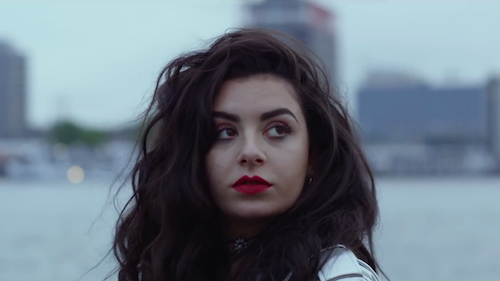
Charli xcx in the music video for “Boom Clap” in 2014.
However, the Charli xcx we know now — the one affiliated with hyperpop experimentation and pushing the envelope of what earworms can be in the twenty-first century — started on her now adored (yet once polarizing) extended play, Vroom Vroom. I loved the EP upon its release, particularly a song that is still stuck in my head ten years later: "Trophy." Charli xcx's incorporation of a line from another Tarantino film (this time, it's Pulp Fiction: one he actually directed) is infectious: she utilizes Mia Wallace (played by Uma Thurman) to repeat her line ("I want that trophy") like a mantra; this line is no longer about a mob boss's wife wanting to win a dance contest — it's about Charli xcx gunning for gold in the pop space (which she would do). Appropriately after a project named Vroom Vroom, the British pop star wouldn't ease up on her then-new sound from that point on, doubling and tripling down on her discovered sound from release to release; including the sublime mixtape Pop 2 (and that glorious conclusionary song, "Track 10") — I must quickly point out the cheeky reference to the Austin Powers franchise in the form of the song "Femmebot" (where Charli xcx uses the allegory of a female android to discuss being an upgrade over one's expectations of her).
Her next full-length effort, Charli, has one key song with much nostalgic and cinematic connotation, and it's named after a year that was rife with many pop culture references (especially in the film industry): "1999" — featuring singer Troye Sivan. The single's cover and music video reference the characters Neo and Trinity from the Wachowski action classic, The Matrix. Outside of the many other references (to TLC's "Waterfalls" music video, the Spice Girls, and Steve Jobs' presentations), the music video to "1999" also has a number of unmissable film tributes, including Best Picture winner American Beauty (by Sam Mendes), horror phenomenon The Blair Witch Project, and James Cameron's epic, Titanic (which, curiously, wasn't released in 1999, but, rather, 1997; however, as any nineties kid remembers, that film felt prominent for years). For an album that feels so futuristic in tone, seeing Charli xcx throw things back to the days of her youth with "1999" is a well-handled blast from the past; in order to look ahead, one must reflect on the past.
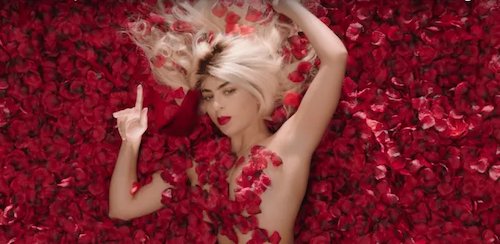
Charli xcx replicating the iconic rose petal daydream in Sam Mendes’ American Beauty for her “1999” music video.
During the days of the COVID-19 lockdown, Charli xcx famously recorded and released an album entirely from the comfort of her home; How I'm Feeling Now. While there isn't anything intrinsically cinematic related to this album (outside of the stylish and dynamic sound of her music and her ever-evolving hyperpop ways), her album cover — a candid image of her on her bed with a video camera — introduces us to the diary-esque nature of the release. It's interesting how this was her method of depicting such a mentality. She isn't shown writing a journal entry or flipping through a photo album and reminiscing. She is operating a device that both captures and displays; in one image, she is both the director and the audience reflecting on what was shot; she is both the artist and the muse. This feels like a throwback to her earliest days as a budding musician crafting songs in her bedroom; she sees a parallel between a visual and musical conjurer's vulnerability and the exhibitionism of putting their heart and soul out there. During the pandemic, Charli xcx was like all of us: lost, confused, lonely, and concerned.
The next album, Crash, similarly isn't overtly connected to Charli xcx's love for film, but I used to think that I was maybe causing a bit of a stretch by questioning if the album cover was an allusion to David Cronenberg's controversial masterwork of the same name. On the cover, we see Charli xcx seconds after apparently being hit by a car; she uses this traumatic pause to pose on the cracked windshield in a bikini, with a fierce gaze and droplets of crimson blood strolling down her temple and chin. Just like Cronenberg's Crash (a perverse film about a small community of people who get turned on by fatal car accidents), there is a blatant blend of trauma and eroticism that places us in this strange purgatory. While Crash may not be my top Charli xcx release (it's still quite great), it is my favourite album cover of hers because of how effectively stirring it is: it is as provocative as it is unnerving, and it is certainly Cronenbergian in nature. A year later, Charli xcx worked on the soundtrack for the queer independent milestone, Bottoms (she worked alongside composer Leo Birenberg); this would be the first time that Charli xcx directly wrote an entire album for a film (and not just songs).
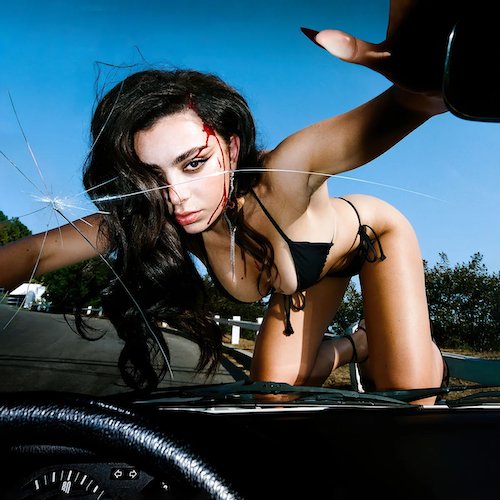
The album cover for Crash: a possible homage to David Cronenberg’s film of the same name.
Across her 2024 magnum opus, BRAT, there are less upfront cinematic references but little concepts proliferated throughout. Despite not being the likely reason for the beloved-yet-loud hue, the album cover's use of what has now been coined "BRAT green" to me feels like a connection to the same (or a similar) green used for chroma-keying effects in filmmaking: the art of using software to remove a specific colour (usually this shade of green; human skin doesn’t contain this colour — outside of tattoos, I suppose — so the risk of accidentally editing someone’s body out of a shot — unless intended — is reduced). Green screen chroma-keying is used to remove or add elements from or into a film in post production. To me, BRAT's album cover suggests a tabula rosa interpretation: you take or place whatever you want from or onto this otherwise minimalist and plain album cover. It becomes your own. There's a reason why the colour was the biggest of that year, and I feel like Charli xcx somehow tapped into how such a bright colour can somehow be impressionable at the same time.
Additionally, there are a couple of other moments in the music of BRAT that felt like cinematic allusions. The hit "Von Dutch" sees Charli xcx calling herself a "cult classic": a title that can apply to music (as she insists here) but is mainly reserved for the filmic space. To me, she is saying that she will be huge one day even if her music isn't conventional or commercial (which, as we now already know, she would not only become one of the biggest names in contemporary pop music, she has helped set a standard). There's the track "Mean girls" that I cannot imagine isn't a reference to the film of the same name (and the motion picture's study of what both unites women and pits them against each other; this is mainly a celebration of bad asses, though). If it counts, there is also the song “Spring breakers” off of the expansion album BRAT and it’s the same but there’s three more songs so it’s not; this is one of the more direct tributes in this era, seeing as it is a commemoration of Harmony Korine’s controversial film, Spring Breakers (down to sampling Britney Spears’ “Everytime”: a song that makes a pivotal appearance midway through the film). Most importantly, Charli xcx released a list of films that she associates with the "brat-like energy" of the album, and they vary from many eras and mindsets. Like a true cinephile, she had these films screened at Screen Slate on 35mm. What a treat for her fans, and a foray into films for those who needed a crash course. These include (in alphabetical order):
• Across the Universe (2007)
• Basic Instinct 1992)
• Daisies (1966)
• Human Traffic (1999)
• Intimate Confessions of a Chinese Courtesan (1972)
• Party Girl (1995)
• Party Monster (2003)
• Project X (2012)
• To Die For (1995)
• Velvet Goldmine (1998)
• Wild Child (2008)
• Yannick (2022)
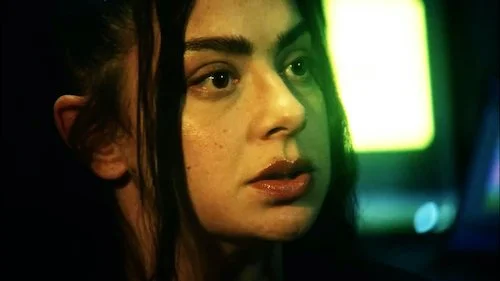
Charli xcx starring as herself in The Moment: a mockumentary about her success post BRAT.
Kicking off 2026, Charli xcx partook in her second attempt at making music for a motion picture; this time, it was Emerald Fennell’s adaptation of Wuthering Heights (whose trailer heavily featured Charli xcx’s song, “Everything is romantic,” quite extensively). Of course, this leads us to her latest release that also came out this year: Music, Fashion, Film. Throughout this entire album, there are all things pertaining to the triptych of topics above, including cinema. On the album's cover is a black-and-white snapshot of three New York innovators of their respective fields: musician John Cale (known best for his solo work and his time in The Velvet Underground), fashion mogul Marc Jacobs, and auteur Martin Scorsese; it is worth noting that Charli xcx worked with Cale on the Wuthering Heights soundtrack, particularly on the song “House.” Scorsese must be the most recognizable filmmaker she could have selected from New York while also embodying the many themes on the album that his films and career represent. If much of Charli xcx's music — especially on this album — is about both the highs of life and the concerns of fading away and burning out, then Scorsese's representation of lost souls indulging in self-destructive behaviours on film (and his affinity for film preservation and curation) can best be seen in his weariness after years of harbouring wisdom and artistry, as well as his instantly-noticeable visage.
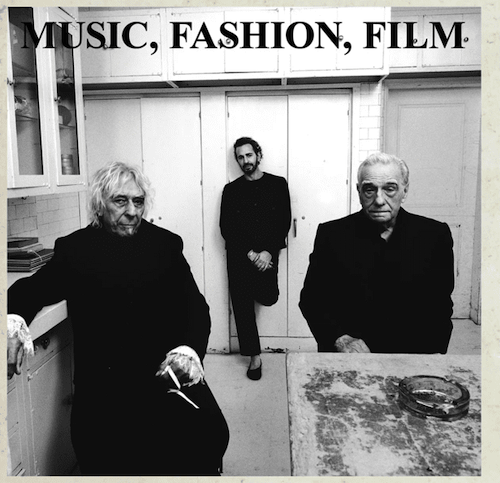
The album cover for Music, Fashion, Film, featuring — from left to right — John Cale, Marc Jacobs, and Martin Scorsese.
Throughout the album, Charli xcx digs deeper into the importance that film has played into her life. The music video for the aptly named single, "Camera," is a greyscale cut featuring French actor Vincent Cassell; this is clearly a reference to his breakout performance in the beloved crime drama, La Haine. Charli xcx has an entire song devoted to my all-time favourite film: Ingmar Bergman's Persona. The avant-garde masterpiece has a reoccurring theme of the faces and identities of its two leading women converging (as if to say that they were always one person); Charli xcx uses this as a way to distance herself from a former friend or acquaintance, particularly in how she will forever linger in the other person's mind: "I know you see me when I see you." If that wasn't enough, the most clear indication of Charli xcx's adoration for cinema would be the surprising cameo of one David Cronenberg in the final song, "No One Lasts Forever" (I feel vindicated and proven correct that Crash's album cover is a reference to his film). Cronenberg's monologue is exactly what you would think it would be: a response to the mortality of all beings and things. This fits Charli xcx's album's themes, especially Cronenberg's mentality that art will outlive the artist.
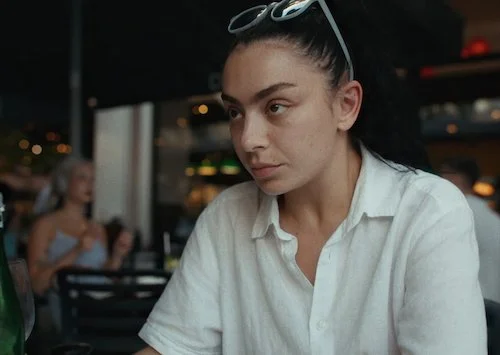
Charli xcx in the film Erupcja.
Charli xcx is also a member of the film industry; after some minor parts in films like UglyDolls and The Angry Birds Movie, 2025 proved to be her big breakthrough year as an actor. First off is Pete Ohs' drama Erupcja which placed Charli xcx smack dab in the leading role (coming off of her success from BRAT). She also starred in 100 Nights of Hero and had a bit part in the genre-bending Sacrifice (likely where she met Cassel before he starred in her music video for "Camera"). 2026 doesn't see her slowing down either, with roles in I Want Your Sex, The Gallerist, and Faces of Death; she is cast in Japanese auteur Takashi Miike's next film as well. However, we must wrap things up with her biggest cinematic statement thus far: The Moment. A mockumentary directed by Aidan Zamiri, The Moment aims to encapsulate the triumph and hysteria surrounding BRAT through Charli xcx's perspective (or a hyperbolic one, at least). In this film, Charli xcx acknowledges that much of her presence is a persona, and she fully leans into it; she becomes her own version of a superstar.
Given how much of a hold she has on all things music, fashion, and film (I didn't touch upon her expertise and exposure in the fashion world, but believe me when I say that she is unstoppable there as well), I can only imagine what she will create or participate in next. Having seen her twice in Toronto — once for a concert during her Vroom Vroom era, and again at the Toronto International Film Festival for the Erupcja premiere), it has been a treat and an honour seeing someone who has been driven by her passions at such a young age become an idol for millions; her open fanaticism for all things cultural (and, in this case, film) is one that is an invitation for her fans to pursue, not a pretension that pushes people away. Also noticing how her film tastes and references have evolved over time (from popular hits to more refined and artistic works) has been a journey for us fans as well; I also appreciate that Charli xcx never fully shed off her love of fun and silly films, proving that no one is above having a good time (even when they plunge into arthouse cinema). With all of this celebration, Charli xcx has effectively paved a way for her fans to discover more about what she loves about filmmaking: she shares the wide-eyed enthusiasm she once had as a young girl and continues to have as a dominant force in contemporary music (cinephilia never goes away). Her latest album does raise a good point: no one lasts forever. However, Charli xcx has ensured that her artistry will remain forever, and — as I hope I have made clear by now — her affinity for cinema will be known for just as long.


Andreas Babiolakis has a Masters degree in Film and Photography Preservation and Collections Management from Toronto Metropolitan University, as well as a Bachelors degree in Cinema Studies from York University. His favourite times of year are the Criterion Collection flash sales and the annual Toronto International Film Festival.