
La bola negra
Written by Andreas Babiolakis
Warning: This review is for La bola negra, which is a film presented at the 2026 Toronto International Film Festival. There may be slight spoilers present. Reader discretion is advised.
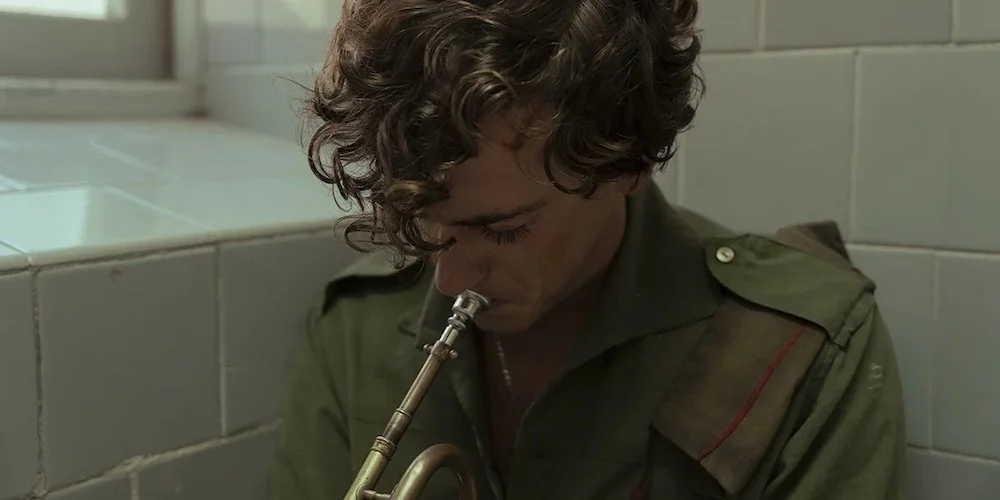
Image courtesy of the Toronto International film Festival.



The joys of a film festival don’t stem solely from a veteran filmmaker delivering upon your expectations once again. Much of a film festival’s triumphs can come from the discovery of newer talent, or names that have now become widespread over night. Not many knew who Javier Calvo or Javier Ambrossi were before this year (at least not to the extent of their instant stature in the third quarter of 2026). The pair — once a romantic couple as well — only worked on one feature film together (Holy Camp! back in 2017), outside of their various individual projects (they do have some television and theatrical work as well, including 2023’s La mesías). All it took was a premiere at the Cannes Film Festival back in may for the Javiers — also known as Los Javis — to become megastars far outside of their previous bubble (sure, they already had an audience, but that’s slightly different than becoming the possible frontrunners to win Best Director at the Academy Awards, wouldn’t you agree). At Cannes, the Javiers shared the Best Director prize for their latest and greatest effort: a little film known as La bola negra. Consider how many international films nowadays maintain their original titles and are not forced to have an English title for the global market. The fact that the Javiers have insisted on this film being called La bola negra — even though it could easily be called The Black Ball — is proof that they had something in mind and didn’t want to waver. Even their unfortunate separation as romancers couldn’t stop this film from being made. It is this certainty that wins directors big awards. It is this confidence that renders artists iconoclasts. The Javiers knew what they had, and, now, we are fortunate to find out.
The Toronto public was blessed with this metaphysical odyssey through a number of generations in Spain during the Toronto International Film Festival. The film wound up being championed the People’s Choice Award (as voted on by the Toronto public), and the majority of winners of the past twenty years have gone on to be nominated for (or even win) the Best Picture Academy Award. No international, non-English film has won such a prize outside of Bong Joon Ho’s Parasite, even though a number of films have been nominated and have been strong contenders. However, I feel like there is something in the air with this film: the same kind of universal buzz and calmness that Parasite had. It’s the kind of quiet hysteria that rumbles not out of the need to be heard but, rather, the knowledge that of course this is a terrific film — so much so that it almost feels redundant and arbitrary to champion it (it’s like calling Mr. Rogers a nice man — his legacy and aura are obvious enough that you don’t need to point this out). When so many other films were predicted to win this award (like the Peter Farrelly biopic I Play Rocky, Sian Heder’s CODA follow-up Being Heumann, or Jesse Eisenberg’s awards-season darling, The Debut), it somehow makes sense that La bola negra won; because why wouldn’t it? If you are relatively new at filmmaking and your film commands these levels of obviousness, either you are natural talents or you truly figured it out this time around. Either way, it is clear that La bola negra is an instant favourite for many, and it could not be more clear as to why.
I could say that La bola negra is three storylines wrapped up into one feature film, but this would sell the motion picture short (even though I would argue that this alone would be a brilliant selling point). Let’s go back to the beginning in order to best appreciate this film. Acclaimed Spanish writer Federico García Lorca has an unfinished poem called, obviously, La bola negra. It was to be his first work with a gay protagonist and, in ways, his approach to coming out to the world; he was assassinated at the start of the Spanish Civil War in 1936. It isn’t clear if he was killed for his political stances or his sexual orientation, but there was clear motivation behind his murder. The Javiers could have made a short film that directly adapts the little that has been recovered, but they saw something much greater in the nothingness of the disappointment of a project being mostly lost and incomplete: they saw the same notion that has permeated throughout history — that queer voices are forever being silenced. The Javiers weren’t just concerned with getting Lorca’s story out to the masses: they wanted all members of the LGBTQ+ community to be heard. They couldn’t quite accomplish that in one motion (because who could), but La bola negra is one of the mightiest attempts I have seen in cinematic form. Just in the intrinsic makeup of the film, I sense a number of queer influences of yesteryear; Stephen Daldry and Michael Cunningham’s different triptychs via their respective versions of The Hours; Derek Jarman’s arthouse approach to historical and classical imagery, like in Caravaggio; even fellow Spaniard Pedro Almodóvar gets a shout out in La bola negra.
So, yes, La bola negra is far more than a trio of stories, but, for the purpose of this review, I will briefly reduce it to such. We kick off in 1932 during the rise of fascism in Europe, with a shocking opening sequence that sets the tone for the rest of the film — not that there is danger throughout every frame of this picture, but the Javiers want you to be unsure of what will come next at all times. This story is led by character Sebastián (played by Spanish actor-musician Guitarricadelafuente), and a major point to know is that this established instrumentalist is shown struggling to play the trumpet — the boldness of stripping a performer down to the barest of his vulnerabilities in a film like this cannot be overlooked. We then see a young man named Carlos (Milo Quifes) in 1937 who is hoping to gain membership in a prestigious casino during the height of a divided Spain. His tale is where the name La bola negra comes in: his fate is determined by the casino’s board voting via coloured balls. The vote comes down to there being more black balls than white (nays versus yays), and it is revealed that there is prejudice towards him because he is rumoured to be gay. The last story is many years later, all the way in 2017 (perhaps when this film was first being constructed). We see a playwright named Alberto (based on the film’s co-writer Alberto Conejero, who worked with the Javiers); Alberto is played by Carlos González. Alberto is informed that his grandfather on his mom’s side has died, and that he has to tend to an inheritance; meanwhile, Alberto didn’t even know that this relative existed.
As the film progresses, not only do the three threads tie themselves together — they also slowly reveal more about themselves. Alberto comes across La bola negra via his inheritance, and he is expected to resurrect it in some way. Sebastián — and his adoration for the captured Spanish celebrity Rafael Rodríguez Rapún (Miguel Bernadeau) — may be the inspiration for La bola negra. Carlos’ story line actually is La bola negra (or, at least, what remains of it). Sebastián’s story provides context around the poem, and Alberto’s sequences resemble the impossibility of us ever knowing the full La bola negra — both are insightful and beneficial to La bola negra as a confession, an artifact, and a piece of mythology at this point. As these stories swirl into each other, it feels like we are swatting at floating dregs of history, trying to grab on to the moments in time that have been erased time and time again by bigoted enervators. You aren’t just made aware of the crying shame here (that La bola negra will always remain severed): you are reminded of how frequently this happens again and again throughout history. When Kansas passed Senate Bill 244 back in February 2026 (stating that trans citizens could not update their identity-based documentation, and that they could only use the sex they were assigned at birth for these items), this is yet another signifier that it is happening again.
It is revealed in the final act that much of Alberto’s efforts — and those of the Javiers — pertain to a brutal reminder: stories can be hidden, but they cannot be imprisoned forever. An allegory is stated at this point: a mosaic unearthed during a session of yard work. In the same way that bones will be found to prove that this person once lived, or the pages of a project can be discovered (hinting at what could have been), try as hateful people might — it is impossible to silence communities forever. We can either let the sands of time get swept away by the wind, thus revealing what was once beneath it all. Or, we can follow the Javiers’ example and do the reconstruction ourselves. La bola negra is that mosaic: an assembly of fact, fiction, past, present, subjectivity, and objectivity. When society refuses to acknowledge you or let you live, sometimes your only method of communication is through expression. In that sense, art is reality. La bola negra explores this hardship as well. It does so with such a celebration of music, dance, and freedom within torment. You will find characters from all across the LGBTQ+ community, including bisexual, trans and drag identities. Of course, La bola negra refers to the act of being blackballed in Carlos’ story, but I’d like to think that there is a second meaning in how the Javiers utilize this title: as if the entire film is a party in the face of darkness. The film is as euphoric as it is tragic, and you get that sense from the film’s name (or, at least, I do).
In this festival are a couple of surprising and terrific cameo appearances. There’s Penélope Cruz, who is in the film for not even ten percent of its run time; and yet her character is unforgettable and worthy of Best Supporting Actress consideration (she doesn’t need much to entertain you and break your heart). Then there is Glenn Close who I was certain would be the American face and English speaker of the film; when she spoke primarily in Spanish for her sequences, I was nonplussed. What a shock: Cruz and Close are great actors. However, when you see how the Javiers utilize these veterans of their craft, you will know how much potential they still have — have you ever seen Cruz and Close like this? Me neither. Needless to say, the Javiers try everything possible in their first epic: a two-hour-forty journey through time, space, and spirit. I have seen some critics insist that these efforts amount to very little, and I cannot fathom how they can come to such a conclusion: how could you reduce the echoing histories of massacre and hate to a declaration that you didn’t feel engaged enough? That is not a Javiers problem: that is a you problem. If you only see Alberto running in circles or Sebastián and Rafael going over the same temptations, you did not understand La bola negra’s true power whatsoever. It is far more than a narrative vehicle. When Alberto can have casual sex whenever he feels like it, the Javiers frame this as a sign of what was once deemed a forbidden act that could lead to death (and now it’s Alberto’s way to pass time and pick himself up). In the same way that Alberto can have sex, La bola negra (at least the film, but not the poem) can be released. Considering how things once were, they are both miracles. They shouldn’t have to be.
Sebastián tries to support Rafael’s battered body upwards, helping to try and nurture him throughout their storyline (whenever possible, anyway). I view the Javiers doing the exact same thing with their version of La bola negra regarding Lorca’s original. Yes, Lorca’s poem is only a couple of pages long in its current (and likely permanent) form, but now the Javiers have done far more than bring awareness to this work and the reason why it is unfinished: they have completed it in an unconventional way that still brings closure to a long-standing mystery. It is true that the “why” (as in why was La bola negra never completed) is a story in and of itself, and through an inventive screenplay, this La bola negra hypothesizes what could have been, creating a new cinematic monument of queer cinema. There is much value in the Javiers and their choices, from wanting to even take on such a project to them sticking out through their separation to finish this crucial mission. Much of La bola negra pivots based on difficult decisions — from renouncing one’s identity at the hands of fascism, and trying to learn more about that ancestor who abandoned your family, to the most horrifying choice that I will dare not spoil in any capacity here (believe me when I say that it reminds me enough of Sophie’s Choice). However, within challenge is liberation: all of the nude bodies that are able to splash about on the shores of a beach, for instance. The community has come a long way, and you don’t have to ask for what: you can clearly see it.
Hell, the Javiers delivering one of the strongest films of the year is evidence enough, let alone all of the instances of exaltation found within it. How many other lives have been stymied or cut short in the name of homophobia or hate? Just mere decades after Lorca’s murder, filmmaker and theorist Pier Paolo Pasolini was similarly assassinated (in a highly gruesome way); once again, it was either his sexual identity or his outspoken politics that resulted in this unfortunate end (neither explanation justifies his fate, and you cannot convince me that how someone loves will ever be more grotesque than the ways that someone can hate). The Javiers did not have to turn to the avant-garde like many of their predecessors within the various queer cinema movements, but they at least dabbled in the waters of arthouse cinema where they see fit in La bola negra (particularly in, well, La bola negra itself — as an effort to match Lorca’s beauty); otherwise, they operate with enough realism so we never lose sight of the importance of this film and what it means to everyday people, not just the freedom of expression. Seeing the film be voted on so strongly by many different walks of life — from Cannes juries to the Toronto public — warms my heart as a cinephile and as an ally; they recognize an excellent film and are also acknowledging its mandatory purpose. La bola negra is a jubilee of a film, but much within it is far from joyful — it is a tango between the brilliance of its existence and all of the hell that millions have trekked through to get here. May people never be killed or tormented for how they identify sexually ever again.


Andreas Babiolakis has a Masters degree in Film and Photography Preservation and Collections Management from Toronto Metropolitan University, as well as a Bachelors degree in Cinema Studies from York University. His favourite times of year are the Criterion Collection flash sales and the annual Toronto International Film Festival.