
Ink
Written by Andreas Babiolakis
Warning: This review is for Ink, which is a film presented at the 2026 Toronto International Film Festival. There may be slight spoilers present. Reader discretion is advised.
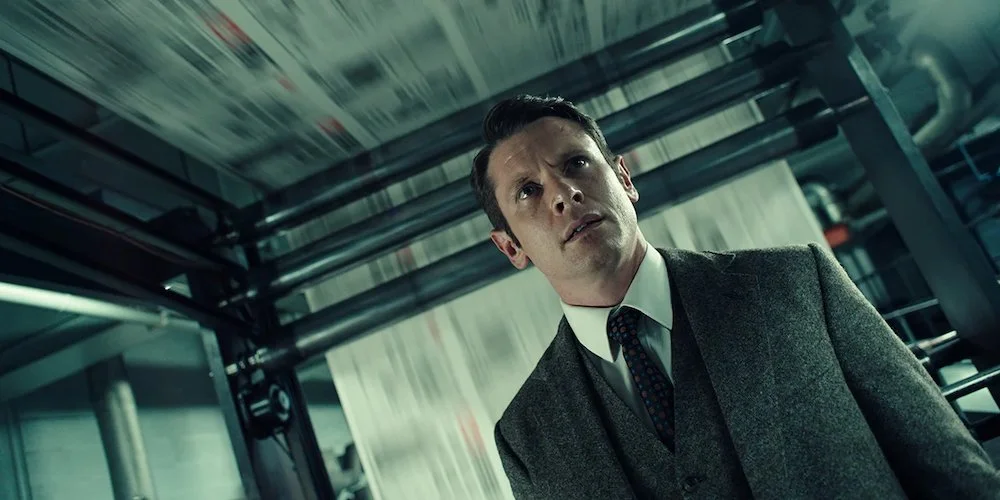
Image courtesy of the Toronto International film Festival.

ADHD-cinema extraordinaire Danny Boyle (Trainspotting, 127 Hours, Slumdog Millionaire, et cetera) is back with his latest dip into the rah-rah insanity of an overwhelmed mind. I have always thought that Boyle’s films are as strong as their screenplays, and that some of his weakest efforts are films that are underwritten. With that in mind, James Graham’s screenplay for Ink — Boyle’s newest film — is one of the strongest of the year, and, naturally, we have another Boyle success on our hands (for the most part, anyway). I have always been a sucker for the journalist film (think Spotlight, All the Presidents Men, Sweet Smell of Success). I’m not sure what it is: perhaps it’s the rapid flow of information that strings me along, or the continuous sequencing of discoveries that add up to a major investigation and revelation. Graham nails that bullet-speed intensity, and Boyle matches it with his frenzied pacing, a flurry of shots and images, and stylistic imagery that will make you feel as though the weed is hitting (even if you haven’t smoked or eaten anything). If you are a fan of Boyle, then I am pleased to say that Ink is a success for a majority of its runtime; I will get into its minor setbacks momentarily. If you find Boyle’s style distracting or verbose, then Ink will not win you over either.
Based on the rise of head editor Larry Lamb and the infamous tabloid paper The Sun, Ink is equal parts The Wolf of Wall Street and The Big Short. It starts off like the former — rambunctious, hilarious, and without zero fucks to give. It concludes like the latter and acts as a metaphorical bomb placed in our lap: the realization that it is too late to turn back now (it feels almost like Christopher Nolan’s Oppenheimer in this way: the revelation that the world was negatively changed from this point on, and the damage is irreversible). Lamb was recruited by Rupert Murdoch (the notorious magnate) after Murdoch’s The Daily Mirror proves to be successful in Sydney. Murdoch — then on the rise — bought The Sun to try and make something of it. In comes Lamb who Murdoch hires to be the guy to fix The Sun. In hindsight, this appears to potentially be an act of sabotage: an impossible project that is meant to kill Lamb for good. Lamb is initially timid and unsure, but he quickly becomes confident and, subsequently, arrogant. The tables get turned, and it is Murdoch who can no longer control Lamb by the end of Ink (what kind of monster did he create here).
The first act of Ink is watching Lamb (played by Jack O’Connell) create a team to take over The Sun and launch their first issue under new management; it doesn’t go extremely well (but Lamb is still chuffed with his slight increase in readership). They begin to change tactics and try to figure out who their audience is and what they want. Thus begins the descent into debauchery: the focus on the kind of smut and taboo controversy that would become synonymous with The Sun for years to come. At first, it seems innocent. Lamb’s team agree that sports, sex, and the weather are important things that everyday Brits would want to read and prioritize in the morning. As time goes by, Lamb becomes hungry for power and to lead the then-troubled news sector, and his motivations become less about the interests of his readers and more to do with getting readers by any means necessary (from panties in cans, to using shock to garner attention). Naturally, Lamb slowly becomes unrecognizable and tyrannical. Murdoch (played by Guy Pearce) is both threatened and annoyed by Lamb’s change of heart — and yet he finds this dark turn slightly admirable in ways as well.
The silliness and electricity — like the high at a party — comes crashing down in the second act: one that details a highly personal crisis within the Murdoch family. It is the ultimate test to see where one draws the line between the personal and the business-minded state of things. I would argue that Lamb fails this test, but that shouldn’t be a shock to anyone. Lamb only gets worse from here on out, and Ink is no longer fun; if anything, it gets terrifying. Boyle saves his anxious style’s biggest idea for last: a montage that made me ill and reminded me of the true horrors of doom scrolling and the state of things — and the news that report said things — today. Earlier in the film, the name The Daily Mirror is reflected upon, and how the newspaper shouldn’t be a mirror (seeing as people don’t want to see themselves). News should be a window — something readers can look through to see new things. In the day and age when the President of the United States is a felon (and far worse), datacentres are scorching the Earth, influencers are at an all-time-high (and low, in that same breath), and our minds are being rotted, I wish to ask Boyle this. Are we more fixated on our news being mirrors (in the sense that online and offline narcissism is rampant, and our actions and content go viral on social media), or windows (we cannot look away at the constant doom that prevails us)?
Claire Foy plays a fictional character named Jules Davies, who is Lamb’s mistress and a reporter — an amalgam of many women in Lamb’s life. She serves as the moral epicentre of the film — a motion picture fueled by a “my dick is bigger than yours” contest between a pair of monsters. Much of the film possesses a sentimentality amidst all of the evil, including the pastel-coloured cinematography that felt like black-and-white film being colourized artificially, and Boyle’s iconic needle drops that always transport us to the time and place we need to go. Then comes Boyle’s well-intentioned use of artificial intelligence that has come under severe fire. The least-offensive use comes in the form of a couple of seconds of rats running around. I suppose I understand Boyle not wanting to harm or stress animals in any way, but when the footage is this short, I doubt that an animator would have cost that much for literal seconds of visuals. Then comes a deepfake image of disgraced leader Margaret Thatcher which didn’t really add up to much and feels kind of pointless. Finally, the animated photograph that is the worst offender by far: an out-of-place, couple-second effort that is not only meaningless, it is distracting and hideous. Boyle maybe wanted to show how the advancement of technology is not always a good thing (an important theme in Ink), or he is an older filmmaker who doesn’t see the harm in using such immoral and dangerous technology. Either way, as a Toronto audience member said at my screening during the Q&A, “don’t do that shit again,” Boyle. You, one of the most inventive and imaginative directors of our time, must know better.
I will say that Boyle’s Ink effectively lures us in to the lion’s den. It sets up a snappy, snazzy environment with highly entertaining antics and sequences. Then, out of nowhere, comes corrosion. It is obvious how important responsibility is when it comes to the news and other forms of formerly-ethical media, but Boyle also shows how easy it is to slip and lose our composure. When you see all of the choices The Sun made which seem tame compared to today, that’s kind of the point. When did news lose its objective — to educate and inform without bias or conflict? It’s hard to pinpoint the exact moment when we had to triple check all sources, but Boyle suggests that the start of this decline was back in the late sixties via Ink: the beginning of the end. In the day and age of fake news, bias, and — ugh — untrustworthy AI slop (again, hypocritical to use in a film like this), we can no longer depend on the sources that once kept us up to speed. We don’t see this side of Danny Boyle too often — his films usually find positivity within the hopeless or the chaotic. With Ink, there is no bright light: we are in the dark age of journalism. Not even one of cinema’s most energetic and optimistic minds can pretend as though we are not. His film acts like a final hurrah and send off to the news of old (as paradoxical as that may be), and it serves as a warning: whether it’s breaking news, the weather, political filibusterering, or even rats running around, be careful who or what you trust.


Andreas Babiolakis has a Masters degree in Film and Photography Preservation and Collections Management from Toronto Metropolitan University, as well as a Bachelors degree in Cinema Studies from York University. His favourite times of year are the Criterion Collection flash sales and the annual Toronto International Film Festival.