
Fjord
Written by Cameron Geiser
Warning: This review is for Fjord, which is a film presented at the 2026 Toronto International Film Festival. There may be slight spoilers present. Reader discretion is advised.
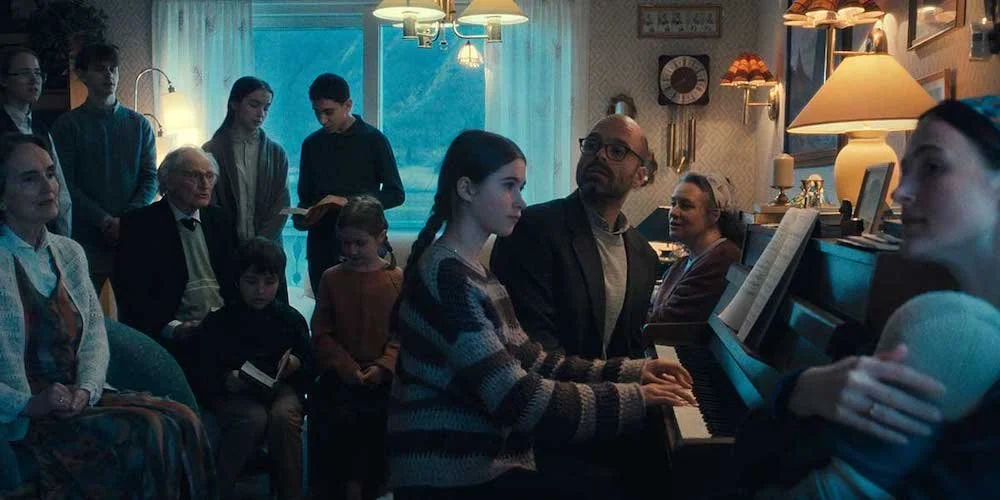
Image courtesy of the Toronto International film Festival.



Written and directed by Cristian Mungiu, Fjord is a gripping moral dilemma of a story that focuses on a conservative Christian Romanian immigrant family as they settle into life in Norway. Starring Sebastian Stan and Renate Reinsve as Mihai and Lisbet Gheorghiu, parents of this family of seven with their five children, Fjord comes to TIFF hot off of winning the Palme d'Or at Cannes earlier this year and after watching I can certainly see why it was given the highest honors of that prodigious film festival. While the film runs at nearly three and a half hours, I was pleasantly surprised to be dumbfounded once the credits began to roll, personally I found the pacing to be immaculate for such a lengthy runtime and I was left wanting more. I believe this is due to the great care that was given to the hook of the film and how the discussion earned its complexity through the expert use of ambiguity and a non judgemental lens from the film’s perspective. The characters themselves however all reserve judgement for each other’s differences in culture, values, and what is or isn’t considered the rights of parents over their children versus nationalized intervention.
As the story and family are both settling into their new frosty home we get acquainted with the Gheorghiu family and their neighbors in this small close knit community. Elia (Vanessa Ceban) and her brother Emmanuel (Jonathan Ciprian Breazu) are the eldest children and we spend the most time with them and their growing friendship with Noora (Henrikke Lund Olsen) the teenage daughter of the local principal of their school, Mats (Markus Scarth Tønseth) and his wife Mia (Lisa Carlehed). Noora is in a teenage phase of acting out and pushing the boundaries set by her parents in a mostly typical teenager fashion. Both Elia and Emmanuel are more mild mannered in nature but they delight in small broaches of their parents’ rules when Noora pushes them into quaint adventures like sneaking the family boat out into the Fjord at night or leaping from their windows at night for a stroll to talk and wander aimlessly. You know, typical behavior from children. Mihai and Lisbet are similarly quieter and reserved in nature but they’re more than willing to engage with their neighbors and community at large, but they stick to their stricter code of conduct while teaching their children biblically and limiting their interactions with the world at large by banning modern music, social media, video games and other such activities.
The conflict comes when Elia is seen with bruises on her back that elicit quick and brash responses from those in the school that believe the Gheorghius could be abusing their children. Without thoroughly researching all possibilities first the state acts swiftly in removing all five children from their homes, putting them in multiple different foster homes while Child Protection Services kick in an investigation of the family life. Thus begins the clash of cultures that the rest of the film dives into. What is allowed in a family’s decisions regarding raising their children? Is spanking a delinquent child to teach them what not to do humane, or cruel? Is it simply a smack on the butt to let them know this was wrong with no real harm being done to the children? Is a child’s response to Child Services saying that yes they have had their hands smacked away from a boiling pot of water an admission of violence against them by their parents? Fjord does an impeccable job deliberating every angle of this discussion with care, while also allowing characters to make quick judgements on both sides of their world view.
Sebastian Stan puts in a hell of a performance as the father of the family, as does Renate Reinsve as Lisbet, the dutiful mother of this tribe. I would be amazed if both weren’t nominated for these roles, each one was handled with extreme precision and intimacy. While Sebastian Stan’s performance may be the strongest character work I have ever seen from him, Renate Reinsve has had a hell of a run with this film, Backrooms earlier this year, and Sentimental Value last year. She has picked interesting roles and fascinating films that vary wildly, but truthfully Sebastian Stan’s performance has lingered more with me in particular since this viewing. The whole cast does solid work but these two in particular are what make the film work as well as it does.
Fjord is certainly a conversation starter, and one that will definitely be a big part of the Awards season dialogue. I’m not sure to what degree Hollywood politics will play into its acceptance or rejection, but the work speaks for itself. The smartest thing Cristian Mungiu did was playing with the ambiguity of the family and the community at large, keeping everyone at an arm’s length gave the whole affair a sense that anything could be possible, but by the time the end arrives the film does indeed take a stance, and I found that to be a fascinating choice. I highly recommend giving Fjord a watch when you can, it was a thoroughly satisfying film about how different cultures can hold very different sets of values and that we should all try to understand each other in good faith arguments and talks without alienating each other with exaggerated assumptions.


Cameron Geiser is an avid consumer of films and books about filmmakers. He'll watch any film at least once, and can usually be spotted at the annual Traverse City Film Festival in Northern Michigan. He also writes about film over at www.spacecortezwrites.com.