
Club Kid
Written by Gabe Kanter
Warning: This review is for Club Kid, which is a film presented at the 2026 Toronto International Film Festival. There may be slight spoilers present. Reader discretion is advised.
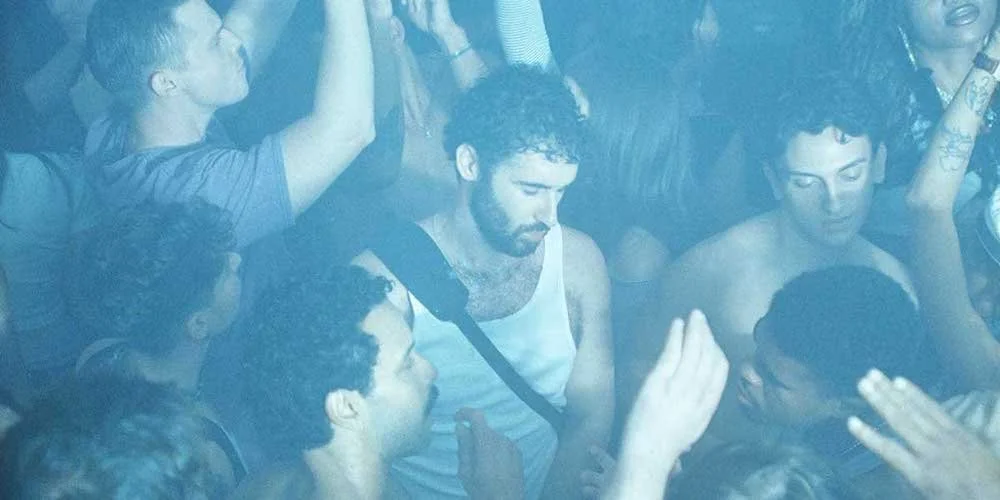
Image courtesy of the Toronto International film Festival.


There is something immediately appealing about Club Kid, Jordan Firstman’s feature film debut as a writer-director. Right from the opening scene where our main character Peter and his friends squeeze into an Uber which drives them over to the club for a night of relentless partying, you can feel there is a lot of authenticity being given to the characters and the setting of New York. The camera never cuts away. It moves in a constant circle while everyone is shouting and enjoying themselves, making the audience feel like we are right in that Uber with them.
After this opening sequence of clubbing, we jarringly jump ten years into the future and Peter is in the exact same spot in his life, waking up hungover after another night of heavy partying. Though at this point in his life, there is a stronger feeling of sadness within the character. Shortly after this time jump, the premise of the film reveals itself when Peter’s life takes an unexpected turn — Arlo, a ten-year-old son of his who he never knew existed, has shown up with a woman from London (after his mother died) and Peter is forced to take care of him when the woman heads back to London without Arlo.
When Arlo showed up early on in the first act, I Immediately thought about how the film could easily end up as an all too familiar coming-of-age story with a predictable arc and a clichéd set of lessons. Instead, Firstman approaches the material with an impressive amount of heart, humour and, most importantly, sincerity. The fact that Firstman also happens to play the main character Peter himself, along with the heavy responsibility of writing and directing this film, is a very impressive feat for the young filmmaker. You can feel that this story is a very personal one to him and the voice behind the camera clearly has a deep care for its characters.
The story itself is perhaps the film’s weakest element. For much of the first half, its trajectory feels relatively easy to anticipate, with the clash between a young man’s carefree clubbing lifestyle and the responsibilities of parenthood setting up a fairly conventional dramatic arc. Despite a rough start of initial hesitation and awkwardness between our two main characters, you just know that he will eventually start to care about this kid who has suddenly shown up at his doorstep. Yet, Club Kid is so warmly observed and confidently executed that its familiarity and predictability never becomes an issue.
Much of that confidence comes from the film’s portrayal of New York’s LGBTQ+ clubbing scene. Rather than treating it as either a sensational backdrop or something to be explained to the audience, Firstman presents it as a lived-in community, full of humour and genuine affection. The film feels particularly earnest in the way it allows its characters to simply exist within this world, without turning their identities or their lifestyle into a gimmick.
The relationship at the centre of the film is also helped enormously by young actor Reggie Absolom, who gives a fantastic performance as the 10-year old son, Arlo. There is an appealing naturalism to the performance that adds so much to the film’s emotional weight, particularly as the initially awkward relationship between father and son begins to develop. The chemistry between Absolom and Peterson is very strong and the entire film would fall apart without it.
For large stretches of the film, Arlo feels like a kid that is just too good to be true for Peter. He is well behaved, mature and has a surprisingly good taste in music, one that is far beyond his years. He is interested in DJing, something that lends itself well to Peter and his group of clubbing friends. While initially, some of these responsibilities of parenting and bonding with a ten year old, felt like they came a bit too easy for Peter and were a tad unrealistic, the film ends up progressing in a way where things naturally become more difficult for him and he runs into his fair share of roadblocks.
The comedy is another one of the film’s biggest strengths, particularly when it comes from Peter’s completely clueless attempts at parenting. There are plenty of genuinely funny sequences in which Arlo is exposed to things that a ten-year-old should not be seeing, and the humour feels earned rather than forced as it naturally comes from these characters and situations. Eldar Isgandarov’s performance as Peter’s roommate “Nicky” is another comedic highlight, it’s a minor role but every time he showed up he made the entire audience crack up and rightfully so as some of his lines are very unexpected and out of left field, yet somehow feel very true to this bizarre character.
Firstman pulls off the comedy-drama balance very well but what ultimately stayed with me is how genuinely moving Club Kid becomes by the time it reaches its conclusion. After taking Peter and Arlo and their relationship through so many highs and lows, the film arrives at an ending that feels both earned and unexpectedly emotional. There’s something particularly satisfying about the way those earlier moments of humour, awkwardness, excitement, and disappointment come together without the film ever losing its warmth or sense of humanity. The result is a final act that feels less like a neatly constructed and overly convenient conclusion, and more like a realistic and earned, emotional culmination of everything Peter has experienced. This final act also features a very powerful monologue in court from Peter, clearly Firstman’s stand out scene and showing that his acting chops are just as good as his writing and directing ones. It was a surprisingly powerful ending, and one that left me with a lot of affection for these characters.
Despite some predictability and minor pacing issues in the middle of the film, Club Kid is a truly impressive debut for Jordan Firstman and I thoroughly enjoyed the ride he takes us on here. His care for the material and characters gives the film a specificity and point of view that feels distinctly his own, without it ever feeling self indulgent. There’s a confidence in the way he balances humour and emotional sincerity, and in how he naturally moves between the lighter and darker themes the film is exploring. After seeing what Firstman is capable of here, we should all be excited for where he goes next.


Gabe Kanter has a Bachelor's degree in Film and Media from Queen’s University and currently works for “Blue Ant Media”, an international streamer, production studio and rights-management company based in Toronto. He is an avid consumer of film and television and is the host and creator of the podcast “TV Sessions”, made for diehard fans of prestige dramas. TIFF is one of his favourite times of the year.