
Train Dreams
Written by Andreas Babiolakis
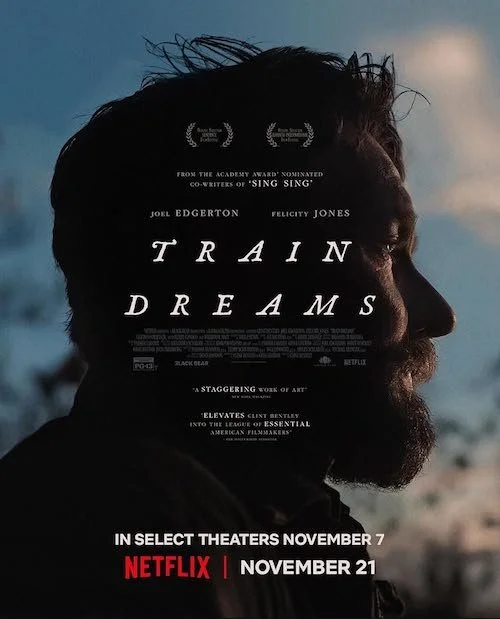



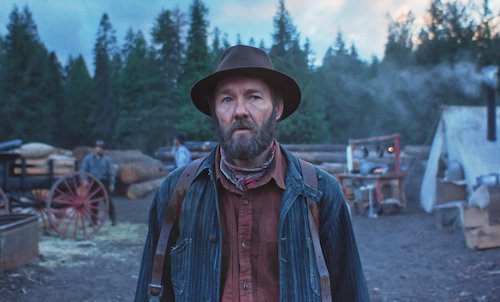
Clint Bentley and Greg Kwedar previously worked together on last year’s superb blend of narrative storytelling and documentary depictions of prison life in Sing Sing; Kwedar directed the sensational indie project while he and Bentley co-wrote the screenplay. Now, the tables have turned. Both filmmakers wrote their latest collaboration, Train Dreams, while Bentley sat in the director’s chair this time around. Outside of who made these films, they possess very few similarities; the main one I can think of is that they are both noteworthy independent films of the twenty-twenties. Train Dreams is shot to feel like unearthed home footage; with an unusual aspect ratio of 3:2 and a typically static, distanced camera placement, nearly every scene feels like it was shot on a personal camera (that somehow contains rich film stock, but maybe that’s where this ghostly photographer wants to devote their budget towards). This picturesque quality makes Train Dreams feel like one of a handful of films to be inspired by the artistry of Terrence Malick: American cinema that condenses the history of the nation into nostalgic time capsules that turn the lore of others into our own memories. You don’t learn from these films as much as you feel like you once lived them, even when you are watching them for the first time. Train Dreams fulfills this mission; it doesn’t feel like we have seen these ideas and shots before, but, rather, they feel intrinsically a part of us because of how subdued, naturalistic, and unrefined they come off as.
I don’t want to go into the plot of Train Dreams too heavily not just to avoid spoilers but because this is a film that lives off of the pulse of its beats. I don’t think any major revelations will ruin the film’s story, considering that Train Dreams isn’t exactly built on many twists or turns, but much of the joy here comes from feeling life and history unfurl in front of your very eyes, and I don’t want to take that away from you. What I can do is give you some basics to get by with. Robert Grainer (Joel Edgerton) is a hard working logger who is to work on a railroad that will stretch across the United States. The objective is simple but complicated. He is trying to create a bright future for his wife, Gladys (Felicity Jones), and their child. We enter his inner thoughts via the use of voice over narration, provided by Will Patton. This internal monologue connects us with the original Train Dreams novella, written by the late Denis Johnson, rendering the film a living piece of literature in a way. Many motion pictures cannot conjure up the feeling of one’s mind racing with images while reading a great story; Train Dreams comes quite close to making this sensation a reality.

Train Dreams is a highly personal film that makes its events feel like our own set of memories.
Train Dreams is written in a way that Robert’s life is also a vessel of American history. We see the change in natural landscapes, national innovation, racial politics, and other shifts through Robert’s life that — by comparison — feels rudimentary; he busts his ass and doesn’t know much else. Train Dreams feels almost mythological in an overwhelming way, like Charlie Kaufman’s Synechdoche, New York (although not nearly as bleak and depressing). This is the kind of film that leaves you rethinking your place in the world. Sure, I may see myself as some random schmuck who has hobbies, works hard, and leads a humble private life I am dedicated towards nurturing. This alone feels massive to me, but likely no one else; meanwhile, their lives will mean the world to them, and that makes sense. However, connect us with the history we have been a part of. I don’t mean watching the Toronto Raptors winning an NBA championship (although that is a feat I will never forget because of how much it meant to me). I mean me being born the year the Berlin Wall was torn down (I was four months old when it happened), my memory of when 9/11 happened (I was just at the start of seventh grade), the legalization of gay marriage in America, and many other major game changers in history that many of us have now lived through (do I even need to go into the many economic disasters we’ve weathered and continue to endure). Are we still simple creatures, or do we not possess rich, complicated, overwhelming histories, too?
Train Dreams takes the scope of American history and squishes it into one hundred minutes of film. It intentionally crawls along with its pace while zipping through its plot points. This is the funny push-and-pull of life that we all experience. Has a year ever felt like it just started while we also remember details of that duration as if they happened a lifetime ago? 2025 is almost over already, and yet former Canadian Prime Minister Justin Trudeau’s shocking resignation — which happened on January 6 — feels like it was at least in the spring of 2024 if I don’t focus on particulates like the logic behind this memory. Train Dreams accomplishes both sides of this strange sensation. It feels glacial enough that we are able to grasp onto what we are seeing like physical objects that are stuck at a standstill, but it is speedy to the point that we wonder where all of this went by the time we finish the film (with a gorgeous final sentiment that we are left on: a statement that makes all of our lives feel far less than ordinary when it is all said and done). Life is as typical as anything can be: anyone who has ever been alive has experienced it to varying capacities. It will remain so miraculous and beautiful nonetheless.
Train Dreams is a stunning indie achievement in 2025, and a must-see for any fans of that kind of cinema.
Then we get into the parts of Train Dream that matter the most to our protagonist, from breakthroughs to tragedy (a pivotal scene in this film is sure to break your heart). At this point, Robert’s dreams — steered by his self reflections and memories — become a part of American history, in a sense; one’s version of provenance must include their experiences, even those that revisit us through our subconscious. This only blurs the checkpoints of life even more, as we lose all sense of time. There are some constants, including stellar performances by Edgerton, Jones, and numerous others (William H. Macy is terrific as an explosions expert co-worker of Robert’s, and Kerry Condon is majestic with her brief appearance later on in Train Dreams). Otherwise, much of Train Dreams is about getting lost in it all. It is paradoxically defined with what kinds of historical moments it is a part of while also being a converged tapestry of feelings, thoughts, and recollections. This film is nothing short of breathtaking when you really bask in what it is achieving. Without ever coming off as pretentious or overly ambitious, Train Dreams is everything and minimalist at the same time: the size of existence within the frame of a solitary life. Robert’s tribulations and accomplishments are a part of American history just as much as American history is a part of him. This applies to all of us and our nations (hell, the world, in fact). Isn’t that remarkable? Aren’t we remarkable?


Andreas Babiolakis has a Masters degree in Film and Photography Preservation and Collections Management from Ryerson University, as well as a Bachelors degree in Cinema Studies from York University. His favourite times of year are the Criterion Collection flash sales and the annual Toronto International Film Festival.