
Wicked: For Good
Written by Andreas Babiolakis

Warning: This review may contain brief spoilers for both Wicked and Wicked: For Good. Reader discretion is advised.
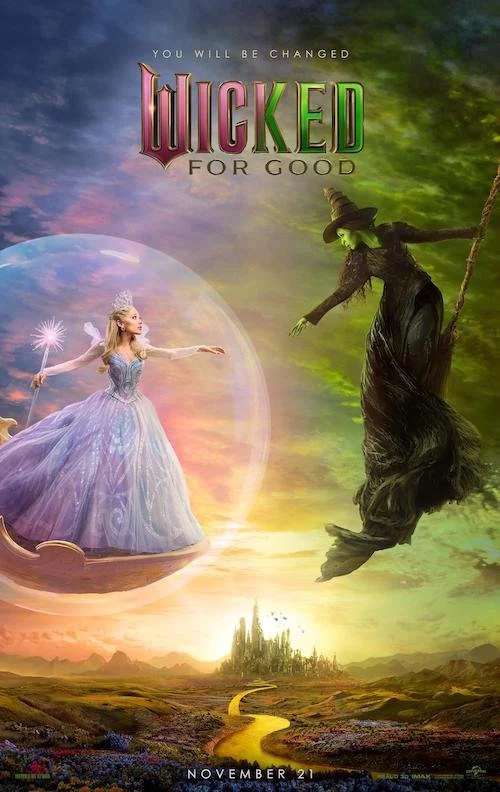
Last year, the musical sensation Wicked set the film world ablaze. Theatre buffs were hoping that this adaptation would match the quality of their beloved production, and John M. Chu’s first film based on this source material did not disappoint. Wicked was an awards season juggernaut, up for many trophies and boding very well for what would transpire with the second and last film in this series. Considering how successful Wicked was, the anticipation for Wicked: For Good may have been even larger. We didn’t even have to wait a full year for this second half to arrive. As for me, I liked Wicked quite a great deal. I felt like it was maybe a little long in parts but was otherwise exciting, vibrant, and charming. A hot take I have is that Wicked is as good — and similar, as a spectacle — to the best Marvel Studios films (and Wicked didn’t need thirty preliminary films or series to enjoy this feature film). I feel like Wicked and films like Black Panther and Avengers: Endgame are strong at taking already-existing properties, breathing new life into them, making them feel fresh as a contemporary event, and being thrilling as fully-produced creations with massive effects, sets, and performances. I was looking forward to Wicked: For Good, and was expecting something substantial since the first half actually surpassed my expectations.
However, if I am to make any Marvel comparisons, I have to also bring up when Marvel films don’t work as well as they should, and that is sadly the case with Wicked: For Good; Both this film and the weakest Marvel releases feel like they are extended to the point of being a sizeable feature film to the point that it is somewhat distracting. With how well Wicked went, I — someone who unfortunately has never seen the play in any capacity — was under the misapprehension that things were mostly well paced, and that we were on the proper track with the bigger picture and what it entailed. Wicked: For Good feels like an hour-long affair bloated to over double its length in order to justify its existence. It would have never happened, but the best thing that could have happened was that the hour’s worth of strong storytelling here could have been placed at the end of the first Wicked to make a nearly four-hour epic that never eases up. Wicked: For Good relies so heavily on the success of its predecessor that it never really creates its own lore (outside of what it is continuing); in that same breath, it takes the emphatic energy of Wicked and grinds it down to a crawl of observations.
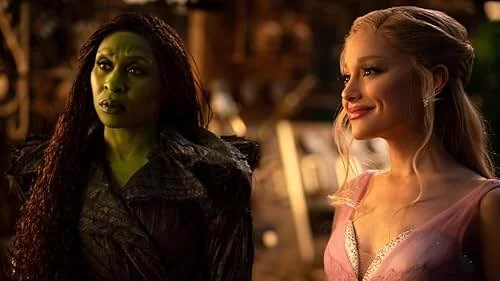
It isn’t that Chu and the film don’t try; everyone is working to their potential here. It’s that much of Wicked: For Good feels like a thorough investigation of plot points that should move by quite quickly. We kick off where Wicked arrived: at Elphaba (Cynthia Erivo) being cast out of Oz after being framed. Five years after Wicked took place, Elphaba is alone with the ostracized animals while Glinda (Ariana Grande) is the Wizard of Oz’s (Jeff Goldblum) spokesperson in the palm of his hand. Meanwhile, Wicked: For Good is not-so-secretly inching its way towards the start of the classic story of The Wizard of Oz, with the revelation of iconic characters throughout the film (like who become the Tin Man and Scarecrow and why, how the Lion comes into the picture, the Wizard of Oz’s motivations, and more). We explore the growing tension between former besties Elphaba and Glinda and find the power that Madame Morrible (Michelle Yeoh) possesses over Oz and the story. All of it sounds constructive on paper, but Wicked: For Good doesn’t possess that same spark that Wicked has; if Wicked mainly feels well paced outside of the occasional lull, Wicked: For Good is the same but in reverse, with a few punchy moments to perk up a film that is predominantly stalled.
When we get to the sequences that happen during The Wizard of Oz, Wicked: For Good feels even more fragmented, as we only get glimpses of a perspective. I know that everyone should have done their homework and must know the lore of The Wizard of Oz already, but a storyteller should never insist that an audience knows what they are already fluent in. This is a storyteller’s opportunity to convey, to educate, to inspire, to deliver. When Wicked: For Good relies on its previous film to make complete sense, you can argue that it is a sequel and that most viewers will have seen the previous film. When much of Wicked: For Good’s climax is hidden because it happens in The Wizard of Oz, it now feels like an oversight. Remember how I chastised Marvel for making films that require many films of backstory in order to make one feature work? Wicked: For Good now feels partially guilty of this. Sure, Wicked: For Good may make The Wizard of Oz feel more interesting (with this hidden information that now contextualizes what really happened in this story), but it shouldn’t be up to The Wizard of Oz to make Wicked: For Good more complete.
Wicked: For Good does its best to bring the Wicked series to a grand close, but all of its sparkle and ambition cannot fix how lethargic it feels.
What helps save Wicked: For Good quite a bit is how well Erivo and Grande understand the assignment; that this is the emotional half of this cherished tale, and that they are to pour every ounce of their soul into this saddening conclusion (credit goes to the rest of the cast as well, but both the leads — especially Grande — will send shivers down your spine). Even when the film dilly-dallies its way forward, the leadership by these two stars — Glinda’s conflicted conscience, and Elphaba’s torn spirit — is what keeps us wanting to see what happens next. Sure, the beautiful sets, glorious costumes, and sublime effects will keep your eyes busy throughout this film, but how can they save something that festers instead of propels? When Grande and Erivo are on screen and carry the film on their shoulders, you can almost feel a Sisyphusian climb up a yellow-brick mountain. Since their soaring voices, moving performances, and electric charm are present throughout all of the film, I would argue that they made the climb.
However, this is Wicked: For Good. They should have defied gravity from the start. Noting that the song of the similar name was already featured to cap off Wicked: Part I, it is clear that much of the series’ best cards were played prematurely and Wicked: For Good is an over two-hour tiptoe to stall for time until the bell rings. Sure, some of that time zips by because of pleasant distractions, but I can’t say that Wicked: For Good dazzled and wowed me like the first half did. I did find it pleasant and touching, but also lethargic (even with all of that colour). It’s fortunate that Wicked can stand on its own two feet as a sole film, because Wicked: For Good does not give it the dynamic closure that it deserves.


Andreas Babiolakis has a Masters degree in Film and Photography Preservation and Collections Management from Ryerson University, as well as a Bachelors degree in Cinema Studies from York University. His favourite times of year are the Criterion Collection flash sales and the annual Toronto International Film Festival.