
Filmography Worship: Ranking Every F. W. Murnau Film
Written by Andreas Babiolakis
Filmography Worship is a series where we review every single feature of filmmakers that have made our Wall of Directors

When you think of the silent film era, one of the most prominent names is Friedrich Wilhelm Plumpe (known to most as F. W. Murnau): one of the great German Expressionist visionaries. Born towards the end of 1888 in December, Murnau was a quiet, introverted kid who became obsessed with the art of filmmaking from a young age. He studied philology in university before serving as a combat pilot in World War I (where he survived countless crashes). He was captured as a Pow in Switzerland, and there he furthered his connection to film when he joined the prisoner theater group. After the war and upon release, Murnau started his own film studio and he hit the ground running with his own releases. Now would be the most appropriate — yet unfortunate — time to bring up the inevitable when it comes to dealing with the early days of cinema: quite a few of Murnau's films are lost and will not be covered on this list (should, by some miracle, they get rediscovered and made available to watch, I will add these films retroactively).
Murnau was one of the earliest directors to exhibit a signature style in his films, including heavy use of shadows, elaborate sets, and inventive technical innovations. His boyfriend, Hans Ehrenbaum-Degele, helped introduce Murnau to expressionist art while both were serving in the war; Murnau's parter died while serving. After releasing a few genre pictures, Murnau had a brief stint in Hollywood during the industry's shift to sound pictures, including one noteworthy film that I will get to later on in this list. The sky was the limit for Murnau, whose career was already proving to be one of the most accoladed and influential, when he died after a horrific car accident in 1931; Murnau was only forty-two. It's bittersweet how iconic Murnau is as a filmmaker when his career and life were so short; his legacy is the kind that is usually attached to decades-long achievements. I can only imagine what other works we could have gotten from this early, brilliantly artistic mind. We don't even have his entire filmography to look at; only twelve surviving examples (and a majority of them are worth your time). Here are the films of F. W. Murnau ranked from worst to best.
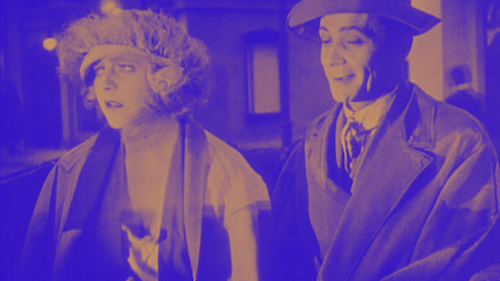
12. The Finances of the Grand Duke
Murnau's worst existing film, The Finances of the Grand Duke, is not a terrible motion picture by any means; it's just a bit much. Uncharacteristically a comedy for the commonly-serious filmmaker, this film is also meant to highlight the woes of economic crises via the titular Grand Duke of Abacco and his numerous attempts at keeping his island and himself afloat (and the kinetic aftermaths of his choices). My biggest issue is that this film isn't certain of what it wants; it clearly attempts a lot of narrative ideas and yet it is only eighty minutes; it hopes to be entertaining and yet it is still serious enough that some of its ideas land awkwardly. The Finances of the Grand Duke is fine, but it cannot hold a candle to the other Murnau films that are far stronger.

11. Journey into the Night
Murnau's earliest surviving film — 1921's Journey into the Night — feels like an early experiment that would eventually lead to Sunrise: A Song of Two Humans — with its storyline about a taken man who is conflicted when he comes across a siren and, thus, begins to question his relationship to his fiancée. What Sunrise does well is placing you in the aura and mindset of both a broken and a beating heart with its highs and lows. Journey into the Night, however, feels a little more barren with its story, and it never feels as strong as it looks; this is still a satisfactory silent film by Murnau that won't hurt you to leave at the end of your journey through his works.
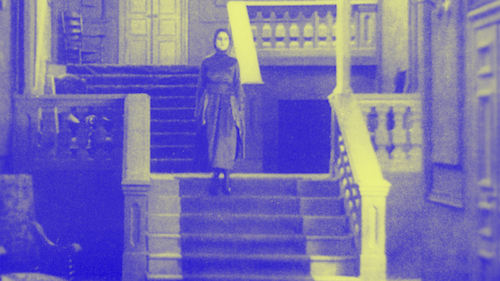
10. The Haunted Castle
It can be interesting to see what may have come off as artistic genius back in the day and now feels a little lopsided. Such is the case with The Haunted Castle: an early Murnau film that almost feels like he pooled together a bunch of ideas in hopes that he would have a masterpiece on his hands. Subjectively, I adore the unnerving mood that Murnau is opting for here; however, it cannot overshadow (heh) the narratively confused film: one that strives to be a murder mystery, psychological melodrama, and horror film (kind of) all in one (and in eighty minutes, no less). Regardless of how fascinating this film can be in bite sized chunks, what is the endgame of The Haunted Castle? How can a film this creative feel so mediocre?

9. Phantom
The thing with some expressionist films is that directors may get carried away with the vibe and tone of the film while sacrificing some of the narrative goodness that can be offered. Phantom is quite good, but it does feel like it is lacking a little bit of its potential depth in favour of placing us within the mind of a smitten, aimless protagonist. The idea is that our lead character is driven crazy by the idea of his fantasy woman: one who almost runs him over with her chariot, and whose presence he chases after for two cinematic hours. One of the last Murnau films to be rediscovered (in2003), Phantom is something I'm glad I saw despite its slight shortcomings because it is quite a trip of a film, especially by the standards of 1922.
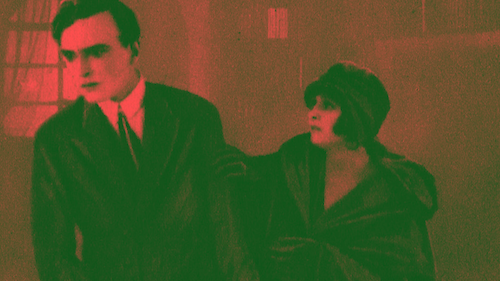
8. The Burning Soil
The rest of the films on this list are Murnau mainstays in my eyes. If you are concerned about potentially great lost Murnau films never turning up, have no fear because such was the case for The Burning Soil which I have now seen with my own two eyes; the film was rediscovered in 1978 (there is hope for films like 4 Devils, yet). This gothic look at the greed and corruption that surround the extraction of petroleum feels incredibly ahead of its time: like a look at then-contemporary sociopolitical concerns through the lens of death (revealing the inner truths of guilty-hearted deceivers). While a bit of an uneven Murnau picture, his eerie aesthetic and expansive, narrative ambition are unmistakable here in a film that is a must for those who like Murnau's most iconic titles.
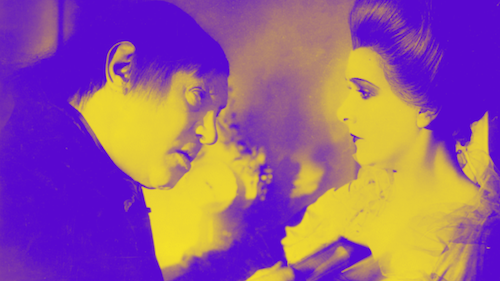
7. Tartuffe
You'll come to realize that Murnau was great at adapting existing works into his own style, and one lesser-celebrated example is his rendition of Moliere's Tartuffe. It would be one thing if, by Murnau's style, I meant that Tartuffe is shadowy, melodramatic, and such eye candy as an expressionist portrait of hypocrisy and greed. However, the fact that Murnau's film (again, an adaptation) turns into a story-within-a-story (both a recreation and a reinvention of the same story) is the kind of thing you'd expect to see in a film decades later, not in 1926. If you want to see a clever, unique example of how someone can make something new with an established work (I love Murnau's other adaptations even more, but I cannot ignore what he accomplishes with Tartuffe).

6. City Girl
Murnau's penultimate film (and the last to be released while he was still alive) is City Girl: a breathtaking drama that utilizes the farmlands of Chicago as a backdrop to detail the forfeited life of a female dreamer who fives it all up in hopes of a better life with her new farming lover. This farm — removed from society — allegorically pits our titular city girl with a number of challenges, all stemming from the frustrating men she has to endure (including her father-in-law, and even her new husband). Despite these tribulations, City Girl is such a beautiful film to look at: as if our protagonist can recognize that the world that she set out to have, in fact, does exist and it is those who are too blind to see it that are trying to take it away from her. When someone can make a straightforward drama feel this exquisite and overwhelming (as if you are watching a stylish genre film), you know they are an expert at their craft.

5. Tabu: A Story of the South Seas
Before Murnau's life was tragically cut short, we got a sneak peak at what was going to be a new era for the innovator in the form of Tabu: A Story of the South Seas. When his time in Hollywood came to a close, Murnau explored the French Polynesia with documentarian Robert J. Flaherty (best known for Nanook of the North in 1922); Flaherty wrote the screenplay and directed just the opening shot of the film. One final romantic drama from Murnau, Tabu sees a couple threatened once the female partner is deemed "tabu" (a sacred virgin in the eyes of the gods, who is to not be tainted by sin or the affections of another. This tug-of-war between culture and romance is a battle of two different types of devotion, in this parable of doomed fates and sacrifice. Murnau refused to make Tabu a complete talkie, instead opting for synchronized sound (which he worked with before) and the ways of silent cinema (even in 1931); if anyone knew what sticking with their greatest love to the bitter end looked like at any cost, it was Murnau.

4. The Last Laugh
The year is 1924, and the catastrophic woes of The Great Depression were far away on the horizon (but present enough that the roaring twenties still knew what was to come). Enter Murnau's The Last Laugh: a dismal, mortifying look at being caught unemployed in a society that is all about appearances, luxury, and success. Our unfortunate protagonist is played by one of the great thespians, Emil Jannings; our lead character learns that he is fired from working at a prominent, rich hotel, and he feels the pressure, judgement, and scrutiny of all of his peers. Murnau turns society into a bit of a carnival exhibition; a hall of mirrors of overlapping, laughing faces; snappy editing that would have given anyone back in the twenties whiplash like a roller coaster; the frenzied chaos of fireworks going wrong. Murnau's biggest — and most rewarding — gamble here is utilizing one solitary intertitle to aid us (and what a powerful intertitle it is); otherwise, The Last Laugh is free of any descriptive clues. We don't need any when this film is so effective at making us feel as though we have gone insane.
3. Faust
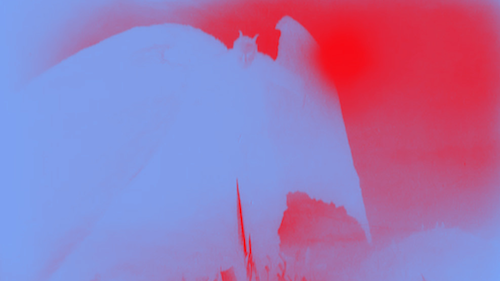
We all know the old tale of Faust: the one where God and Mephistopheles (the Devil, essentially) feud over the state of the world, and the Devil convinces a mortal man to sell his soul in order to chase the riches of existence. If anything, most of us may know this classic story because of Murnau's adaptation. Easily Murnau's most ambitious film (this almost feels like a Fritz Lang production, if anything), Faust is as maximalist as silent cinema could get; seeing Mephisto looming over society is one of the great cinematic images of the twenties. Murnau's gorgeous aesthetics help us recognize why one would chase after the best that life has to offer, while simultaneously reminding us that beauty is all around us without having to make such morbid deals. This film also acts as an exquisite allegory; here's Murnau operating almost entirely with his artistic and aesthetic talents while the film industry was slowly shifting into something more driven by profit and business-minded directives (who really sold their souls here).
2. Nosferatu: a Symphony of Horror
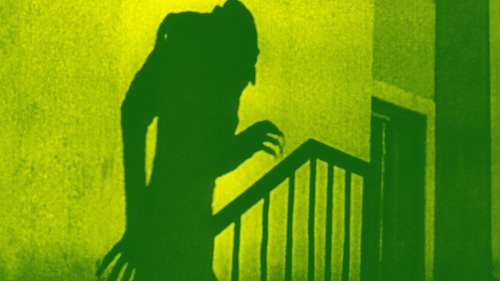
Murnau's most well known film has to be Nosferatu: a Symphony of Horror. Essentially an adaptation of Bram Stoker's Dracula (with heaps of details changed in order to avoid claims of copyright violations), Nosferatu set the stage for the vampire story in film (and for all horror films that would follow suit). While many German Expressionist films experimented with shadows and architecture, how Murnau does so in Nosferatu is on a whole different level: in the kind of way that feels extrapolated from the pits of your subconscious. I find films like Nosferatu to talk about in great length because of how ingrained they are in pop culture; what might seem old hat now was revolutionary for its time, and you also have many pale (pun intended) imitators to thank for making Nosferatu seem typical. Focus on what cinema would have been like back in 1922, and understand the horror that many viewers would have felt seeing their worst nightmares come to life. Now, understand the one-hundred years Nosferatu has withstood as one of the most inventive horror films ever made, even if you no longer feel an ounce of dread with contemporary eyes. This film is vital to cinema as we know it, and I don't think its imagination and innovation should ever be undersold.

1. Sunrise: A Song of Two Humans
The very first winner of the Best Picture award at the Oscars is Wings; however, the first ceremony actually had two winners, and there wasn't a tie. The sole winner of the quickly-discontinued category for Best Unique and Artistic Picture is Murnau's Sunrise: A Song of Two Humans. Already in 1927, Murnau delivered one of the most inspired takes on what a romantic film could look like, and — similar to the duality expressed in its title — Sunrise certainly is a story of two halves. First, there is the spooky premise of a husband who is convinced by a vampiric, ghostly woman from the city to murder his wife so the two of them can now be together. In a hypnotic daze, we watch our unnamed man lure his wife into a horrific predicament in order to finally put an end to his madness, her life, and their marriage. Suddenly, he snaps back into reality before he snaps for good, but the damage is already done: his wife knows his intentions and is now fearing for her life. Enter part two: the act of falling in love all over again. The first portion is incredibly plot driven, but Murnau allows the remainder of the film to be more of an open-ended, anything-goes exploration of adoration; when you are in love, the world opens up and sings with you.
The murder storyline would already be the best thing Murnau ever directed because of how genuinely unsettling it is, but Sunrise blossoming into this gorgeous, sublime excursion into a blissful daydream is an unforgettable moment in film history. Furthermore, Murnau utilizes synchronized sound so his images can come to life, making audiences back then (and even us, ninety-nine years later) feel the world explode with vibrancy and joy. What an extraordinary film this is: one that makes you want to live to see another day (in the same way Murnau uses the images of sunsets and the titular sunrise to mark what is to come for his characters and for us). Murnau saves some of the film's craziest events for Sunrise's climactic act, when he tests his leading couple one last final time (while repeating the same notion: you don't know what you've got until it's gone); it sounds cliche, but no one accomplishes this maxim in the way Murnau does here. When films try to sell you on the notion that love can overcome anything (a sentiment that is so frequently proclaimed that it has lost all meaning and only developed suffocating amounts of cheese), they're likely trying to capture how F. W. Murnau showcased this with his magnum opus. This film about true, unconditional love in the face of adversity (especially when the honeymoon phase is long done) is as magical and exquisite as motion pictures get.


Andreas Babiolakis has a Masters degree in Film and Photography Preservation and Collections Management from Toronto Metropolitan University, as well as a Bachelors degree in Cinema Studies from York University. His favourite times of year are the Criterion Collection flash sales and the annual Toronto International Film Festival.