
The Invite
Written by Dilan Fernando
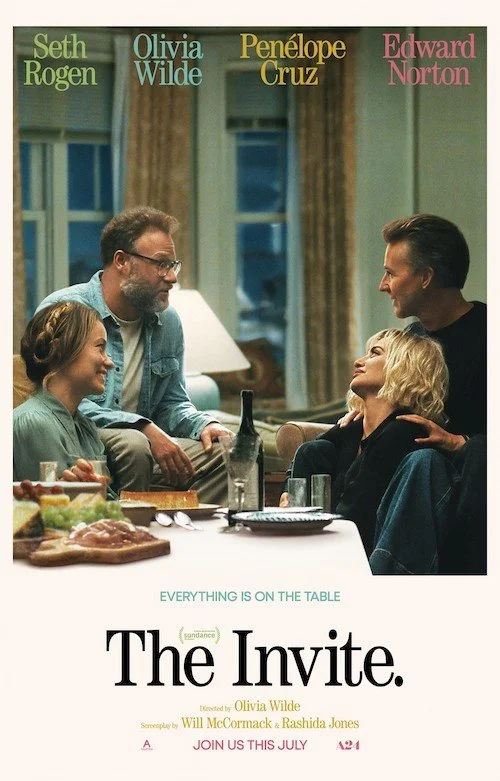



Angela (Olivia Wilde), Joe (Seth Rogen), Pína (Penélope Cruz) and Hawk (Edward Norton) are the quartet that star in Olivia Wilde’s latest film, The Invite. Co-written by Rashida Jones and Will McCormack; whose dialogue has a chaotic energy to it reminiscent of screwball comedies of the 1930s and 40s with an underlying subtext of how relationships work; specifically, ‘what is needed to make them work’? Like the characters in the relationship dramas it draws influence from – Who’s Afraid of Virginia Woolf? (1966) and Bob & Carol & Ted & Alice (1969), the characters in The Invite look elsewhere for solutions to problems that have been stifling them and their partners, not realizing the resolution lies within each partner that makes up the relationship.
The film opens with an Oscar Wilde quote followed by a flurry of serene moments between Angela and Joe. Wilde introduces Joe sitting alone in an auditorium watching with quiet contempt as the jazz band on stage tries to play through a composition. Joe grabs his bag and foldable bike and hurries out the door, leaving the players who are still holding their instruments. As he struggles to bike all the way home, the film’s mosaic style title sequence begins intercutting Joe’s bike ride with Angela’s gathering of the ingredients for her dinner party. Joe arrives home, enters the luxury apartment and lies on the floor to alleviate his back pain. Angela, who’s too busy to offer a proper greeting bluntly says, “Shoes off please.” Joe follows her request while on the floor and she responds with, “You didn’t fold this.” (noticing the bike), entering the frame and doing it herself. It’s here where the synchronicity between the writing and direction presents itself. Once Joe realizes what Angela is preparing for (a dinner party after inviting the upstairs neighbors Pína and Hawk) after Angela’s chance encounter with Pína in the elevator, is when the simmering tension in their marriage begins to boil over.
It’s fitting that the party takes place when Angela and Joe’s daughter is off at a sleepover, because when parents are fighting, wouldn’t a spectator or mediator for the fight only provide more firepower for the insults they hurl? Within the first 30 to 40 minutes of the film, the score is overplayed, shot compositions are over directed (i.e. isolating characters within frames and door jams) and a frenzied editing style is used for simple character movements like walking from one room to another before cutting to different angles of the same motion. Notice the scene where Angela and Joe are both changing for the party and continue their conversation through a mirror. Cinematographer Adam Newport-Berra racks focus between the characters rather than keeping them simultaneously in focus. The stagnation in their marriage is visualized by isolating the characters physically, reflecting their interior loneliness.
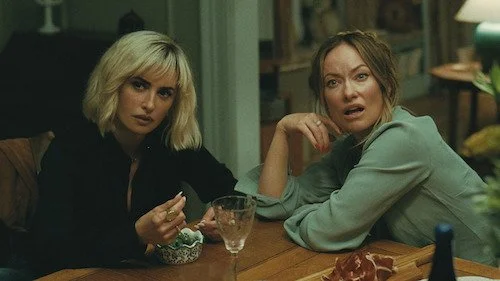
The Invite modernizes the antics of screwball comedies and the interpersonal studies of characters from the New Hollywood era.
Wilde’s recreation of that lonely, neglected feeling within the audience helps in understanding how Angela and Joe both feel a sensation of walking out on the marriage without actually putting it into action. Instead, they suppress, loathe and passive aggressively bark, leer and gnaw away at each other slowly but ineffectively trying to goad the other to take the lead on making a change in their stagnant marriage. How exactly, neither Angela nor Joe know nor are they willing to put forth the effort in trying to figure out a way either. They’re content with arguing because it can be done anywhere without moving – from different rooms, without even looking at each other, sometimes even with a look or non-verbal mannerisms. The invite itself to Pína and Hawk is the catalyst for the introspective look Angela and Joe must take of their marriage and themselves. Instead they idolize their guests’ relationship which they consider perfect. When Pína and Hawk arrive, is when the film’s momentum picks up moving much more swiftly.
Angela and Joe begin seeing all of their personal and marriage faults as reflected in the body language and reactions from Pína and Hawk. Wilde, Rogen, Cruz and Norton’s performances are one of the film’s many standouts as they share chemistry on both dramatic and comedic levels. Each line delivery, movement, facial expression and silence is perfectly choreographed showing the polish each performer has applied to their character when bringing them to the life of the party. The quartet of Angela, Joe, Pína and Hawk all feel like real people because they’re playing characters. They don masks, play roles, put on facades and suppress or address social cues and faux pas’ to be more accommodating and seem normal (showing their efforts in trying to present the image of a healthy relationship when they should be working to maintain one).
As the dinner party progresses there are revelations between couples and among each member of the quartet; like how Joe refuses to play a certain album or speak of when he was once a musician with his band or why Angela’s fastidious nature is imperative for this night going perfectly. Given their professions, Pína being a psychotherapist and sexologist and Hawk a now retired firefighter shows how conditioned they are to have a more acute level of attentiveness to the verbal and unspoken communication between Angela and Joe. It’s this attentiveness which creates an opportunity for impromptu private discussions, leading to Pína and Joe going to smoke a joint while Angela and Hawk move to the kitchen to do shots of tequila. In each of these discussion sessions, Pína and Hawk each get a feel for Angela and Joe, while Angela and Joe are able to vent to a third-party about how they feel. Pína and Hawk’s tactfulness highlights their strengths in communication and presents the disparities between the communication or lack thereof between Angela and Joe. Each of Angela and Joe’s life aspirations are mentioned – Joe becoming a musician before settling on a musician adjacent career and Angela continuing her career as a photographer before sacrificing it to wholeheartedly be a mother. This sequence gives the film a moment to breathe, with both the characters and audience walking away with some perspective to carry into the later scenes of the film.
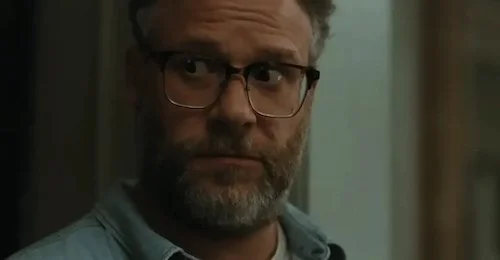
The Invite perfectly balances its comedic and dramatic tones throughout its entire runtime.
When the quartet reassembles in the living room for shots of tequila and to indulge in Pína’s flan, is when Joe realizes it’s an opportune time to voice some of the frustrations he’s had with his neighbours, mainly the volume of which they have sex. Thus begins the conversation about Pína and Hawk’s active lifestyle leading to one of the film’s best lines said by Joe, “Next time you’re in there you should count the rings.” and Pína’s invitation of Angela and Joe to consider joining in. This is a pivotal moment in the film for two reasons. One, Pína and Hawk’s invitation acts like a retractor providing a closer look at the biopsy of Angela and Joe’s marriage. Two, when Angela and Joe excuse themselves to discuss their thoughts on the invitation, it is one of the few shots in the film where the pair are both present looking at each other in focus within the same frame – briefly showing them both on the same page. Returning from their deliberation Angela and Joe agree to the proposition, the quartet assembles and Pína and Hawk establish some ground rules before everyone swings away to reignite their passions.
In the kitchen, Angela clumsily and nervously tries to initiate sex with Hawk. In Joe’s study, Pína shows him how to build passion on an emotional level before jumping into the act of sex, with the two of them seductively dancing to Sade’s ‘By Your Side’, before Joe falls hurting his back even more. Once again, the quartet reassembles, Joe, pants around his ankles crawling into the living room as Pína, Hawk and Angela look over him. Angela, sits down and blames Joe for ruining her moment to have sex after so long, beginning the discussion where Pína shows her prowess as both a psychotherapist and sexologist as Hawk attends to Joe’s back injury. Joe fires insults at Hawk without even extending a ‘thank you’ for helping alleviate some of his back pain. The seemingly perfect relationship projection between Pína and Hawk fades as they bicker like Angela and Joe (who are seated together by a window with a throw pillow of two swans swimming in a row between them) subtly relishing in the chaos.
Edward Norton gives one of the most moving and profound monologues in both his career and cinema proving he’s still got great acting talent; which doubles as Hawk showing how he’s gotten to the great place he is in life thanks to Pína after visiting her for therapy after losing his wife to cancer. Pína defends Hawk by pointing out some faults in both Joe and Angela, inferring the real reason for Joe’s back pain. Pína’s questions to Angela and Joe like, “Would you fuck yourself?” or “When was the last time you had sex?”are layered as they establish their lack of physical intimacy as one factor in itself while also showing it’s added to the other problems in their marriage. Given how often they argue, Pína wonders if they also have sex as often.
There’s an old observation from Richard Pryor’s comedy album Craps (After Hours) (1971), that’s more informative as it is humorous; “I found out if you be with a woman if you don’t fuck in a week you got to fight. You either fuck or fight, one of the two.” Joe blurts out his reasoning as to why he and Angela don’t have sex anymore, “You’re my wife, you’re supposed to be attracted to me.” Joe doesn’t realize how hard this line hits, making it seem like it’s Angela’s role and responsibility to feel attracted even when the attraction may no longer be there anymore. Joe seeing Angela’s attraction as an obligation to him makes it less about her and more about him; it’s instances like this where infidelity seems a lot closer than reconnection. Pína’s wise remarks, “We only get a few meaningful relationships.” and “Is it better for parents to be happy and separated or miserable and stay together?” echo through the house even after her and Hawk leave. Wilde closes the film with some moments of quiet reflection for Angela and Joe alone before reuniting through music. Seated at Joe’s piano playing Thelonius Monk’s “I’m Confessin’ (That I Love You)” shows Angela and Joe are headed in the right direction to fix their marriage. I believe they’ll get there – eventually.

Dilan Fernando graduated with a degree in Communications from Brock University. ”Written sentiments are more poetic than spoken word. Film will always preserve more than digital could ever. Only after a great film experience can one begin to see all that life has to offer.“