
Teenage Sex and Death at Camp Miasma
Written by Nik Asaris

“Camp Miasma . . . was about two very simple things: flesh, and fluid.”
I’ve dragged pretty much all of my friends out to see I Saw the TV Glow. How could I not? It’s a film that—more than anything else I’ve seen released after the decline of the ‘90s new queer cinema movement—seemed made for us. This phantasmagorical exploration of the mental decay that comes from denying yourself your own identity; we were in awe of how it resonated with us so terribly, as if its director-writer, Jane Schoenbrun, had somehow custom-built the film for each of its millions of viewers. It’s become my favourite film of all time, despite having been released just two years ago. I’ve spent hours rewatching it, hoping to pick apart something new from its dream-like visuals or heartrending dialogue each time (and you know what? I still do). TV Glow was the film I chose to write about for my very final project for my bachelor’s degree, a video essay on the boundaries between the real and unreal which Schoenbrun so playfully blurs as an antidote to easily digestible narratives of transition. I have a quote from the film, “there is still time,” stamped underneath a tattoo of a burning TV on my arm, a permanent reminder.
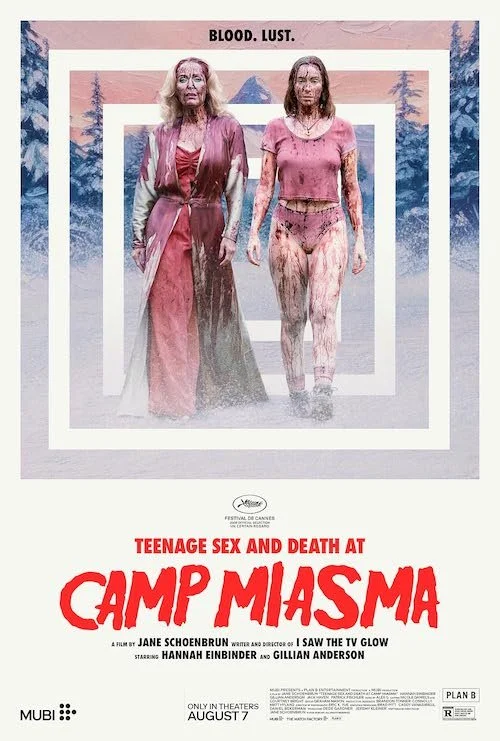
Of course I was excited for Schoenbrun’s next and third feature, Teenage Sex and Death at Camp Miasma, a satire and so-called deconstruction of the slasher genre. I couldn’t wait to throw my academic, analytical lens at more of their work—but that’s not how their newest film ought to be approached. Camp Miasma comes at you with a lot of raw emotion, and demands you match that energy back. It’s a film that ultimately—in spite of its few technical blunders—slashes through a decades’-long legacy of “problematic” queer horror history to pierce right through to the juicy heart of what matters most in our many contemporary, admittedly clinical conversations about whether it’s okay to relate to Sleepaway Camp’s Angela Baker or if you’re a bad person for thinking The Silence of the Lambs is still a pretty awesome movie (it is, by the way): how have these gender-bending figures really made us feel, deep down?
Put the theory away—no, no, forget how that character fits into Julia Serano’s model of the deceptive transsexual, if only for a moment. How do we address queer and trans viewers who’ve best made sense of their identities and desires through their strong personal ties to villains that were created simply to mock them? As has become standard with Schoenbrun’s filmography, Camp Miasma offers no easy solution to reconciling with the many selfhoods forged by the media with which we as queer audiences engage. It does, at any rate, firmly underscore our need to remember how even old, transphobic horror still holds value for its role in enabling queer fantasies.
Teenage Sex and Death at Camp Miasma is a very welcome return from one of contemporary cinema’s most imaginative and inspired minds.
Teenage Sex and Death at Camp Miasma follows Kris Williams (Hannah Einbinder), a young director catapulted into the Hollywood spotlight after the recent success of her debut film at the Sundance Film Festival. For her next project, Kris has been hired to helm the reboot of Camp Miasma, a slasher franchise left dormant after too many bad sequels and questionable spin-off rap album releases killed its box office numbers. She’s thrilled about this. She grew up on the Camp Miasma movies, you see, and this is her opportunity to do right by the franchise. But here’s the kicker: the series has long been condemned for the deeply transphobic origin story of its antagonist, Little Death (Jack Haven), and Kris—her gender and sexuality themselves queer—faces immense pressure from studio executives to transform the character’s tale in something more “elevated, AKA woke.” In her own words, Kris is aiming to “beat Hollywood at its own game” as a queer director rehabilitating an anti-queer IP. Seeking inspiration for her script, Kris heads northwest to consult with the first Camp Miasma’s final girl, an actress-turned recluse named Billy Presley.
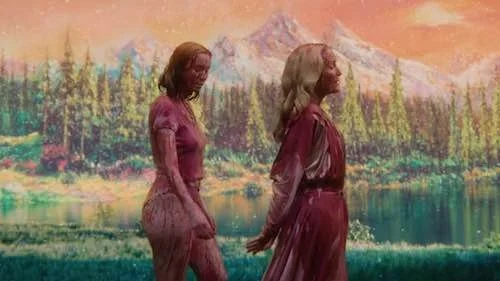
Billy, played by an appropriately sultry Gillian Anderson, is revealed to be living on the old campgrounds where the first Miasma was shot. She doesn’t hit it off with Kris right away; she dismisses the younger woman’s overly academic explanation of her interest in Camp Miasma, its “cultural depictions of monstrosity,” and general “gender trouble.” The two eventually connect when Kris opens up about her unhappiness with her partners (she’s polyamorous), however, and, over some fried chicken and a joint shared that night, start to bond over their mutual fascination with Little Death and the Camp Miasma series. What ensues between them is bloody, sexy, and a little bit of an absolute fever dream.
Like I said, I pulled up to Camp Miasma with my queer/trans theory and TV Glow-fixated brain right in tow. That first exchange between Billy and Kris on the academic intrigue inherent with the fictional Miasma franchise had me hooked right away. Aha, I said! Gender trouble—that’s a term from seminal queer scholar Judith Butler. I’ve got you, Jane Schoenbrun; I’ve done my readings, I know who you’re citing.
And then Billy shuts Kris down completely, dismissing her with a simple “We’re just different generations, is all.” This shut-down of Kris’s overanalytical brain continues throughout the film. Before she meets Billy, while watching the fifth Miasma sequel alone in a hotel room, Kris scribbles the simple word “DESIRE” onto a blank page in her notebook and underlines it twice; this rather uncomplicated attempt at dissecting Camp Miasma here was met with laughter from my cinema, making me acutely aware of my journal beside me. Billy hissing at Kris to “shut up” about some particularly dated language in the original Camp Miasma—which they spend a night watching together—furthers the film’s identity as one which seeks to resist a cold and calculated investigation into queer horror’s legacy. What enables Kris to crack the Miasma code for herself and her reboot is when she reveals to Billy that her queer awakening was Billy. Kris’s admittedly misogynistic fantasies of taking on Billy’s role as final girl, of being pinned down and slaughtered by Little Death, are just that—misogynistic, and possibly rooted in the fetishization of a trans character to boot—but it is her embrace of this desire that grants her sexual release. Her queerness is made most fully legible to herself when she allows herself to let go of her theory and become absorbed in the gore-soaked scenes of this sleepaway camp horror series. It’s a fantastic address to people who have found themselves in a medium that has sought so hard to paint them as nothing short of undesirable.
Narrative aside, Teenage Sex and Death at Camp Miasma is a film with striking personality in its production design. Scenes of a winter forest handpainted onto glass make up the ethereal background of Billy’s campground home, perfectly complementing her and Kris’s descent into fantasy and sex. Blood—this is Schoenbrun’s goriest film yet—is gratuitous and operates with a cartoonish logic, jetting like colourful geysers from Little Death’s mangled victims. The production design of the titular Miasma franchise’s films and merchandise is breathtakingly detailed. Viewers can expect to be treated to an array of mock promo posters, VHS and DVD case designs, wind-up bobbleheads, media articles, and photographs all composed to make Little Death’s world feel more authentic.

Whether it’s satire, theory, or gore, Jane Schoenbrun dials it all up to eleven in Camp Miasma.
Little Death’s design is outstanding, too. The killer’s massive spear naturally recalls the knives, machetes, and chainsaws of Little Death’s predecessors often deemed phallic in nature, but I’d argue that the true brilliance of his costume is to be found with the massive air vent he wears as a helmet. It’s a helmet distinctly yonic in character, as a central hole surrounded by layers of metal folds (is it too risqué to outright state that they look like the labia?). It’s an incredible way of incorporating a character’s cross-dressing origin story into their very physicality.
The film does, admittedly, struggle with some odd stylistic choices. A few editing decisions—an establishing shot that cut away too quickly to be comfortable and a redundant medium shot into a wide shot of the gas station clerk, for example—left me scratching my head, and some of the dialogue echoes characters from I Saw the TV Glow to such a degree that the script almost feels a touch stale in some scenes. I’d be lying if I said that latter point actively bothered me, however. Schoenbrun’s recurring artistic themes are so personally enticing to me that I didn’t mind this repetition. Still, I’ll admit that yet another character talking about watching themselves as if through a screen may come off as redundant to fans of Schoenbrun’s preceding works.
From Gregg Araki’s return to the silver screen with I Want Your Sex to Sundance darling The Invite to now, finally, Teenage Sex and Death at Camp Miasma, this summer has been a remarkable one for queer films which demand that we engage in difficult conversations around sex against a continuing global rise in purity culture and anti-LGBTQIA+ backlash. Camp Miasma, I’m thrilled to report, has solidified itself quite readily as my favourite of this unofficial trio. Its appeal to queer desire borne from raw emotional attachment to a given film offers a refreshing take on academic discourse surrounding horror history, and it is an absolutely beautiful visual treat rounded out by another perfectly dreamy synth-heavy score from Alex G for his third time partnering with Schoenbrun now. Catch a 35mm screening if you can. Go on, give in.


Queer writer with an endless curiosity in transfeminist approaches to genre cinema—especially horror. Nik Asaris graduated with a BA in English & Cinema Studies from the University of Toronto in 2025. In the debate between vampires versus werewolves, Nik would choose zombies every time.