
The Social Reckoning
Written by Andreas Babiolakis
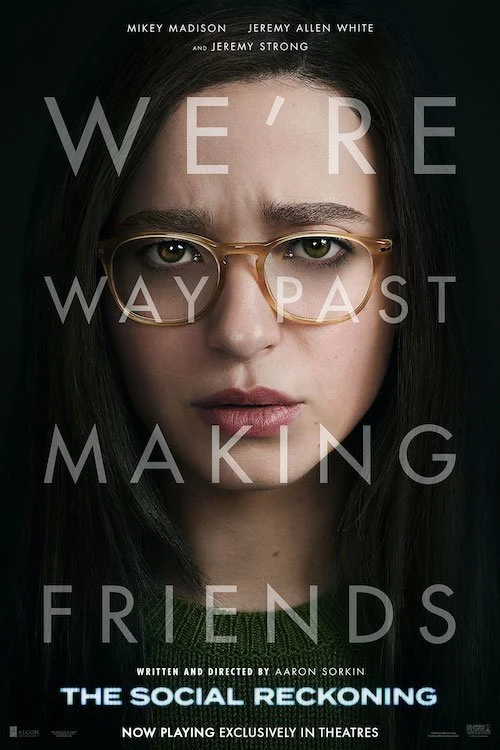

The inevitable curse of making a sequel to a beloved film is that you cannot help but reflect on the predecessor in almost every way. Yes, it makes sense why Aaron Sorkin wanted to revisit the life and times of billionaire cretin Mark Zuckerberg after the success of David Fincher’s The Social Network. Fincher’s film — which is his masterpiece — is one of the great depictions of human inter-connectivity in the digital age (and the lack thereof, despite the world having been figuratively shrunken down to the size of a pea). A major reason why is how whip-smart Sorkin’s screenplay is (he was also operating at his very best). Sorkin took the rapid fire dialogue of the tech world and made it into near-visual brilliance. His characters were flawed but natural. He blended legalese and academic rambling into an ongoing stream of intellectualism that literally anyone could understood (not only could you keep up with Zuckerberg’s legal battles, you could also stay afloat with the insane speed of Sorkin’s screenplay). There are many reasons why The Social Network became an instant classic, from Jesse Eisenberg’s layered performance to the groundbreaking score by Trent Reznor and Atticus Ross (which now feels like a launch point for the wave of cinematic music to come, but this score was a revelation upon its release). However, much of these strengths stemmed from the excellent foundation that Sorkin laid out. He has been considered one of the great screenwriters for a reason.
However, where he excels in screenwriting, he flounders as a director. I have said time and time again that Sorkin is not the best filmmaker, and this is only proven by the steady decline in the quality of his films (where even his greatest works — Molly’s Game and The Trial of the Chicago 7 — are a little overly sentimental and rudimentary in tone). I have noticed that Sorkin’s writing is more successful when he is challenging directors to work with his rampaging dialogue and dizzying vision, but — for some reason — when he deals with his own scripture, Sorkin operates with an extreme amount of safety and precaution; if Sorkin encourages filmmakers to push themselves, it paradoxically feels like he is crippling his own writing when he is the sole director. It is a strange phenomenon that has happened too many times for it to be a coincidence at this point. This brings us back to The Social Reckoning: a journalist, legal drama that spins its wheels in place for an hour and a half before it begins to finally make traction in its final act. Where The Social Network was a unified experience where everything gelled together, The Social Reckoning is part Spotlight and part overly-theatrical biopic that feels more in line with Bohemian Rhapsody (to the point that it almost feels satirical). The former elements are quite good — even though Sorkin’s bread-and-butter (his walk-and-talk dialogue) feels a little tired and not as spunky as it typically is (his signature writing is exciting even at its worst). However, the latter sequences are distracting, and are a considerable low point in Sorkin’s career.
The Social Reckoning is two storylines happening at once. First, there’s the better of the two: the slow-burn calculations of how Frances Haugen and Jeff Horwitz will blow the whistle on Facebook and its nefarious, unethical practices. Haugen is played by Academy Award winner Mikey Madison in the film’s strongest performance. Madison — who is different in every film she tackles — is an anxious introvert with constant ticks and vocal quivers here. Haugen is a former engineer who loves working for Facebook (she says so often, to the point that her frequency is even brought up in the final act); however, there is something about her job that is bothering her. So, she turns to reporter Horwitz of Wall Street Journal. He is played by Emmy darling Jeremy Allen White, who is quite good (but I also feel like he is given less to work with than Haugen, so White is only so good when we know that he is capable of far more). The primary issue with this storyline is that we already know a bulk of the revelations being made here about Facebook and Meta; Sorkin’s pacing of these revelations doesn’t help since he lays everything out steadily and over the course of three quarters of the film. This makes us feel like we aren’t going anywhere for the most part. Most journalist films are handling the same problem: telling us what we are already aware of. However, it is the responsibility of these kinds of films for telling us how this information was obtained, and what else the general public may not know. The Social Reckoning saves the majority of these hardest punches for its final half hour, but it feels like there is too little too late at this point.
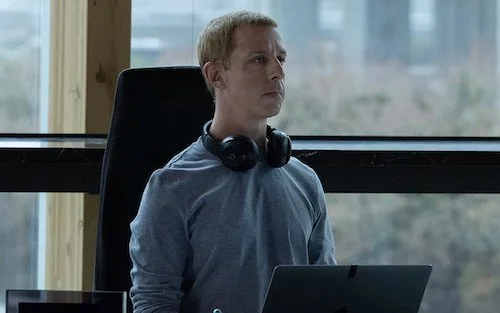
The Social Reckoning never reaches the highs that it sets out for itself (or the bar set by its predecessor, The Social Network).
Then, there is the weaker storyline: Mark Zuckerberg’s court testimonies (encompassing the mogul’s constant appearances in court). When The Social Network first dropped, many weren’t sure of how to feel about Zuckerberg, and his portrayal in the film felt unnecessarily harsh (boy, were we naive). In 2026, I think it’s safe to say that most people cannot stand this man or what he stands for (whatever the fuck that means, given his sole allegiance to whoever can get him more money). Going with an Eisenberg-type performance would have felt off due to what we know now, but at least it would have been in line with what we have already seen in another cinematic version of the tech figure. Then, there’s Jeremy Strong’s take on Zuckerberg, which feels like a breathtaking, clone-like depiction for two seconds before it swiftly reveals itself as an extreme caricature that feels impossibly distracting. When you have a film with more down-to-earth, intrinsic performances like Madison’s and White’s, you cannot suddenly toss in the equivalent of Peter Sellers in Dr. Strangelove. It does not work. Strong — who is taking this role quite seriously (almost too much so) — comes off as a farce here: like an animatronic exhibition at Disney World’s Epcot park who is trying to have a discussion about global ethics. It doesn’t help that these sequences also feel like the worst elements of Sorkin’s sugary direction so they come off as clunky, as if they are pale imitations of his usually sharp style. You know how many writers have tried to be Sorkin and have failed? Well, the Zuckerberg sequences feel like Sorkin ripping off his rip-offs. It sadly also isn’t as entertaining as it sounds. I also do not blame Strong for this awkwardness as much as I put the onus on Sorkin for not recognizing how poorly this performance “fits’ in the film; would you watch Ernie from Sesame Street in 12 Angry Men and think that it was a match, too?
There are still some bright spots throughout this film. I think most of the scenes with Madison and White keep me interested enough (even if it feels like the film isn’t making as much ground as it would like). There are also some surprise appearances, like Wunmi Mosaku (who was just Oscar nominated for Sinners last year) who makes the Zuckerberg-fuckerberg moments feel a little bit more rooted in reality. However, the longer I have been a film critic, the more aware of what is happening at this present moment. Once I start pointing out all of the things that worked, I am either describing a near-perfect motion picture with too much to gush over, or I am trying to soften the blow of a film that didn’t work for me. I could keep going with the pleasant cinematography by Jeff Cronenweth (the only additional person carried over from The Social Network alongside Sorkin), or how strong Sorkin’s writing is in the film’s final act compared to the rest of the film, but — again — I am just rattling off additional things to try and tell myself that The Social Reckoning is not an awful film. That is true: it just isn’t a good one, either. It is too tonally inconsistent between its two natures for it to ever feel like a solid effort; if anything, it feels like the sensation of doomscrolling while paying only half attention to a film that you are watching (which feels indicative of the social media era), so mission slightly accomplished?
On the note of social media, my final complaint is how The Social Reckoning feels like old news. Yes, we are aware of the unfavourable allegiances companies like Facebook have made in recent memory, and how these platforms have negatively affected things from elections to sociopolitical causes. However, social media has been far more damning and damaging than the couple of ways that The Social Reckoning brings up. What about the many other forms of fake news outside of biases? The corrosive effects social media has had on mental health and the youth of today? The killing of businesses and industries? The threats to many forms of personal and global security? The spread of AI and deepfakes to an uncontrollable degree? While The Social Reckoning deals with some of these subjects to a marginal degree, it could have touched upon them far more. Instead, it fixates on a moment in time to scrutinize what transpired from Haugen’s revelation; I am depressed to say that much has transpired since. Where The Social Network opened our minds and invited us to discuss, The Social Reckoning reiterates much of what we are already experiencing (but on a far worse level now). Yes, Haugen’s whistleblowing was important, but Facebook has not slowed down since, and I wish Sorkin recognized the true horror at hand here: that you can no longer stop this machine. You can just bring awareness to its monstrosities. I don’t think The Social Reckoning enlightened us on the crucial details in between the headlines; it instead feels like a sequel to The Social Network that had to exist just because. Unlike many pointless sequels, I would argue that there was a need to follow up The Social Network because of the many injustices and concerns that have taken place since the Fincher-Sorkin exposition. The Social Reckoning is not what it could have been or should have been. It exists because it was expected to, and that’s basically it.


Andreas Babiolakis has a Masters degree in Film and Photography Preservation and Collections Management from Toronto Metropolitan University, as well as a Bachelors degree in Cinema Studies from York University. His favourite times of year are the Criterion Collection flash sales and the annual Toronto International Film Festival.