
Sound of Falling
Written by Andreas Babiolakis
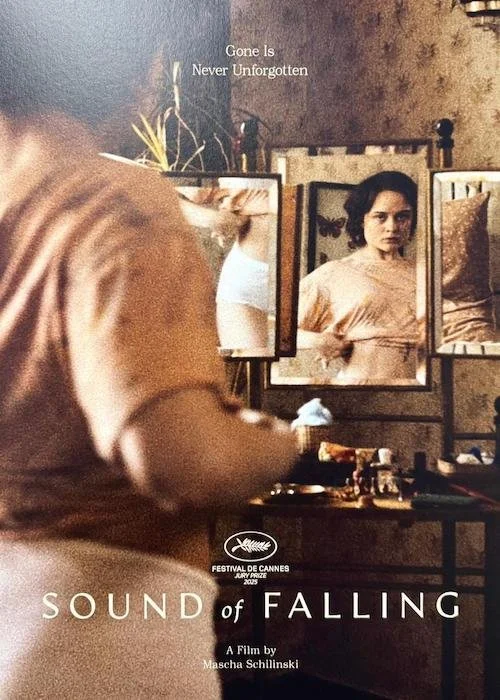



The weight of history cannot be ignored. When the stench of misogyny can be felt throughout the centuries of civilization, both the lasting impact of trauma and the recognition of the forms of abuse of yesteryear are highly present; sadly, to the degree that they are the present. Oftentimes, bigotry never goes away; it disguises itself in hiding and waits for the first opportunity to spring out and fester once more; look at the high number of older, problematic concepts that are returning these past few years. German director Mascha Schilinski's breakthrough film, Sound of Falling, cleverly portrays the permanence of trauma in both historical and personal contexts by staging four stories of different women and time periods within the same setting. These stories weave in and out of each other, making them often feel difficult to differentiate from one another (yes, even with the obvious cues like the time-appropriate costumes and props). This feels like a constant force of mystery that leads to a parade of anguish; as if Schilinski stumbled upon a bottle that contained the ghosts of various girls who have been wronged and uncorked it to unleash all of their memories out at once.
What is the "sound" of falling? This is an action, and any sounds come from what surrounds falling, including an elicited scream, the noise of impact, and any other audible affiliations. To me, there are two possible explanations that Schilinski had in mind with this title. First, there is the collective sounds attached to this weightless feeling of free-falling: we watch a century of neglect, sexism, and abuse all happen at once, and we are suspended in the air and unable to find our footing throughout this motion picture; one of the final images of the film is a jaw-dropping image of such a feeling of floating, but not in the free sense (rather, against one's control) — this is a level of helplessness that is difficult to put into images, but Schilinski succeeds here. Then, there is the idea of a built wall of oppression being knocked down; one of the first things we see in the 2020s storyline is portions of the central farmhouse being knocked down with a sledgehammer. This is a striking image that heavily indicates the catharsis surrounding the dismantling of cemented hatred so the next generation can live at least a little more freely than you and your ancestors have. The main thing is that the rates and sounds of these different types of falling are starkly different; the liberation is loud and quick to the point that the following silence feels almost like an open world ahead, whereas the remainder of the film is stretched out, strenuous, and full of despair. This renovation was a plot point in the 2020s storyline, but it was a desire that our other protagonists had — and never experienced — for their entire lives. There is a more blatant reason why this film is called Sound of Falling, but I will not spoil this additional example.
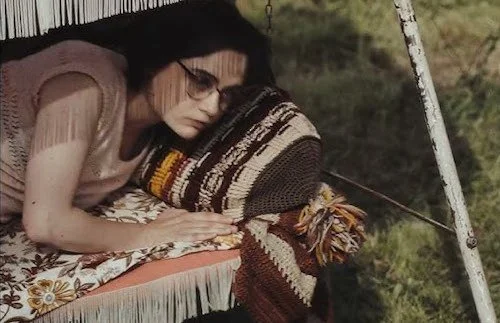
Sound of Falling is an ambient-yet-punishing collage of generational pain.
As stated, the entire film circles around the same farmhouse that is passed down from generation to generation; it’s as if the history of our characters is stored in the walls of this structure just begging to be heard (and so we hear their stories all at once, as if we are seeing blemishes in crevices or stains on the floor from what happened before). In chronological order, the first of four stories is that of young Alma who has a tumultuous life while living on a farm (I'd argue that this acts as the most central and substantive narrative of the quadrilogy that ripples into the three other works); this takes place in the 1910s. Her older brother is Fritz, whose daughters, Erika and Irm, are featured in the next story that takes place in the 1940s. Irm's daughter, Angelika, steers the third story set in the 1980s, and it is Angelika's daughter, Lenka, who is featured in the 2020s and who is seen renovating that very farmhouse that has been there the whole time. While much of the misogyny is subdued for a few of these stories (it is the most blatant in Alma's), you feel this damage represented in symbolic form, like eerie images, pensive coincidences, or poetic punches. There is this ghostly act of our leading girls and women being linked with the dead throughout Sound of Falling (like characters being drawn to the same place out of habit, or actions mirroring those that came before); much of it feels cryptic to the point that you will begin to second guess what you have already seen.
The entire film feels like a tightly-knit tapestry not just in its narrative identity but as a work inspired by the likes of Andrei Tarkovsky (The Mirror), Michael Haneke (White Ribbon), and Béla Tarr (The Turin Horse). These are all inquisitive, crawling looks at distress in ways that only arthouse cinema can depict: with haunting apparitions that drill their way into your soul. Much of Sound of Falling will not reveal itself to you right away, and some segments may not make blatant sense for a while after you complete the film, but all of it will be instantly coherent on a visceral level, as if you cannot recollect a specific memory but you can identify the feeling of said memory as it is ingrained into your being. For me, Sound of Falling is far more simplistic on an abstract level; if you follow the film and how it feels, it will make perfect sense on that first watch. The finer details — the metaphysical take on generational hurt, the motifs that conjoin our characters in a unified experience, the absence of themes to make them ring even more loudly — will percolate in your mind upon the continuous reflection that I guarantee you will have after watching Sound of Falling.
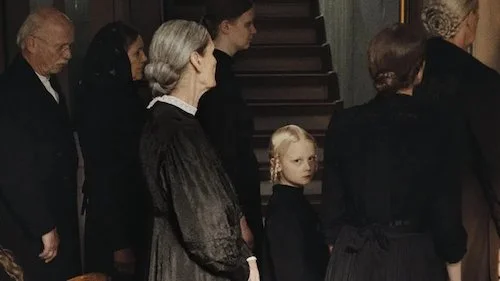
As heavy as Sound of Falling gets, it is made with the message that the world around us is beautiful (captured by how gorgeous the film is); it is what happens within it that spoils the bigger picture.
One of my favourite albums of all time is Lift Your Skinny Fists like Antennas to Heaven by Canadian post-rock giants Godspeed You! Black Emperor. The final song on that album never fails to get me teary eyed. Appropriately titled "Like Antennas to Heaven...", the conclusionary track begins with noisy feedback and two nostalgic recordings; the first being band member Mike Moya performing a folk song ("Baby-O"), and the second being the sounds of children playing and singing amongst themselves. Surrounding these snippets of life are drones that beckons dread. Sure, we can reflect on the good times of the past, but — like the drone insinuates — that time between then and now is gone. Fperseverancea bittersweet thing, to remember. We feel that rush of once was, only to remember that much has happened since. Sound of Falling feels like the reverse answer to a musical moment like this. With all of the stunning images and the collages of sound, the film feels like a blurred collection of concepts like a daydream. Instead of yearning for the past, we fear it here. We also remember our comfort in the present. Needless to say, that same spine-chilling realization of time as an unforgiving curse sets in. Whereas Godspeed You! Black Emperor was capturing the loss of innocence and the suffocation of existentialism at the hands of political malfeasance, Sound of Falling is a reminder of how much history, time, and identity has been sacrificed by atrocity. How many lives have been cost at the hands of bigots. How many women lost everything against their will; how many women never had a chance to begin with. Nostalgia is to reflect on what we loved and request it again. In Sound of Falling, much of the reflection is the reminder of how there wasn't much to embrace without being hurt for these characters.
Two things help make up our identity: memory and family. If we lose all of our thoughts or our concept of piecing together our memories, how do we know who we are? If we lose contact with our family, or if we begin to lose our family members, the threat of us being the last representative of millennia of generations comes closer and closer. There is a lot of pressure just being alive because of what came before us (and how much of what is to come we will desire to cling on to, as well as the memories we will likely wish we could shed in that same breath). Sound of Falling is the unfathomable weight of being a part of this bigger picture: the generations of a family who deal with both similar and different dreads. In that same breath, Schilinski has crafted such a beautiful film that makes life feel extraordinary and worth fighting for. The cinematography glows like a throbbing heart underneath the bones of steel necessary to close off said heart from the rest of the world. The story fragments snuggly fit into one another as if they are there to console one another so each event doesn't feel alone in its pain. These desperate vignettes are told with patience, care, and love despite what happens within them. Life is gorgeous; it is the lives within it that cry out for help. Schilinski shows us both sides in her cinematic act of perseverance known as Sound of Falling: a film I hope won't go unnoticed this awards season.


Andreas Babiolakis has a Masters degree in Film and Photography Preservation and Collections Management from Toronto Metropolitan University, as well as a Bachelors degree in Cinema Studies from York University. His favourite times of year are the Criterion Collection flash sales and the annual Toronto International Film Festival.