
The Lost Bus
Written by Andreas Babiolakis
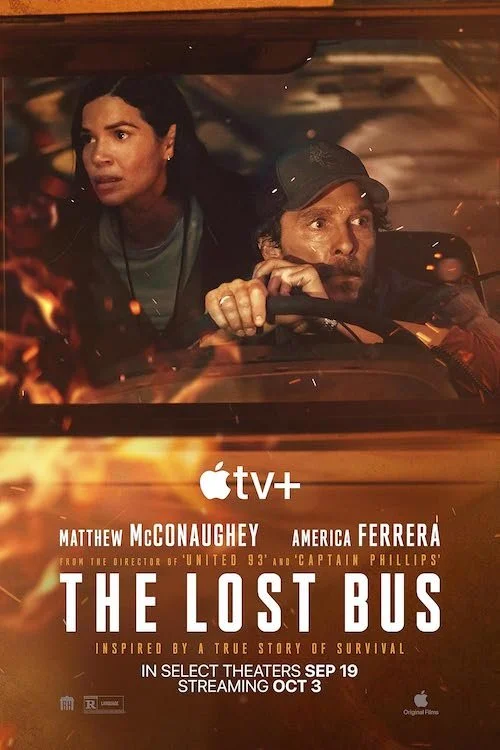


Paul Greengrass is no stranger to making heartfelt disaster or crisis films: they don’t go quite as far as massive-scaled pictures that make you feel like there is no getting out of this scenario because he prefers to make you feel like you can see the light during the events he poses. These include Bloody Sunday, Flight 93, and Captain Phillips. He’s back with The Lost Bus which is another such film that is rooted in a true story and the sociopolitical themes that come with it. Based on the real efforts of bus driver Kevin McKay who saved students and teachers during the 2018 fires in California, The Lost Bus takes a moment of contemporary American history and emphasizes the severity of it and how climate change was its catalyst. I hope not to come off as a sourpuss when I say that not every story can be made into a film, even if they are exciting or show such promise. What McKay accomplished is extraordinary, with dozens of lives saved and futures spared. I think a documentary of this story would have been special. The Lost Bus tries its best to make this story into a feature film, and Greengrass’ efforts seem to meander and stall.
McKay is played by the always charming Matthew McConaughey, who knows when to turn on his dramatic chops precisely when needed; he does not disappoint here. Alongside him is America Ferrera, who I think has been long overdue a nice dramatic role like this one; she plays teacher Mary Ludwig (allegedly, there was another teacher in the real event who did not want their likeness used in this film). It doesn’t take long for the film’s premise to kick into action, (with Ludwig and her students noticing the wildfires from afar) and much of The Lost Bus becomes a set of strategic moves to navigate the flames and save lives. Part of The Lost Bus’ pacing issues is that Greengrass felt the need to balloon this story to over two hours in length, causing much of the action or suspense to feel drawn out as opposed to enticing. He has done such a thing before; I will never forget how gripping the start and end of Captain Phillips felt when I watched it, but the middle felt prolonged for the sake of making the film feel more like an epic than a reasonably-lengthed motion picture. This tendency returns here.
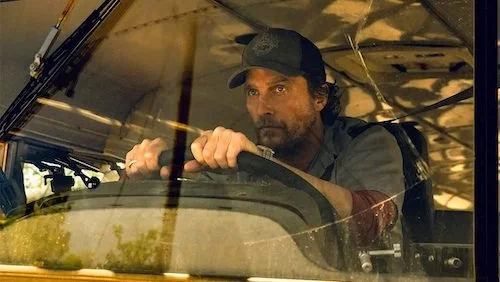
The Lost Bus is a powerful story stretched out to the point of thinning.
In that same breath, some of the padding Greengrass does is beneficial. Being able to see McKay’s personal life (played by actual members of McConaughey’s family, including his mother and son) adds context to who is looking forward to him coming out of this inferno alive. It elevates the notion that this is an everyday man who became a hero for his efforts. Ludwig gets a similar spotlight, especially as a teacher who put her life at risk to help her young students. The Lost Bus is better for these backstories, and Greengrass excels at the humanization of his real subjects once again. I feel like he can get carried away with trying to champion these people as mythological beings with his elongated stories; are the noble deeds of his subjects not enough for us to know that these people are extraordinary? The Lost Bus doesn’t come to a complete crawl, but it does slow down enough to feel like it is playing it safe when I feel like Greengrass isn’t trying to with his larger-than-life films. There’s enough juice here that Greengrass celebrates his everyday champions effectively, but I also feel like enough of The Lost Bus’ stalling feels like there was a clear effort to make this a blockbuster-esque film when it could have been a tremendous short, featurette, or, better yet, documentary.


Andreas Babiolakis has a Masters degree in Film and Photography Preservation and Collections Management from Toronto Metropolitan University, as well as a Bachelors degree in Cinema Studies from York University. His favourite times of year are the Criterion Collection flash sales and the annual Toronto International Film Festival.