
The Ugly Stepsister
Written by Andreas Babiolakis
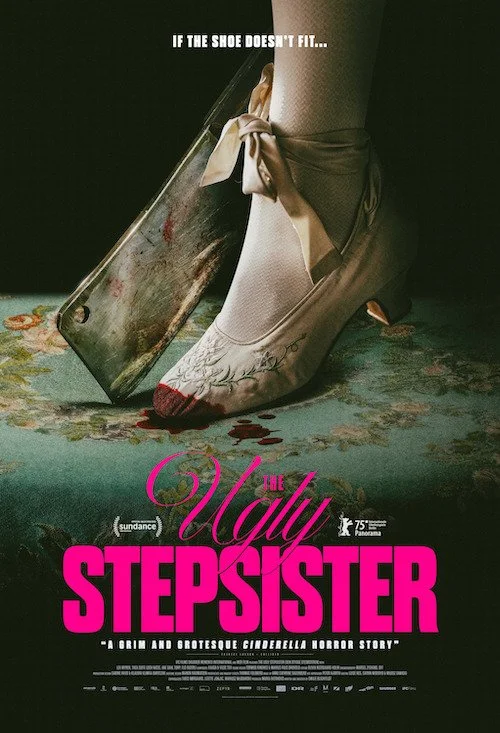

Emilie Blichfeldt has become the next member of the contemporary women auteurs who are leaving their mark on horror and thriller cinema, including Coralie Fargeat, Julia Ducournau, and Justine Triet. I’m not saying that The Ugly Stepsister is as good as the best work of these aforementioned ladies, but Blichfeldt’s feature film debut is one hell of a good start (and I hope that the following this film has amassed can lead her to an even greater project with a bigger budget). Blichfeldt’s film, The Ugly Stepsister, reminds me a little bit of what Emerald Fennell strives for with her films: feminist ideologies that rewrite what a genre film can be. Blichfeldt has adapted Cinderella for the umpteenth time, but this stab at the tale by the brothers Grimm is quite different to the point that you may rejoice. You know how modern takes — especially the animated Disney classic — resort to Cinderella’s stepsisters as hideous girls who are driven by jealousy and spite. Blichfeldt’s film takes this notion and has the sisters pining for affection and attention to the point of self destruction, particularly the title character named Elvira (Lea Myren).
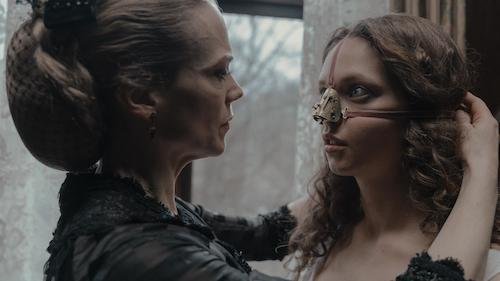
Elvira and Alma (Flo Fagerli) share a widowed mother, Rebekka (Ane Dahl Torp). Rebekka marries Otto (Ralph Carlsson), and he and his daughter, Agnes (Thea Sofie Loch Næss) are welcomed into the family. It doesn’t take long for Otto to pass, and for Rebekka to take on Agnes as her own daughter. It becomes clear that Agnes is who most of us modern folk would recognize as Cinderella, and she is prized as the perfect child. When Prince Julian (Isac Calmroth) is to attend the local ball and pick a young virgin to be his wife, Rebekka wants to use this opportunity to rid the family of poverty. She wants Elvira to marry Julian, but Rebekka deems her daughter unworthy and, thus, someone in need of fixing. Thus begins the transformation, and I don’t mean in a pleasant My Fair Lady kind of way. Elvira is quickly put into awful predicaments, including having her teeth drastically worked on and a file slammed into the bridge of her nose. This is only the start of Elvira’s horror story, and her sacrifice is Blichfeldt’s opportunity to reinforce her statement on superficial and ludicrous beauty standards and what they do to girls and women.
The Ugly Stepsister is a fresh — albeit twisted — take on an old tale for modern audiences; its unapologetic nature bodes well for Emilie Blichfeldt’s future as a storyteller.
The Ugly Stepsister keeps going further and further to the point of being hilariously hyperbolic (albeit in a bleak sense). Poor Elvira’s predicament worsens to such an extreme that the ending becomes a Cronenbergian body-horror bonanza. We feel every ounce of her pain and know the ridiculousness of what she has endured is at the hands of others. If we ever laugh, it’s out of shock and discomfort, not because we find her predicament actually funny. That is Blichfeldt’s plan: to take a fairy tale that we know like the back of our hand and recontextualize it to the point that it is no longer familiar. Maybe that’s the point. We have excused a number of dated ideas because they were featured in an old story. Blichfeldt is here to create new lore to combat old fashioned nonsense, and I am all for it. Her film is pretty with its pastel colours and filmic haze, but it never loses sight of its message with some of the finest (and most stomach-churning) special effects makeup work of 2025; your hair will stand on end watching what transpires. If this is as assured as Emilie Blichfeldt is now, I cannot wait to see what she crafts when she is motivated by the success of a film as daring and startling as The Ugly Stepsister; this is a bright — and gruesome — beginning for her.


Andreas Babiolakis has a Masters degree in Film and Photography Preservation and Collections Management from Toronto Metropolitan University, as well as a Bachelors degree in Cinema Studies from York University. His favourite times of year are the Criterion Collection flash sales and the annual Toronto International Film Festival.