
The Testament of Ann Lee
Written by Andreas Babiolakis
Warning: This review is for The Testament of Ann Lee, which is a film presented at the 2025 Toronto International Film Festival. There may be slight spoilers present. Reader discretion is advised.
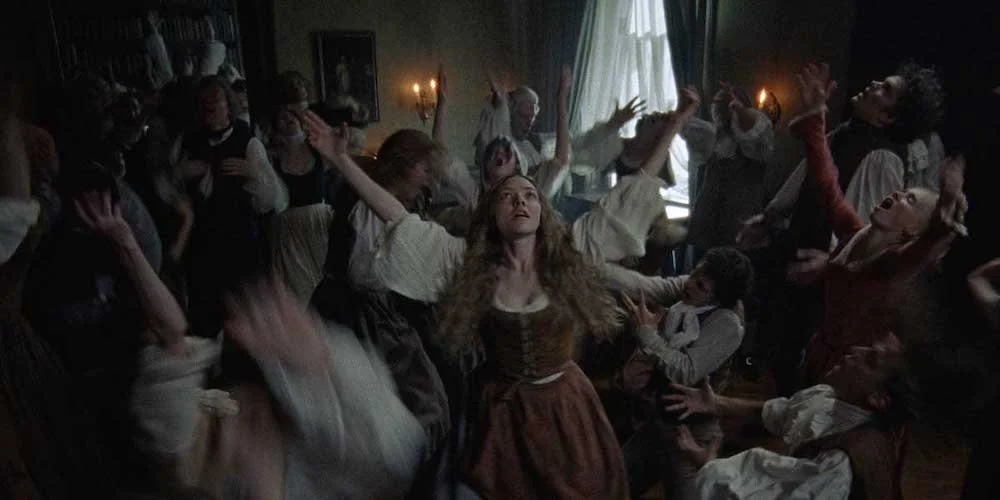
Image courtesy of the Toronto International film Festival.


Mona Fastvold and Brady Corbet have become strong descriptors of the inexplicable paradoxes within American history. Corbet’s Vox Lux points out the hypocrisies of using popular music as a method of healing when it preys on the vulnerability and trauma of a pop star. The Brutalist chases after the American Dream, only for our immigrant protagonist to find that he is not welcome (even if his mastery remains and withstands the test of time). Now comes The Testament of Ann Lee, which, unlike the other two films, is based on a real figure: the founder of the United Society of Believers in Christ's Second Appearing from the late 1700s. Seeing as Corbet worked on the former two films but both he and partner Fastvold co-wrote all of the above, The Testament of Ann Lee is directed by Fastvold but the unifying themes of a complicated America can be found here as well. If Corbet gets swept away by the pounding psychology of his films, Fastvold is far more interested in how the history of her films read, as if we are engrossed by a tome in the middle of the quietest library. Her previous film, The World to Come (not written by her or Corbet, but still fascinated by the depth of America), is akin to discovering the letters written by a damaged soul who needed to get their thoughts out to someone. Fastvold has a gift for placing us within the mindset of both the writer and the reader.
Such is the case with The Testament of Ann Lee: a spellbinding and anomalous history lesson. It is rare for a film to depict the mindset of a believer and the gaze of the outsider at precisely the same time throughout the entire film. It is empathetic to its subjects while also being able to frame the insanity of what we see; the film studies Ann Lee and her following, but it does not judge them. If anything, the film joins in on the ceremonies. The Testament of Ann Lee is partially a musical: an audacious choice that could have sunk this ship before it even took off. Fastvold is clever with how she utilizes songs and music in her film, ensuring that no song overstays their welcome and that the entire film has a pulse (and it comes in the form of Daniel Blumberg’s unabated, shrieking, pummeling score; an audible highlight of 2025). The Testament of Ann Lee feels like a full-on sermon, stuffed with hymns and chants throughout the gospel according to Ann and her disciples. From the very start, you are met with illustrations and a broken fourth wall where we are effectively told what we are about to watch. You get yourself strapped in, and The Testament of Ann Lee never slows down right to the very last image (acceptance that everything is as it should be, before you are ushered out of the film).
The story is quite unbelievable, especially through the eyes of Ann Lee. Ann is born into the Society of Friends (a denomination of the Quakers movement) and was one of eight children in her family, who was destitute and could not afford proper education. She couldn’t read or write, and was ridden of her rights and freedoms as a woman, condemned to serving whichever man she would marry. She was beaten continuously. We quickly cut to an older Ann (Amanda Seyfried) who undergoes numerous tribulations that I won’t spoil here; all I know is that Seyfried is so committed to this role that tears welled up in my eyes for much of this opening chapter (the film is divided into three acts). I was watching a woman surviving absolute horrors, all in the name of what was expected of housewives. She never wavers on her faith; if anything, she only feels closer to God. During one of her darkest hours of her young adult life, Ann envisions a connection with Jesus Christ: as if she is one with Him. She speaks about her prophesy with her immediate and religious families; thus, the Ann Lee version of the Shakers movement was born.
The Shakers are a Christian following who tremble, convulse, wail, and, essentially, shake while they pray and worship, as if they can feel the power of God throughout their whole bodies. The Testament of Ann Lee matches the continuous movement of Ann and her followers with Blumberg’s score, inviting us to feel what we see, as ridiculous as it may ever be. The film makes no mistake about how nonsensical all of this may seem to us by getting its absurdity out of the way as early as possible; my press screening of this film had a couple of very early walkouts, but the rest of us were in for the long run (the viewer is basically given a warning as to what the entire film will be like before it gets even more intense). I’m sure the response to The Testament of Ann Lee will continue to be at least slightly polarizing as it gets released in more theatres, but take this as an incentive to see a film that is far from orthodox; it is always better to see a daring film that may not succeed in your eyes than a safe film that hasn’t changed or provoked you in any way.
The film progresses and we see the church travel across the Atlantic Ocean to settle in America and spread the word of Ann, where she is treated like a blaspheming witch. While this response doesn’t come as a shock to most viewers, I found myself wrapped up in Ann’s quest throughout the film. Despite her obvious delusions, there was merit to her agency, including her efforts to elevate women from being more than sex objects, child bearers, and servants; this hope for equality leaked into Ann’s dismissal of slavery in America. It’s easy to root for Ann without having to buy into the frenzied levels of worship that she and her peers experience. You can also choose to reject what religion can bring to society while also understanding and sympathizing with Ann and what she feels is the best course of action for herself, her family, and society as a whole. Since the film provides enough of a distance between you and itself, you are welcome to remain on the outside as a thinker while being enraptured by the aesthetic experience.
Shot and presented on 70mm (like The Brutalist), The Testament of Ann Lee is a stunning film that feels like a soul being awakened. The leveled-out shadows and lighting make each image feel sleek, with rays cracking out of the darkness like the sun piercing through drapes, or like purity breaking through sin. I cannot emphasize how beautiful this film is, with immaculate mise-en-scene, pulpy colours, and tasteful effects (there are certainly slight uses of fish-eyed lenses that never overstay their welcome). There are sequences where a flurry of gorgeous images hit us like a fever dream, clearly depicting Ann’s visions as if they were our own; they don’t last long enough for us to make the most sense of them, but we understand Ann trying to decipher them as Christ’s lessons. Towards the end of The Testament of Ann Lee, we see Ann’s mind wander a little bit, revealing that either she is privy to the unreliability of her foresight or that she has lost her ability (but is getting closer to those on the other side). We console her again instead of mock her, especially in her worst moments.
The Brutalist is a dance between maximalism and minimalism; The Testament of Ann Lee feels more like a cleaner blend of both styles to the point of poignant-yet-sublime filmmaking. The entire film feels like a rush that never eases up: as if you are speeding through life, history, and circumstance. There is an undeniable fire bursting throughout the film that feels like the culture and faith of a movement being kept alive. Now, you may not be happy with what has resulted from such a religion in the years to come (neither am I), but there’s something to feeling the resonance from the source in the way that it is displayed in The Testament of Ann Lee. This film isn’t what you believe: it simply professes what Ann believes. It may seem ridiculous to you, but being able to feel what Ann felt despite what you believe is quite the feat that the film achieves: you are welcome to see and feel her light without having to become a convert. Seeing the connection the film makes with how women have been treated throughout history creates further staying power; if you don’t care about Ann Lee’s faith, at least watch the film for its feminism.


Andreas Babiolakis has a Masters degree in Film and Photography Preservation and Collections Management from Ryerson University, as well as a Bachelors degree in Cinema Studies from York University. His favourite times of year are the Criterion Collection flash sales and the annual Toronto International Film Festival.