
Hamnet
Written by Andreas Babiolakis
Warning: This review is for Hamnet, which is a film presented at the 2025 Toronto International Film Festival. There may be slight spoilers present. Reader discretion is advised.
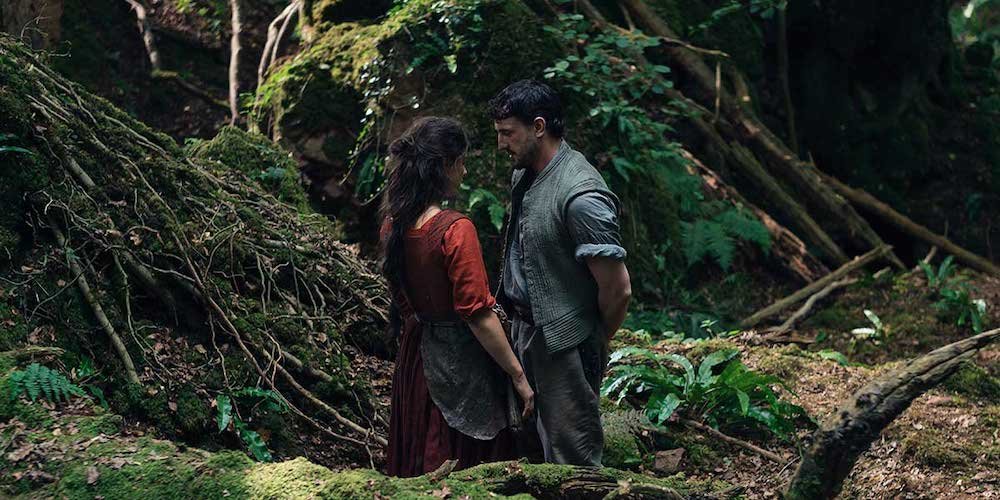
Image courtesy of the Toronto International film Festival.



Warning: This review deals with the topic of loss, specifically the loss of a child. Reader discretion is advised.
When Nomadland won Best Picture at the Academy Awards, it felt like a win for everyday people: it was a film that contextualized the nomadic experience and brought the spotlight to humans who were never deemed superstars in the eyes of Hollywood. Director Chloé Zhao was an emerging voice of the American horizon: a champion of the unheard citizens of the nation. Her followup, Eternals, was a clear deviation from her norm. The Marvel release felt like a paradoxical clashing of Zhao’s focus on distanced poetry and the studio’s obsession with marketability; the amalgamation did not work. Eternals doesn’t feel like a true successor to Nomadland despite being Zhao’s most watched film. The film simply was not honest with her style and contingent with her vision. I awaited the day when the true Nomadland followup commenced. When Hamnet was announced, part of me was slightly apprehensive considering that Zhao wasn’t making a film about America again. This depiction of William Shakespeare and Anne Hathaway’s marriage obviously takes place in England. However, Zhao’s themes here are universal, and there’s something American in how atypical Hamnet feels to the Hollywood experience with its hyper focus on raw emotions.
William (Paul Mescal) is almost never referred to by name, and the name “William Shakespeare” appears just once towards the final act. The film focuses on he and his wife as regular people so that their family dynamic and the film’s central tragedy aren’t just an anecdote in an iconic life. Based on the fictional novel of the same name by Maggie O'Farrell, Hamnet places us in the home of a couple who fall in love, start a family, and ultimately deal with loss. I understand that the premise of the film is based on the latter fact (and the name of the film doesn’t shy away from that), but I will note that it happens quite a ways into the film, and so discussing the main plot of Hamnet is to give away much of the film, hence my vagueness. That is my only gripe: that I cannot describe every single inch of Hamnet and not spoil what is an incredible film. I will note that — like the novel — Hamnet is more of an interpretation of William and Anne’s relationship and family more than a factual recount, in the way that Amadeus is more invested in the dark mindset of Antonio Salieri than the actuality of Wolfgang Mozart’s life and death. Hamnet acts as the soul of William and Anne’s marriage, as well as the fractured pieces barely being held together.
While William Shakespeare acts as a reference point for viewers, Anne (Jessie Buckley) is the true protagonist of Hamnet, given that much of the film is from her perspective (especially when William ventures to London and Stratford for many months and she is to tend to her kids at home). Referred to by the name Agnes (what is listed in her father’s will, which means that Anne may have potentially been a shortened nickname used by loved ones) throughout the film, she vows to take care of the family when William is gone even at her own behest. When giving birth to her twins, Hamnet and Judith, the latter child almost didn’t survive; Agnes coddles Judith to ensure that no harm comes her way (this stems from Agnes’ own traumas). Meanwhile, Hamnet was told to be the man of the house by his father: a responsibility that weighs heavily on the child’s shoulders. Zhao sets up a layered family dynamic that is far more contextual than one that includes a father, a mother, siblings, and nothing more. This is a machine with changing parts that must keep running. We see how any missing piece can cause the machine to break down.
When they first fall in love, William tells Agnes about the Greek myth about Orpheus and Eurydice, where the former aims to rescue the latter from the depths of Hades on one condition: Orpheus cannot look back to see if Eurydice is still behind him, or else she will be locked in Hades forever. At the edge of Hades’ gate, Orpheus excitedly looks back at Eurydice and accidentally condemns her to Hades. This is a theme that is prevalent in Hamnet. We see many doorways and understand that these are points of no return (a vision of Hamnet walking towards an endless door is used a handful of times). We hear William and Agnes ask to be looked at (even if this tempts fate). We understand that a loved one can be snapped away from us at any given moment, and all we can do is look back at where they once stood and know that there is this void now. Even if we never get a complete recreation of this myth, I prefer what we have instead: a festering reminder of this myth’s existence in the form of people who are terrified of it. Their lives are controlled by this fear: one of which actually comes true. Even if we know this is inevitable, we are never prepared enough to face death (with ourselves or others).
Zhao works as a head editor on this film as she has done in the past, but here her efforts are immeasurable with what she accomplishes with the passage of time and the weight of empty spaces. Alongside her is cinematographer Łukasz Żal (known for his sensational work in films like Cold War and The Zone of Interest), who paints a picture very much like Andrew Wyeth’s Christina’s World: one of sepia warmth and the finest details of nature, but an alluring hesitation between a fallen figure and the world she once knew that now engulfs her. Then there is composer Max Richter and his score that runs deep in the veins of the film. It always throbs. It always runs. You sometimes feel it like a stoppage of breath or a rush of adrenaline. Together, these elements create a sombre tapestry of a family that was always driven by dread amidst love, and a future that feels impossible.
The most obvious trope of Hamlet, Shakespeare’s iconic play, is the “To be, or not to be” monologue: one that is so over used that those who will never read his work will know it. Hamnet savours this monologue for when it is absolutely necessary, and the concept of staying alive is vital; this re-instills the gravity of the monologue that has been removed by half-baked renditions. Richter has a similar moment when his frequently played masterwork, “On the Nature of Daylight”, is used for a pivotal sequence. It is his “To be, or not to be”. It is his signature song. It gets reclaimed in one of the most powerful scenes in any film of 2025: one that acts as a major release in a film full of pent up anguish and sadness. All of the pressure steams out of us, and we sob. My screening was full of stifled sniffs and the occasional gasp made wet by clogged sinuses; you can almost hear all of the tears being shed. Zhao unlocked the universal language of empathy in a way that never feels insincere or unearned.
Hamnet ties together many concepts found in the alleged life of William and Agnes Shakespeare in ways that make Hamlet the truest tragedy — one that is indicative of both parent’s complete version of pain. They met in a forest, and a forest is where Hamlet begins. The main character is a young boy who is now an adult who says all of the things William and Agnes needed to hear. The ghost that haunts Hamlet is played by William on the stage (perhaps a statement that William would have wanted to go in place of his son). At first, Agnes doesn’t see Hamlet as the breakthrough that will save their family financially or fill the void within their souls: she sees a betrayal. As the play proceeds, her eyes widen. She laughs. She sees her son again. She finds comfort in art. Her final response is a stunning image where she connects with her loved one once more (we connect to Hamlet now in the same way: as an extension of this tragedy in the Shakespeare household).
Buckley is tremendous as Agnes with one of the best performances of the year. This is such a risky film where we watch an actor display all of their capable sadness on the big screen with zero reservation. It is the only way that we can understand the severity of this grief, and Buckley places herself in a dark place in order to achieve what the film requires. Mescal is a booming William Shakespeare who dominates the screen as much as he feels is fit, but he always allows Buckley to steal every scene. We need this moment to be Agnes’. We must see what Shakepeare saw in her. We have to decipher Hamlet from Agnes’ perspective this time around. The end result is a cathartic experiment where Chloé Zhao allows art to soothe the spirits of the damned.
If Hamlet can tend to a broken mother and father, their shattered household, and all of the initial onlookers when it first hit the stage, Hamnet can bring solace to those of us who have been cursed by loss, like myself. The opening screen indicates that the names Hamlet and Hamnet are interchangeable, and the evidence is instantly clear. However, no child is, nor are they replaceable (Hamnet gets into the difficult conversation of if any child would be an easier loss, especially between Hamnet and Judith; a clever scene where they pretend to be the other sibling enforces this notion). We are all afraid of death, and Hamnet recognizes that. William and Agnes Shakespeare — according to this film — were shaped by the tale of Orpheus and Eurydice: we cannot afford to lose what we have or who we love. When we have already experienced loss, art can comfort us. We can find who we lost in the details and be acquainted once more. In the case of Hamnet, we aren’t told to never glance, we are advised to never look away.


Andreas Babiolakis has a Masters degree in Film and Photography Preservation and Collections Management from Ryerson University, as well as a Bachelors degree in Cinema Studies from York University. His favourite times of year are the Criterion Collection flash sales and the annual Toronto International Film Festival.