
Sentimental Value
Written by Dilan Fernando
Warning: This review is for Sentimental Value, which is a film presented at the 2025 Toronto International Film Festival. There may be slight spoilers present. Reader discretion is advised.
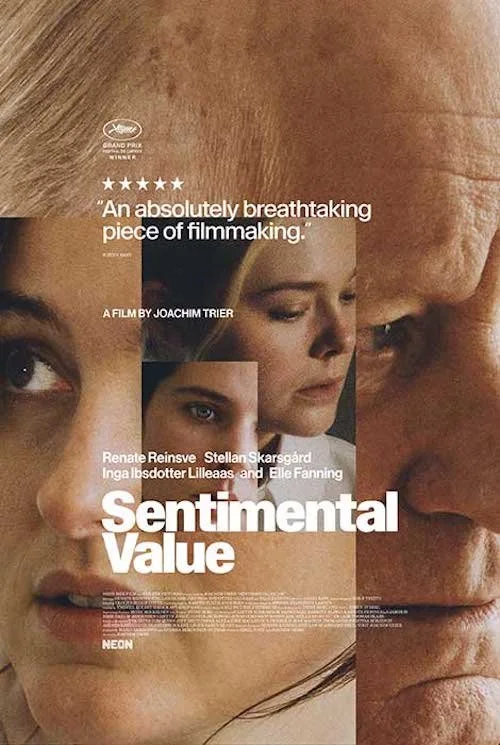



After watching Joachim Trier’s latest film Sentimental Value, at the Cannes Film Festival and rewatching it at the Toronto International Film Festival (TIFF), both times the film’s immersive power made me feel like a welcome member of the Borg family, taking up a room in their historical house. Sentimental Value is about family and the components that make its structure. Trier’s fascination with human stories specifically, the connections between people and how these connections contribute to their personal growth is present throughout his filmography. In cinema, it’s been said that the cast and crew of a film production play the role of a family. Though the word family is subjective to how one defines it, those who make up a film production can be considered a surrogate family. With any film production there are long hours on-set, close proximity of the cast-crew and rearing until a film is fully formed. During this production stage, moments of bickering, laughter, care and collaboration will undoubtedly be shared. Trier’s reunion with co-writer Eskil Vogt, cinematographer Kasper Tuxen, editor Olivier Bugge Coutté and actors Renate Reinsve and Anders Danielsen Lie, demonstrates how Trier sees and values this (working) family.
The film opens with a monologue describing an old house – an heirloom, its narration spoken like that of an elderly living relative reflecting on their life (a grandmother twice great). The monologue is partly drawn from Trier’s grandmother’s home (also an heirloom) and is written by a young Nora Berg (Renate Reinsve) in the film for a school assignment. Terry Callier’s Dancing Girl plays over angles of the shutters, windows, doors, rooms, marks on the walls as Nora wonders what feelings the house has – misery, emptiness, fullness, downtrodden, loneliness, yearning. Nuances and intricacies that have created a deep emotional bond between the Borg family and their abode; despite one fatal flaw – a crack in its foundation. One lyric from Dancing Girl stands out, affirming the house’s place, “...somewhere between time and space.” Trier meticulously illustrates the importance of the house and its sentimental value throughout the generations of Borg family homeowners. The depreciation of the house creates an appreciation and preservation for the home it has become. The film poses the question, ‘What’s required to fix a broken home?’
The current generation of inhabitants of the Borg family home includes, patriarch film director Gustav Borg (Stellan Skarsgård), eldest daughter stage-film actress Nora, youngest daughter information-archival historian Agnes Borg-Pettersen (Inga Ibsdotter Lilleas) and psychotherapist mother Sissel (Ida Marianne Vassbotn Klasson) whose recent passing reunites the estranged father and daughters. Gustav’s reentry into the lives of his daughters is more of a selfish necessity to look through and sort out things in his life and the family house. Gustav, Nora and Agnes all have had some theatrical experience, the latter having starred in one of her father’s renowned films as a child who is separated from her younger brother when he’s captured by Nazis. Their connection to art once unifying the Borgs now separates them; as the result of Gustav’s philandering led to a divorce causing him to move to Sweden, which created a rift between him and the family when Nora and Agnes were young. Nora hasn’t spoken to her father in years, while Agnes periodically helps with research for his films. However, when cleaning up after their mother’s funeral reception Nora implies that Agnes’ inability to confront her father about how she feels only adds sorrow she continues to suppress. The performances that Trier draws from Skarsgård, Reinsve and Ibsdotter Lilleas are astounding. They truly feel like a family, giving the film warmth, tenderness and in some instances a relatable tension.
Trier focuses on how the divorce creates fissures within each of the Borg family members. Gustav who was once a prominent filmmaker now washed-up, remembered through his films rather than for them. Sissel after the divorce fell into depression and was a distant mother to Nora and Agnes. Nora, being the eldest, had to fill the role of both mother and father in helping raise her sister Agnes (hence why they are so close). Agnes, affected by the event, rather deflects her feelings instead directing her energy into areas such as her career and family. Nora is a stage actress, one night when set to go on stage for a performance is overcome by tremendous stage fright. Nearing her cue, she tries to keep her composure before running towards fellow co-actor Jakob (Anders Danielsen Lie), proposing they ‘Do it.’. He hesitates and ultimately refuses. She then proposes to be slapped in the face to redirect her attention. He hesitates before blindsiding her with a slap. She then goes out to a stage filled with ladders leaning, propping each other up. Whatever low point Nora is at provides the foundation for what makes her a great actress. However, is it worth wallowing in sorrow?
Gustav, like many filmmakers, continues to strive for another great work of art. Having finished a script which took over 15 years to write, Gustav tries to clumsily offer Nora the part overlooking their strained relationship and the numerous times he’s drunkenly phoned her trying to reconnect. She rejects him and his offer before storming out. While in Deauville for a retrospective of his films at a film festival, there’s a screening of one in particular that gives him a great sense of nostalgia (the film made with Agnes). Another member of the audience, who’s also got a film in the festival, actress Rachel Kemp (Elle Fanning) is also deeply moved and after the post-film discussion invites Gustav to dinner to discuss the film and other upcoming projects. The evening begins with a dinner alongside Rachel’s entourage before ending with the group drinking champagne on a beach, where Gustav offers Rachel the script to read and decide whether she’s interested. Here’s where Gustav strives, by dropping and picking up alternatives that boost his creative ability rather than his emotional stability.
Agnes begins sorting through the various items left behind by her mother, analyzing her familial roots in the process. One of which is her grandmother (Gustav’s mother) who was a harrowing figure, part of the WWII resistance before being taken by the Nazis in the night never to be seen again. Agnes uses the resources of her information archival historical society to help bring closure to this inexplicable event within the family’s history. The photographs of the torture and tactics used to elimate resistance members are unflinchingly brutal and gruesome. Despite this lapse in the Borg timeline Agnes brings necessary closure and a wholeness to an empty familial chapter. Even in her profession she hopes to mend familial wounds and bring their family together. This demonstrates how familial trauma can only be healed with time and care. Later on, when returning home after this fulfilling moment, Agnes tells her husband Even (Andreas Stoltenberg Granerud) everything that happened. Trier holds on a shot of the couple on the couch in a daze watching television. A tear falls from Agnes’ cheek; she discreetly wipes it away. Any disarray in Agnes’ marriage is seen through the instinctual movements of her and Even, which makes one wonder how deep their communication really is?
Agnes’ hope to reunite the family begins when Gustav is invited to her house for grandson Erik’s (Øyvind Hesjedal Loven) birthday – much to Nora’s discontent. Gustav saunters into the home with a gift and wine bottle in hand, directs Even to get some wine glasses, swoons Even’s mother Therese (Ingunn Beate Øyen) and gives Erik his present. While Agnes, Therese and Even prepare the birthday dinner, Gustav and Nora sneak outside for a cigarette. Notice Trier’s details in this wide shot. Gustav and Nora physically side by side share a brief smile and cigarette, while Therese washes dishes in the window behind them. Look at the blocking of Therese's eyes by the window frame, this moment is meant to be shared between Gustav and Nora alone. Despite their strained relationship, Trier still provides a moment of hope for the pair to reconcile their differences. After the party all the grown ups sit and converse in the living room while drinking wine. Overcome with anger and frustration towards her father Nora mentions how he was, “...fucking actresses.” (alluding to his infidelity). Gustav, taken aback, remains still and despondent to Nora’s hope of having an argument. This is the emotional counterpart to Nora’s preparation for her theatre performance in the film’s early scenes.
Agnes, Gustav and Nora’s way of dealing with their emotions and frustrations is through self-infliction. Agnes lets her feelings well up until they subtly overflow. At a time for Gustav it was sex and intimacy, now it’s mainly through binge drinking. While Nora uses sex as a catharsis. As one character says in the film, “How could anyone love, filled with so much rage?” From these affairs does any love form or is it merely physical? There’s never any mention as to whether or not Gustav’s affair continued after his wife’s realisation. When on a picnic with friends, Jakob mentions to Nora that he’s getting a divorce. She ecstatically mentions that they no longer need to be discreet about their affair; Jakob responds saying he cannot continue with the affair (realizing he’s a distraction in Nora’s life, filling in the time where she doesn’t have to overcome her emotions) and instead recommends Nora see a therapist. All three find unhealthy outlets for what they are unwilling to communicate.
After reading Gustav’s screenplay Rachel agrees to the role inspired by Gustav’s mother and is given a tour of the family home. Gustav introduces Rachel to Agnes while Nora sneaks out the back door. Gustav and Rachel’s collaboration begins and they share the various parts of Gustav’s life which have informed the screenplay, perhaps something he’s never done with either of his own daughters. It’s here where Trier draws influence from Ingmar Bergman’s Persona (1966), as Rachel, hoping to really adapt to the role of the mother in the screenplay, goes so far as to dye her hair brown and even adopt a Scandinavian accent. The further into this role Rachel dives the more she realizes that the role is written with Nora in mind, ultimately bowing out because she doesn’t have a feel for the material in a certain way.
This is how much Gustav is willing to sacrifice rather than grow. Envisioning Erik in the role of the son character in the film, Gustav casts him without discussing it with Agnes, who immediately rejects the offer. Leaving a copy of the screenplay for Erik to read, Gustav leaves. Agnes begins reading the screenplay and is so moved upon finishing it, realizing that it’s Gustav’s apology after being absent for 15 years. Here’s where Trier shows the power of art; however, it takes a great sacrifice to understand its healing power. It’s conceivable that Gustav could’ve left and never been accepted back into the family (a sacrifice he didn’t even know he was making). Agnes visits Nora’s apartment which is in shambles, after her affair with Jakob concludes and is still unable to adjust to Gustav’s return. Agnes convinces Nora to read the screenplay while she cleans up the apartment. In the film’s warmest moment, the two sisters sit on a bed reminiscing. Agnes, thanks Nora by saying, “You were there to take care of me when mom was down. Washed my hair. Took me to school. There was no one there to take care of you.” The sisters also discuss the suicide that’s mentioned in the screenplay and how Gustav could’ve possibly known about Nora’s suicide attempt (mirroring the film within the film’s final scene) also stemming from depression.
One thing that stood out after watching the film was the interesting use of scene transitions. During the film’s press conference at the Cannes Film Festival I was fortunate to ask Trier, “The transitions from scene to scene abruptly cut to black, is this to reflect the displacency within the characters?” Trier’s response was, “Thank you. It’s not, I think, I think this film every time we do something Eskil and I, we want to and this continues with Olivier Bugge Coutté our editor as well. Which kind of helps us figure out ultimately, what the film will be. I think there’s something about this one where I wanted fragmentation and moments of life to slowly move towards a type of continuity and intimacy between the characters. But that the film form still kept them apart somehow so that not everything is resolved in that kind of face to face situation that very often drama demands. So we were playing around with that. I think there’s something wonderful about creating a bit of absence and hoping for patience from an audience.” Art stems from life and has the power to mend life’s wounds; something Trier sought and found when making this film. It’s fitting that the film’s final scene and resolution takes place on a film set.

Dilan Fernando graduated with a degree in Communications from Brock University. ”Written sentiments are more poetic than spoken word. Film will always preserve more than digital could ever. Only after a great film experience can one begin to see all that life has to offer.“