
Caught Stealing
Written by Andreas BabiolakiS


When people think of Darren Aronofsky, they’ll recall the New York director whose films are incredibly serious; from the near-vérité stylings of The Wrestler and the melodramatic fever dream of Black Swan, to the allegorical damnation of Mother! and the crosscutting panic attack of Requiem for a Dream. Aronofsky is one of the most audacious and creative directors working today, but, as much as I admire him, I would never consider him or his work to be “fun”. When Caught Stealing was painted out to be Aronofsky’s fun film, I couldn’t tell what that meant. I was worried that he would strive to be silly: something many depressing filmmakers attempt and fail at (I don’t hate Ingmar Bergman’s All These Women as much as the average cinephile, but I wouldn’t call it a great film, either). After catching Caught Stealing, I can now see what Aronofsky meant by this being his fun film: not in a A Fish Called Wanda sort of way, but, rather, via the eccentricities of America’s Quentin Tarantino and Britain’s Danny Boyle. Both directors were major mainstays in the nineties thanks to their bonkers, unique, meta takes on the crime film genre. Tarantino used the French New Wave’s limitless ways to craft Pulp Fiction, shatter narrative flow to make the most of budgetary limitations to concoct Reservoir Dogs, and redefine how the literary thriller could be read with Jackie Brown. Boyle responded with the hectic, vibrant Shallow Grave before descending even deeper into ADHD-riddled madness with Trainspotting.
Caught Stealing is Aronofsky’s throwback to these kinds of crime films: ones where the assemblage and production of these stories creates the same highs, drives, and anxieties found within the criminals we follow or come across. I’m not sure if the average person would deem these kinds of film outright “fun”, but they certainly do have a fun side to them (amongst their dangers, taboos, and conflicts). I suppose this is the most fun film that Aronofsky has made, but it is still quite intense, upfront, and tense by the standards of your common film goer. Fortunately for Aronofsky, I am a little anomalous as a human being and with my art: Caught Stealing was fun to me. However, where the film does fall a little flat is when it tries not to be fun, but, rather, when it tries to be funny. Aronofsky is not one for holding back, and this usually leads to punishing reflections. When it comes to the comedy in Caught Stealing, enough of the jokes or gags feel a little much, as if they need to be as abrasive as the sequences of gore, suffering, and regret. I can admit that Aronofsky has found his fun side but not quite his funny bone as of yet; the comedy does not come naturally to him.
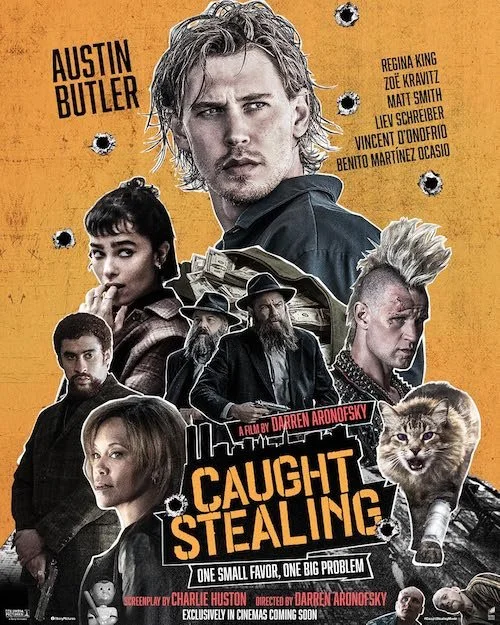
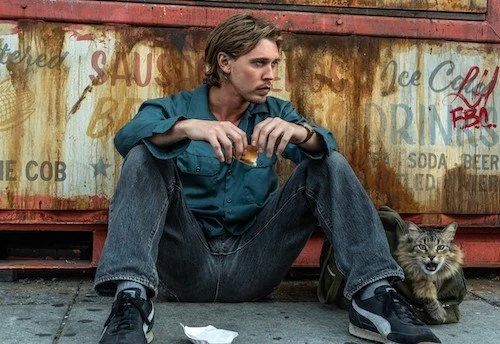
We begin with a shot of a youthful baseball game before quickly cutting ahead to the “present”: 1998 New York City. Hank (Austin Butler) was a promising baseball star who now lives as a bartender struggling to make ends meet; he also gives some of his earnings to his mother who lives back in California. Hank is dating paramedic Yvonne (Zoë Kravitz), the latter who wants their relationship to get serious and tells Hank to finally face his fears in order to keep going. What may those fears be? Caught Stealing is one of those kinds of films where the less you know before going in, the better, so I won’t go too deeply into narrative details. I will say that Hank’s already-rough life gets thrown up in the air even more once his neighbour, British punk Russ (Matt Smith), has to leave due to a family emergency. Russ has clearly been caught up in the wrong crowds when a slew of bad-news folks — from Russian gangsters (Yuri Kolokolnikov and Nikita Kukushkin) to Hasidic tough guys (Vincent D’Onofrio and Liev Schreiber) — start showing up at his door. All Hank knows is that Russ is gone, Hank is to take care of Russ’ cat, Bud (Tonic), and now there is trouble at every turn. Hank quickly gets in touch with Detective Roman (Regina King), who is vigilant on this particular case, and begins weighing his options after having a terrible run in with the Russian mobsters.
Caught Stealing is a welcome throwback to the kinds of crime films that spawned from the nineties: ones full of vibrancy, broken rules, and an artistic angle beneath the madness.
Without divulging in spoilers, Caught Stealing is far more than a crime film. It is a depiction of a broken man who cannot escape his demons. The most obvious addiction he possesses is alcoholism, but he has a much deeper obsession: what could have been. He is a major fan of the San Francisco Giants MLB team for reasons I do not wish to reveal, but he essentially cannot miss a game. With every game he watches, he becomes deeper and deeper in a well of despair: living glory days that never even existed. We all want our lives to have meaning, but we do not truly live if we are chasing dreams and not exploring reality. Many crime films deal with protagonists who are running from their pasts, but Hank is also caught up in fiction. If we are to continue with the baseball references like the one found in the film’s title (inferring to the act of stealing bases as part of a double entendre), much of Caught Stealing’s plot deals with Hank continuously running and, effectively, trying to find home (whatever home may be to him). Each portion of the film poses as its own base, with the romanticized opening sequences marked literally with the act of “first base” (indulging in kissing) via Hank and Yvonne. However, Hank has to keep running or else he’s “out” (and I don’t mean that he is being sent to the dugout). Reaching other bases is only a brief reprieve: it’s all about finding “home.”
Aronofsky is one of the best directors when it comes to getting the most out of his actors. While some of the roster is already qualified and reliable (like King, D’Onofrio), some of the other stars who can be hit-or-miss turn out gold here. Butler has never been better and isn’t hiding behind likenesses or frills with this bare-bones, candid performance of a shattered person who cannot afford to take a breather. Kravitz is as charming as she always is, but Aronofsky’s direction encourages her to use her magnetism to mask her true feelings, which can be revealed with slight cracks in her gaze. I must also point out the casting of one Benito A Martinez Ocasio, better known as Bad Bunny, who stars as Puerto Rican intermediary Colorado. He is either a natural on the big screen, or Aronofsky pulled off a miracle with this effortlessly captivating performance which stole quite a few scenes. In that same breath, I must bring up Kukushkin’s Pavel who I unfortunately feel is one of the weakest characters in any Aronofsky film — to no fault of Kukushkin whatsoever (he does the most that he can, rendering this meathead at least somewhat amusing). Meant to be a brutish form of comedic relief, Pavel is either poorly written (he spews out nonsensical American pop culture references as humorous intimidation) or wrongfully directed; either way, he comes off as a frustrating-enough sight that I tried to ignore every time he was on screen. Again, I’m not sure if Aronofsky knows what to do with straight-up comedy, because Pavel isn’t it.
Whatever comedic shortcomings may appear get easily forgotten about due to the clever plot development (courtesy of screenwriter Charlie Huston, who also wrote the source material novel of the same name) and the fantastic world building of New York City (perhaps via the efforts of both Huston and Aronofsky). Almost everything that was introduced throughout the film — from characters and themes to devices and instances — was revisited. When you are frantically trying to piece together all the separate parts of a calamitous film, this kind of detailing is what makes Caught Stealing worth revisiting: the kind of depth that many other quickly-paced capers may overlook in favour of a lighter load to carry. Circling back to the precise portrayal of New York City and its neighbourhoods, I was frequently reminded of Aronofsky’s smashing debut film, π, where we follow a mathematician around Manhattan and come across the many communities that feel enriched with culture, history, and personality. This is the first time that Aronofsky has returned to such a dynamic portrait of New York City, and feeling the many simultaneous bustles of nineties NYC breathes life into characters and settings that could have felt like stereotypes; instead, Caught Stealing is a diorama (and a gritty one at that). Chinatown is more than just a location for Chinese representation. The Jewish community has many layers to it. Ghettos are more than just “bad places”: they’re all some people in this world have.
It is this scope that makes Caught Stealing even stronger. Hank isn’t the only one who is having to answer for his tough past. Every person in this film doesn’t just show up: they reached this point through their lengthy existences, for better or for worse (if you’ve fought to be a paramedic or a detective in spite of your upbringing, or if being in cahoots with gangsters as a drug dealer or a “banker” was a means of survival). No one wanted the life they currently have here, but they are all playing their own games and are constantly on the run in a world where you need eyes in the back of your head. Even when some jokes fall flat or the tone of the film can feel confused, it is this ongoing tenacity that propels Caught Stealing.
Aronofsky’s foray into film began as an anthropology student at Harvard, as he shot documentaries — beginning with studying seals and eventually progressing into the photography of different civilizations of people (something he continues to do on social media). I think there is a prescient parallel between his background and his filmography as we study human beings as if they are animals experience fight-or-flight responses to desperation. While many of his films have open-ended conclusions, leaving us to wonder what will transpire later on, Caught Stealing is one of the few Aronofsky films to feel definitive, as if it is a clear nature study (of sorts) on Hank and all the beings caught up in this mess that he finds himself in.
This concrete jungle is hell on Earth, but there’s something about rooting for that little lemur to make it out alive that keeps you watching (as you would any nature documentary). However, this also feels like a video game, like Rockstar’s Grand Theft Auto series (particularly IV, given the New York and Russian angles). This is due to the crisp sound design, dynamic cinematography by Aronofsky regular Matthew Libatique (especially those phenomenal pans and zooms that feel ghostly), and the impressive soundtrack that feels exactly like a currated radio station for the aforementioned game (songs from Portishead, Madonna, Orbital, Buju Banton, The Magnetic Fields, and many more); post-punk band Idles provide the film’s score, which is a bold and wise choice that gives each moment a throbbing pulse. With all of this in mind, Caught Stealing is indeed fun in a Darren Aronofsky kind of way. As graphic and uncomfortably honest as it gets, it also vibes to the heart of the city, the beat of the streets, and the heat of the moment. However, as we learn by one of the more hopeful final shots in any Aronofsky film, Caught Stealing tells us that the most alive we may ever be is when we find peace away from all the noise. The ending credits are unusually bombastic, so I’d like to think that — despite their friendliness and cuteness — the credits are meant to match the tone of Caught Stealing, and that Aronofsky wants us exiting the theatre or turning off our devices to allow us to hear that serene silence for ourselves and encourage us to think about what our versions of home are (as long as it doesn’t take the events of Caught Stealing for us to reach that nirvana).


Andreas Babiolakis has a Masters degree in Film and Photography Preservation and Collections Management from Toronto Metropolitan University, as well as a Bachelors degree in Cinema Studies from York University. His favourite times of year are the Criterion Collection flash sales and the annual Toronto International Film Festival.