
Little Amélie or the Character of Rain
Written by Andreas Babiolakis
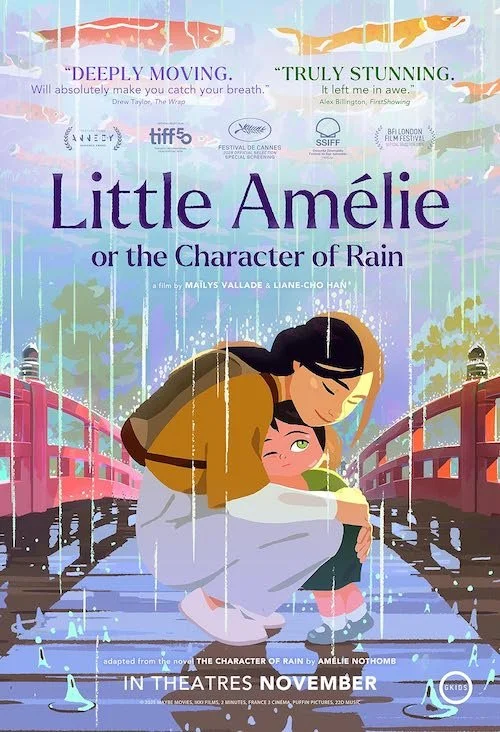

Oh, to be able to view the world through a young pair of eyes again. That does seem to be the mission of the Belgian-French animated film, Little Amélie or the Character of Rain (known in French as Amélie et la métaphysique des tubes). Despite these other two nationalities, the film is also deeply rooted in Japanese lore, particularly the notion that children are born miniature gods until they reach the age of three. Much of this delightful-yet-mature film is an experience: planting us back in the perspective of a kid who has yet to learn much about the world, who also feel like — when looking at their limited surroundings and exposure — have everything figured out. I will never forget being around four years old and seeing myself in the mirror for the first time (that I can remember, anyway), with my mother confirming that I was peering at myself. I was stunned, confused, but also amazed: I think it was in this moment that I realized that we are organic miracles. I wasn’t just this floating field of view and sound. I was a complete human being, just like the many I was becoming familiar with around me. Little Amélie goes even further than this kind of memory by rendering its title character an impossible child: a three-year-old who is capable of speaking full and complicated sentences, amongst other capabilities.
An adaptation of Amélie Nothomb’s semi-autobiographical novel, Little Amélie is a warmly made project by directors Maïlys Vallade and Liane-Cho Han over the course of seven years; Nothomb’s version is infused with the personal provenances of both Vallade and Han, turning this film into a mosaic of identities (this actually adds to the applicability of the film). Even though this feels like the early days of many kids (albeit in a simplistic sense and not a literal one), this is still tiny Amélie’s story to tell. Amélie is born unconscious and unable to move; this can be a direct observation of an awful reality for many children, but, here, it can also serve as a representation of those first years of our lives that we have no recollection of. On her second birthday, Amélie can now suddenly talk. She seems to possess psychic powers. She is a superstar, and she appears as such in the eyes of her family (outside of her older brother André, who proves to be a bully to Amélie throughout the film). Curiously, as Little Amélie progresses as a story, her abilities strengthen but she is in far less control of the events that occur; she may have capabilities, but she doesn’t possess the power she thought she did. No one is able to steer their entire life according to their plan. We all learn that we can only do so much. This is the story of Little Amélie.
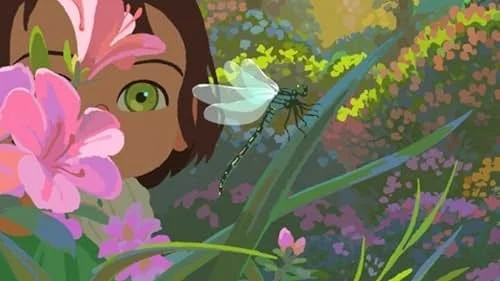
This becomes especially true when our protagonist turns three towards the end of the film and now feels completely helpless. Before this realization came many revelations for Amélie, from the existence and familial impact of World War II, to the possibility that she and her family may have to leave their beautiful home in Japan and have to go to Belgium. The film is animated in a way that looks both like an illustrated storybook and a live action fantasy film (albeit with a far choppier frame rate; intentionally, of course). There is a blend of the unknown and the obvious, as if we are aware of everything that is going on but not necessarily always why they are happening. Everything is magnificent to look at here. Narratively, there is quite a bit to nibble on as discussed, but I also feel like Little Amélie could have afforded to go even further with the magic that the title character possesses; if she is, indeed, a mini God (in her eyes, anyway), I feel like the film should have sold that point with the utmost confidence so that the character’s eventual descent into reality would ring even more true. As it stands, Little Amélie is only somewhat on another level of spectacle when it could have been the animated event of the year.
Even so, in a year that has proven to be just satisfactory for animated feature films, Little Amélie may still be amongst the best (yes, even though it could have afforded to have been even more daring). I think that there is enough that any viewer can relate to that will make this at least mesmerizing while the film is on (and, perhaps, for a little while afterward). With the darkness that has taken over many of our lives, yes, cynical films may allow us to feel seen, but a film like Little Amélie that can help us feel consoled to the point of being even partially nurtured is also necessary. We may miss our childhoods quite a bit, but we don’t really put into perspective what it felt like to be a child (we just recollect what we liked, who we loved, and what we did, not how we felt, especially back then and not how we interpret these memories now). Little Amélie somehow allows us to look back as aged viewers peering at the life of a child, but it also allows us to feel like a curious and wide-eyed youth again. This film is so beautifully animated and even its bleakest moments are told with sympathy. Life isn’t easy; nothing in Little Amélie is graphic, but parents should know that the film is far from silly and pandering, and some of its lessons are at least slightly mature (perhaps older children would gravitate towards this instead of the littlest ones). However, the title star of Little Amélie is working her biggest miracle: getting through each day. Considering how every morning is a call-to-action to brave and embrace the day, we are all little miracles.


Andreas Babiolakis has a Masters degree in Film and Photography Preservation and Collections Management from Toronto Metropolitan University, as well as a Bachelors degree in Cinema Studies from York University. His favourite times of year are the Criterion Collection flash sales and the annual Toronto International Film Festival.