
The Running Man
Written by Andreas Babiolakis
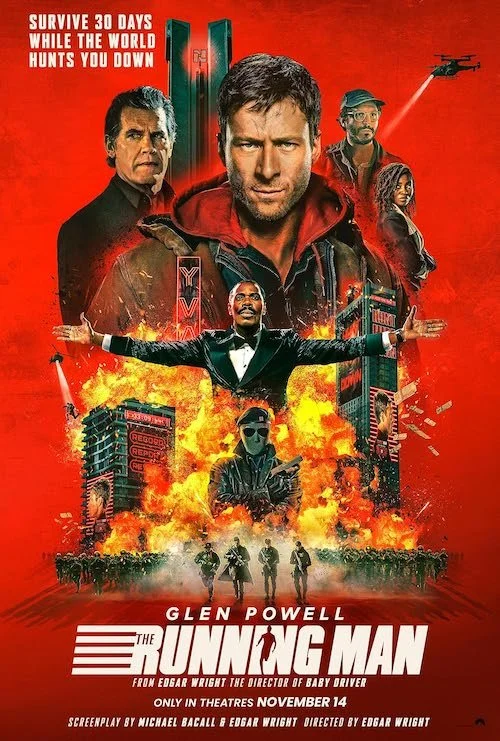


If Christopher Nolan is the bridge between blockbuster epics and arthouse spectacles, then Edgar Wright is his more conventional counterpart; his films are far less demanding and challenging than Nolan’s, but they are similarly inventive and unique enough to stand out from your typical mainstream flicks. Wright has always felt one step ahead of most like-minded directors, thanks to his blisteringly kinetic filmmaking style: one that makes entire films feel like an MTV music video viewing session. Each sequence explodes with flavour, usually via a flurry of cuts and splices on top of gorgeous sound design (which usually incorporates great needle drops and hilarious one-liners). All in all, Wright’s films just feel like a good time, whether you are watching any of his Cornetteo trilogy favourites (Shaun of the Dead, Hot Fuzz, or The World’s End) or his other genre-bending efforts (the toxic-romantic Scott Pilgrim vs. the World, the shuffled-playlist action thriller Baby Driver, or the time-hoppinh psychological horror Last Night in Soho). This leads us to The Running Man: the first time Wright has tackled a film that has been done before (see Paul Michael Glaser’s 1987 film of the same name, also based on Stephen King’s novel). Usually, when a director recreates a familiar story, you can expect them to get lost in trying to remain faithful and — in a way — lose sense of themselves.
I didn’t think that Wright — a commonly identifiable director whose style has been certified for decades by now — would have fallen for such a trap. The Running Man still possesses hints of Wright’s relentless style (mainly thanks to the fluid, feisty editing), but this is the most mainstream that Wright has ever felt; he doesn’t feel like he is leading the pack here but, rather, lost in the midst of his peers. It feels ironic, considering the premise of a protagonist trying not to get caught for thirty days; it took around thirty years (since Wright’s debut, the indie comedy-western A Fistful of Fingers) for Wright to feel like a part of the class of typical directors who used to chase after him (the trouble is that this was a result of Wright slowing down, not the other filmmakers getting significantly better). Just like the 1987 film, we follow an everyday guy, Ben Richards (played by the human capybara himself, Glen Powell). Ben and his family are destitute like the majority of civilization in a dystopian near-future; everyone is struggling to survive, but they are brainwashed by the false realities of FreeVee (a provider of crappy reality television shows), particularly by the seemingly-impossible game show, The Running Man. Participants of this show must survive being hunted by professional assassins for thirty days; if they succeed, they win a billion dollars. However, most contestants do not succeed, and it feels like a suicide mission by simply entering. Ben’s child is ill with influenza, and the suffering of his family ends now. After some coaxing, Ben becomes one of the new “runners” for this season of The Running Man. He and his fellow runners get a twelve-hour head start to flee and hide before the hunters try to find them.
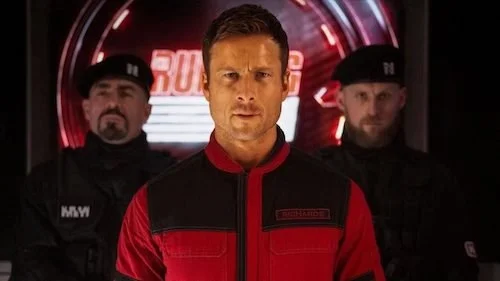
Edgar Wright holds himself back with The Running Man when he should be creating a precedent; at least he continues to have fun with making motion pictures.
When it comes to the dialogue-based scenes, Powell does a good job making Ben feel a bit like an average Joe who is pulling out all the stops to survive for his family, but that illusion disappears when he becomes an action mega-hero; I suppose the implication is that this physical brilliance is what sets Ben apart from the many other contestants who failed before him, but I think that the film would have been more interesting if we doubted how far Ben could go (as we see ourselves in his prickly situations). I’d also argue that The Running Man kind of squanders its thirty-day theme, as the film honestly felt like it took place over the course of a week at most (if the film wasn’t gracious with its time stamps and reminders, I would have forgotten). I do not feel like I am watching someone who has been through hell and back for this long; if anything, I begin to question how Ben hasn’t taken care of his opposition sooner, seeing that he comes off as a hulking behemoth. I do not blame Powell for this misrepresentation, but, rather, how Ben is written and framed.
Wright’s film succumbs to the expectations of action cinema in a number of other ways, including the obviousness of the one-liners that once made Wright feel like he was using a different lexicon than any other director, the cookie-cutter action sequences that used to be opportunities for Wright to play in his sandbox and come up with fresh ideas, and the one-by-one roll call of characters who seemingly fade out of existence once they’re gone (Wright usually crafts memorable characters who own any scene that they are in). When you have a cast consisting of Colman Domingo, Josh Brolin, William H. Macy, Lee Pace, and many other massive names, and they do not stand out as much as they should (outside of Domingo, I’d argue, but he is so damn talented that he could act his way to the top reading a Reddit “Am I The Asshole? thread), that’s a problem.
Considering that this is easily Wright’s worst action film to date, I’ll still point out that it is quite fun in a pedestrian kind of way (it isn’t a cliche action film as much as it is Wright’s least-inspired effort, which maybe hurts even more to admit). The Running Man is still enough of a ride that it can be a nice night out with a massive bag of popcorn (layered butter for this one). However, considering that much of the film takes a stance on the problems of today including the use of artificial intelligence (as a provider of unreliable and damning “news”, including using deepfake technology), this should have been an opportunity for Wright and The Running Man to show what pure artistry looks like in a world that is seemingly giving up and in an industry that is killing off its participants in favour of lazy and horrifying measures. Instead, The Running Man just comes off as something that has been done, not what could be done. Edgar Wright doesn’t have to continuously reinvent the wheel to prove himself at this point (the rest of his career speaks for itself), but The Running Man certainly feels like a missed opportunity made by someone whose films are swiftly identifiable no matter what you think of them; The Running Man is the first (and, hopefully, the last) time that Wright has ever ordinary — he needed to be Ben Richards (particularly the one in Wright’s film; well, maybe not that extreme, since this Ben is too damn extraordinary to the point of being impossible to measure up to).


Andreas Babiolakis has a Masters degree in Film and Photography Preservation and Collections Management from Toronto Metropolitan University, as well as a Bachelors degree in Cinema Studies from York University. His favourite times of year are the Criterion Collection flash sales and the annual Toronto International Film Festival.