
Springsteen: Deliver Me from Nowhere
Written by Andreas Babiolakis
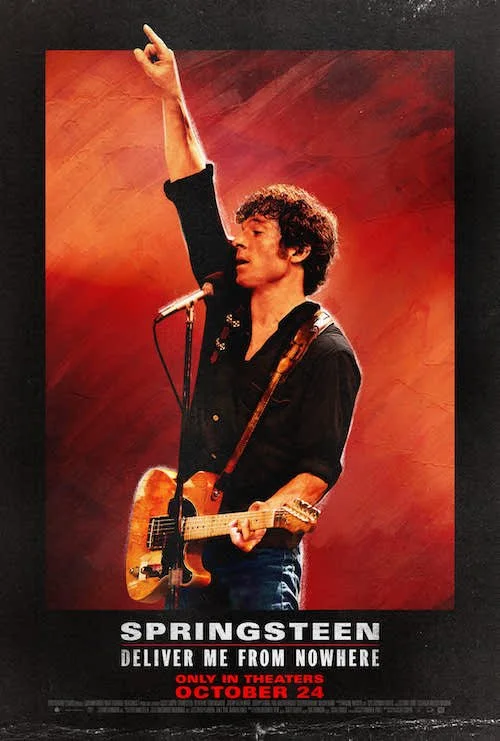


One of my favourite musicians and lyricists of all time is the New Jersey boss himself, Bruce Springsteen. The way he crafts together a compelling story that grips you is second to none; whether he is evoking a Phil Spector sixties pop ballad via Born to Run or a blusier, heartland opus like Darkness on the Edge of Town, the E Street Band leader always understands the assignment. With such a thorough, extensive, and consistent career, Springsteen is someone who warrants the utmost respect and care when it comes to representing his impact on songwriting, live performances, and contemporary music as a whole. So Scott Cooper’s biographical picture, Springsteen: Deliver Me from Nowhere, has a lot of its work laid out for it. All it needed to do was hone in on even just one aspect of Springsteen’s life and follow it as closely as possible. Deliver Me from Nowhere succeeds with the first initiative.
It covers the creative process behind Springsteen’s solo album away from his band; the 1982 classic, Nebraska, was a stripped down folk album recorded solely by Springsteen in his bedroom. While there were multiple attempts to get the E Street Band involved with fully realizing these demo tapes, Springsteen detested any results that came and felt as though these initial recordings tapped into something raw and real. Springsteen could no longer hide behind his backing band and his rockstar persona; with Nebraska, he was finally facing his demons with stories about real life criminals, the novels of Flannery O’Connor, and – ultimately – his tumultuous childhood in a challenging home dynamic (a lower class family with an alcoholic and abusive father with mental health issues; Springsteen’s mother took care of them and also was their primary money earner).
By focusing just on this period of time, Cooper is also channeling Springsteen’s rough youth, so the director/screenwriter is getting two stories for the price of one. Simple enough, right? Well, don’t forget the other major contingent as to what Deliver Me from Nowhere required to succeed: the ability to stick to this plan. Deliver Me from Nowhere attempts to accomplish two tones at once. First, there is that of Nebraska: an artistic, raw, stripped down look at depression and suffering that is laid out for the public to see. We get Springsteen played quite well by star Jeremy Allen White (of The Bear fame, amongst numerous other projects). Springsteen wants to record some new demos but is letting his darkness take over his well being.
As a result, he is conjuring up new tracks that just do not work within the confines of the E Street Band. Some of these demos would wind up becoming the blueprints for Born in the U.S.A.: Springsteen’s highly successful album that made him and his band megastars. You can already spot the starkly different natures of Born in the U.S.A. and Nebraska from a mile away; if Nebraska is anti-commercial, then Born in the U.S.A. is as mainstream – albeit magnificent – as rock music got in the eighties. This is where Deliver Me from Nowhere flounders. It wants to be Nebraska but settles frequently enough for Born in the U.S.A. that it hinders the film; there’s nothing wrong with being a traditional and expected biopic, but if you are going to take risks, you must go all the way and stick your landing. Trying to be both risky and predictable is a tango that just does not work here.
The film is beautifully shot and meant to feel like home-recorded footage (depicting the candid nature of the Nebraska sessions), but then Deliver Me from Nowhere will have stunted, simplistic dialogue at the forefront that almost feels over produced in the sense that a studio demanded an audience can follow along to this already-basic storyline (perhaps this film was written with viewers who are chronically on their phones in mind: the kind to spend half the film at home looking up images of Springsteen to see if White actually looks like him rather than paying full attention). The editing style is a little choppy in an unvarnished way, but when each scene feels like it was constructed to win awards, this doesn’t make the film come off as organic but rather unfinished; as if we are watching a hastily-assembled compilation of set footage to try and tell a story with what the filmmakers had. You see, trying to curry favour with both common audiences and hardcore cinephiles doesn’t work in this case because when you are being pulled from both sides, each audience loses with a film that is disjointed and tonally befuddled.
Watching White as Springsteen is essentially why we stick around. Even though he is instructed to lose his cool a couple of times (we need those “for your consideration” Oscar moments, after all), he carries Springsteen’s pain with such self-loathing that is present even when he is staring off into the distance. White embodies Springsteen’s on stage and real life identities so well that you get more truth from his performance than you do from the actual story itself (of which feels like a speedy assignment to pull as much information from Wikipedia overnight as possible). Jeremy Strong grants us the second best performance as Springsteen’s manager, Jon Landau, who is so peculiar yet charming that you understand both this man’s massive passion for music and his ability to command difficult negotiations. Odessa Young is given a bad hand of cards as Faye Romano: a fictional character who is meant to be Springsteen’s love interest of the film, but she is so poorly written and featured that she comes off as the plus-one cliché of biopics that her character truly is; there’s a great role with Young’s name on it, but it isn’t this half-baked attempt at trying to win over the popular crowd yet again (and in ways that are detrimental to the film and story, too).
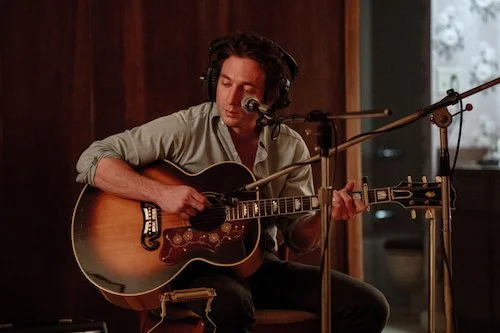
Jeremy Allen White makes Springsteen: Deliver Me from Nowhere watchable when the numerous other head-scratching choices make such a compelling story feel confusing and frustrating.
Much of the final act is Springsteen being told to stop running away from his problems, which is something I’d understand if the vast majority of Deliver Me from Nowhere wasn’t devoted to Springsteen literally recording an entire album about his problems and trying to find catharsis in his art. I became so frustrated with the lunacy of telling a man who is trying to figure things out to figure things out throughout the film. I also didn’t care for how much of the film was just that Springsteen was depressed. Sure, it goes into his childhood with his abusive father (played by Stephen Graham, who also deserves a shoutout for being terrific in all stages of father Douglas Springsteen’s featured life), but that only explains why Springsteen had a bad youth. Depression usually stems from a lack of love for one’s self, and we can piece things together, I suppose, but a fuller picture would have gone into Springsteen’s actual mental health concerns while recording Nebraska; what’s the point in a character study of a man’s depression if the ultimate conclusion is just that this same man is depressed (and nothing more)? To have someone just push others away without us, the audience, getting any sort of tangibility means that we, too, get pushed away.
Of course we know that Springsteen was sad recording Nebraska (just listen to the damn album). What we’d like to know is what was going on in his head during it, outside of his influences (like Terrence Malick’s Badlands, or Suicide’s self-titled album; both nods are welcome, mind you). This is all information that can be looked up and read about. What a biographic film can provide is the subject’s headspace and soul. When a film that shows that Springsteen didn’t want his face plastered on the Nebraska album feels the need to toss his last name in the title (so we know it’s a Bruce Springsteen film), I get the sense that Cooper and company didn’t truly know what the musician was like during this time period; perhaps only White proves that he possesses something more than five-minute research can offer (in his performance that renders Springsteen: Deliver Me from Nowhere at least somewhat watchable).


Andreas Babiolakis has a Masters degree in Film and Photography Preservation and Collections Management from Toronto Metropolitan University, as well as a Bachelors degree in Cinema Studies from York University. His favourite times of year are the Criterion Collection flash sales and the annual Toronto International Film Festival.