
A House of Dynamite
Written by Andreas Babiolakis



Warning: This review contains blatant spoilers for A House of Dynamite. Reader discretion is advised.
Director Kathryn Bigelow has been sharpening her mastery of building tension for almost two decades now. The Hurt Locker gave us a timeline of how long a bomb disposal squad had to survive in order to finish its latest rotation, with every explosive threatening to forbid our protagonists from ever arriving home again. Zero Dark Thirty condenses the decade-long search for Osama bin Laden, only to equate the extent of this mission to the actual length of bin Laden’s capture (with a real-time half hour sequence that feels like five hours, and I mean this as a compliment). Detroit lulls us into an ease of comfort for its first act before presenting us with the horrors of the Algiers Motel incident of 1967; we, too, are forbidden from leaving and are forced to see the horrors of corruption and bigotry. Now, there’s A House of Dynamite: a long-awaited project between Bigelow and writer Noah Oppenheim (formerly of NBC’s Today Show before venturing forth into writing for films like Jackie and The Maze Runner). The premise is quite basic: there is a foreign missile entering the skies of the United States of America and is set to impact the city of Chicago in around twenty minutes. That’s all youa re told via the film’s trailer and promotional materials, and only vaguely so.
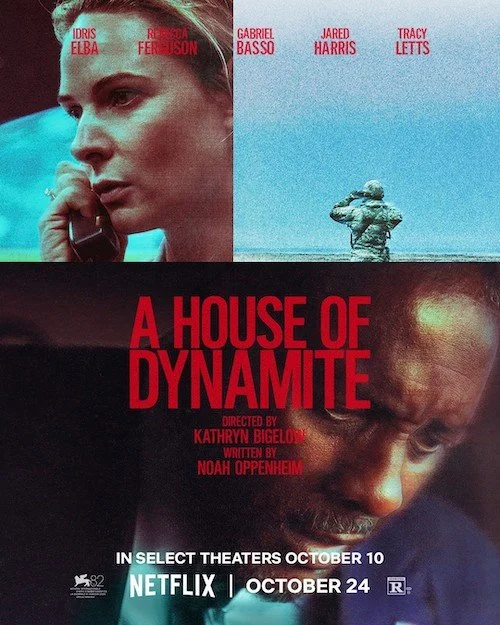
What is not conveyed is the triptych vignettes of hyperlink nature. A House of Dynamite is presented in three chapters and vantage points, all surrounding the same horrific event. We start off in the White House’s Situation Room, where reports of a rogue missile are relayed. Captain Olivia (Rebecca Furgeson) and her team try to assess the situation scientifically, with trajectory markings and attempts to thwart, divert, or outright stop the missile from reaching its target. During these protocols, we see an online meeting with many participants; this is where all of the stories link. This emergency meeting leads us to the second chapter, which begins earlier in the day just like part one, but now we follow General Anthony Brody (Tracey Letts) at a military base, as well as Deputy National Security Advisor Jake (Gabriel Basso). Jake awkwardly delivers his information via a video chat off of his mobile phone, and is speed walking his way to the base in order to be heard; you get the sense that he is barking up the chain of command and is not entirely authorized to be speaking to whom he reaches (but he needs to be heard in order to prevent as much damage as possible); meanwhile, General Anthony sees the imminent, military threat that is posed, and wants the President to strike back instantly. That president is seen in the third chapter: the nameless POTUS (Idris Elba) is flagged about the crisis at a sporting function and is forced to make decisions on the fly while stuck in a limousine. Meanwhile, the Secretary of Defense, Reid (Jared Harris), attempts to hold down the fort in place of the president.

A House of Dynamite is a film that never lets up, only to provide its biggest wallop with its empty, hopeless final statement.
There are seamless ways A House of Dynamite weaves its story threads together. For instance, Admiral Mark Miller (Jason Clarke) is with Captain Olivia in the first chapter, only to be forced to evacuate; we reunite with him in the latter half of the second act where he arrives at the military base. Bigelow and Oppenheim are crafty not just how frequently they use their characters, but also by how sparingly they are utilized. NSA lead Ana Park (Greta Lee) is on her day off in the second act, and FEMA employee Cathy Rogers (Moses Ingram) is a newer recruit given very specific orders in the first chapter; them barely being seen throughout the film, only to be brought back for a snapshot of despair in the final moments before credits, is a risky method to display helplessness, chaos, and a lack of order; these are people we don’t know, being thrust into a last-ditch act as a hail Mary, considering that there is no other choice. We feel the weight of the uncertainty, because — as trustworthy as they likely are, nonetheless — we were never properly acquainted with these characters to be certain of them or their fates (even if we have faith in their capabilities).
A House of Dynamite gets even more inventive with its use of characters. In the same way The Leftovers did, a famous face is used as a benchmark of sorts; Chicago Sky’s Angel Reese is at the same basketball function that the POTUS is; this reminds you of recognizable people who are potentially in harm’s way, subsequently reminding you that this could also be you, your friends or kin. There’s also a striking, brief cameo appearance that reunites Bigelow with star Kaitlyn Dever (who worked together on Detroit); she plays Reid’s daughter for one scene but is used highly effectively to convey the voice of an unknowing loved one who you want to hear one last time; their ignorance is bliss, and their peace is your peace. With a star-studded lineup of actors, A House of Dynamite juggles its many solid performances (there’s no weak link in this chain) with a focus on the absence of major names to balance the prominence that is present with key actors; now this is how you work with an ensemble cast.
As we watch the same disaster from multiple angles, we are provided with more than enough information to gnaw on. If we felt like something was amiss in the first act, we were clued in on the missing pieces by the time we reached the remaining two parts. If we had any reservation about something that could have been done, we were likely informed that such action did take place and fail by the time we are shown additional vantage points. You may wonder about the silence of the president throughout the film and think that he wasn’t doing anything, only to see things from his angle and know what he was truly experiencing during his “negligent” moments. What becomes clear is how much is set in place if a missile crisis were to happen in 2025. What is also revealed is how doomed we may still be, despite — or, if anything, in spite of — all the defensive precautions that are established. If military warheads are meant to be a country’s method of caution to instill safety in the eyes of that nation’s people, Bigelow’s feature film is a contrary cautionary tale: we are not safe; we are living upon a ticking time bomb known as planet Earth.

A House of Dynamite is an enrapturing thriller that gets you invested so you hear Kathryn Bigelow’s message loud and clear: nuclear fallout can be imminent at any moment.
I couldn’t help but think of a handful of films throughout A House of Dynamite. There’s Sergio Leone’s spaghetti western, Duck, You Sucker!, which is also known as A Fistful of Dynamite; the similarly titled A House of Dynamite feels like a Mexican standoff between nations at time, even if we cannot stare into the eyes of the awaiting rival nations, and the tension in this film is thick like a Leone calm before an explosive storm (the difference here is that we do not see said storm, possibly to leave us questioning what we have just seen or to inform us that impact has been made and it is far too late [it already was too late, anyway]). There’s also Stanley Kubrick’s Dr. Strangelove: the beloved satire about an accidental bomb strike order that leads to a catastrophic endgame. The key difference is that Dr. Strangelove is comedic; A House of Dynamite is released during a time where such a subject is no more a laughing matter, given how many threats are flagged on a regular basis. Dr. Strangelove is also driven by inept imbeciles who are in charge of the world. A House of Dynamite projects its characters as being defensive via anxiety at worst, and quite skilled at best. The result remains the same: there is no preparation for such an attack, and our odds of survival are extremely low.
The film is titled A House of Dynamite after a declaration the president makes in his — and our — final hour: a realization that a country sitting on warheads is not one that is barricaded but, rather, one that is awaiting that first domino to fall; the chain reaction that will ensue will wipe out all who are meant to be protected. All three chapters end before the missile reaches Chicago; act one has an embrace between coworkers who cannot be with their loved ones, so they may as well console one another; part two is a head-to-head between calling off a retaliatory attack and bombing the ever-loving shit out of a rival nation in response; the final chapter features a president who has all the power in the world and is frozen by this responsibility (there will certainly be blood on his hands, but how much can he take?). All three parts — and the film — end without resolution; A House of Dynamite caps itself off with two uncertain sequences (including mobs of people fleeing to an underground bunker). We are left to wonder multiple outcomes; did the missile reach Chicago and wipe everything out; did the missile fail, yet a counter attack was launched anyway; was the missile one that was AI driven that went rogue by accident; was all of this a careless mistake or a deliberate strike?
The only thing that is certain is that we are at the point of no return as a society: we have these missiles and nukes, and it is only a matter of time that such a day arrives in reality. Kathryn Bigelow and Noah Oppenheim are not telling you to try and stop this: it is too late. Instead, love who you love, live freely, and embrace your existence. Enjoy the brilliance that human beings are capable of, because we will be forced to face humanity’s worst monstrosities at some point (if not us, our future generation). A House of Dynamite misleads us into thinking it is a nerve-wracking film about choices. Instead, we are given the film’s true intention: to let us know that we live within the titular house of dynamite. This is not a documentary, but — given the extreme details, well-assembled through lines, and apparent countless hours of research — A House of Dynamite may as well be; it certainly feels like the journalistic exposition to try and inform audiences of what can happen. And, thus, the standoff continues.


Andreas Babiolakis has a Masters degree in Film and Photography Preservation and Collections Management from Ryerson University, as well as a Bachelors degree in Cinema Studies from York University. His favourite times of year are the Criterion Collection flash sales and the annual Toronto International Film Festival.