
Filmography Worship: Ranking Every Kathryn Bigelow Film
Written by Andreas Babiolakis
Filmography Worship is a series where we review every single feature of filmmakers that have made our Wall of Directors

Director Kathryn Bigelow has always had a firm grasp of the pulse of the United States of America. After earning a master’s degree in film theory and criticism at Columbia University, she was fine tuned to analyze what makes American cinema tick; by the end of the seventies and the start of the eighties, there was a major rise in thrill-seeking action cinema meant for blockbuster audiences. Bigelow was instantly subversive: something modern audiences may take for granted and see as Bigelow taking part (I’d argue she never truly played ball). Her early films dabbled in the action and thriller concepts that many of her peers were fulfilling around her, but she always had something extra to say. Near Dark couldn’t just play into the vampire flicks of the eighties; it had to be a slick, badass neo-noir western. Blue Steel had to be more than just a cop drama with a female lead; it needed to be a major statement on societal misogyny. She couldn’t just have stunts in Point Break; actors had to literally skydive. Bigelow always had something to say, even in genre films that are usually shrugged off as popcorn entertainment. Then, she got even better at her craft.
There was a bit of a strange middle period for Bigelow where she was hoping to transition from her works of old into something even more directly profound. While she did have at least one successful film in this era of metamorphosis (Strange Days), she also created a couple of failed experiments (including The Weight of Water). Nonetheless, she knew she had more to give and that she couldn’t just make stylish, socially aware action films forever. Soon enough came The Hurt Locker: the official start of the second phase of Bigelow’s career (and the one she was itching for a few films prior) — one that was hyper political, no-nonsense, and as visceral as American cinema can get. She remains in this celebrated era of her decades-spanning career today. Both sides of Bigelow’s career can be attributed to who she prefers to work with, including frequent collaborating screenwriters like Eric Red (Near Dark, Blue Steel), Mark Boal (The Hurt Locker, Zero Dark Thirty, Detroit), and Christopher Kyle (K-19: The Widowmaker, The Weight of Water); nonetheless, Bigelow still takes the wheel of every project. Whether she makes fun films for the masses or punishing political dramas to get discussions rolling, it’s safe to say that Bigelow has always been uncompromised.
Bigelow has always succeeded in walking the fine line between mainstream cinema and something more provocative, gritty, and, essentially, her own (whether she’s having fun, or getting a message out). As a result, she has rightfully been championed as a contemporary icon of filmmaking. She is the first woman to ever win Best Director and Best Picture at the Academy Awards (while it stupidly took eighty-two [!] Oscars for a woman to finally win, her award was highly deserved). Her political works have mainly been instantly adored as masterpieces of the twenty-first century, while a number of her early projects have been reassessed as being far more substantial than they were once considered. With Bigelow’s inevitable fate in the history books of cinema, it’s never too late to get familiar with a filmography that is quite strong. I wouldn’t call much of her output passable, and enough of her films are essential viewing for any lovers of motion pictures. Needless to say, seeing as I am a bigger fan of one phase of Bigelow’s career than the other (you will find out shortly soon enough which chapter is stronger in my eyes), ranking her feature films was quite a breeze for me. Here are the films of Kathryn Bigelow ranked from worst to best.

11. The Weight of Water
The only film I’d consider a dud (in ways) in Bigelow’s career is The Weight of Water: an early attempt to focus on historical elements with a heavier tone than the films of the first stage of her career. While there is a proper effort to tell a good and engaging story here (using non-linear narrative techniques and numerous experiments to try and place you within the minds of the characters), The Weight of Water just comes off as a slog of a feature film. Nonetheless, I don’t think The Weight of Water is a complete waste of time, thanks to strong performances (especially Sarah Polley’s), I do think that the film’s biggest flaw is that it feels detached enough from reality that most of the crucial moments do not land with the gusto that Bigelow clearly intended, rendering The Weight of Water a chore instead of an affective event. If you are a major Bigelow fan, it’s worth watching just to complete her filmography and to see her awkward transition into the next era of her life as a filmmaking master (some of the early signs of her next-phase greatness are present here), but I would otherwise start at almost literally anywhere else in her filmography if you want to get familiar with Bigelow’s films.

10. The Loveless
Even though this is Bigelow’s first film (and, understandably, there are numerous rookie-inclined choices being made here), The Loveless is kind of a fun time in a cult film sort of way. Both an homage to the bad boy flicks of the fifties (think James Dean, Marlon Brando, Montgomery Clift) and the counterculture responses to these releases (Dennis Hopper’s Easy Rider, Kenneth Anger’s Scorpio Rising), The Loveless is weirdly in the middle of both sets of films: an earnest attempt at making a motorcycle picture while also being ethereal, self-aware, and eerie enough to feel like a subversion. While there aren’t too many reasons to watch this film (outside of seeing Bigelow’s first film, and a very early performance by Willem DaFoe), it is nice seeing a film that is so indicative of such a nostalgic genre without going nearly as overboard as, say, Wild at Heart (as much as I love that film, it’s a lot). On the topic of the late great David Lynch, The Loveless wasn’t just directed by Bigelow; it is her only film to be co-directed, and by her fellow university classmate Monty Montgomery, no less; if the name doesn’t ring a bell, he is best known as being “The Cowboy” in Mulholland Drive of all things (maybe the slightly surreal tone of The Loveless was meant to be; the film does feel at least partially Lynchian, so maybe fans of that director should check out The Loveless over Bigelow’s fanbase, ironically enough).

9. K-19: The Widowmaker
While a number of Bigelow’s films have been reassessed over the course of time, I’m not sure if the overall reception to K-19: The Widowmaker will be much stronger, but I do think that the film deserves at least a bit more kindness than it has received over time. Another transition film of sorts for Bigelow (who was clearly pining to make massive political epics by this time), K-19 is at least ambitious; I’d argue that her knack for making thrilling sequences is ever so present here, particularly any moments involving war-based action (and, obviously, there are quite a lot of those in K-19). However, the biggest issue with the film is that it is longer than it needs to be; I could chalk up the extended runtime to Bigelow’s effort to try and create suspense (something she’d perfect by the very next film she’d release), but Christopher Kyle’s screenplay isn’t engaging enough to make the jargon-filled exposition feel worthwhile or necessary to be as padded as it is. Nonetheless, I wouldn’t call K-19 a bad film: just an okay one.

8. Point Break
I’m expecting a lot of backlash over the placement of this beloved film, but let me try and defend myself. I will kick off by saying that until I revisited this film lately, I was considering placing Point Break even lower. Okay, now let me defend myself after that damning revelation. Growing up, I always found this action film incessantly corny to the point that I couldn’t muster it. Oddly enough, it is with the decades of additional film experience that I appreciate Point Break at least slightly more. I see the cheesy style as a bit of a tongue-in-cheek response to the action films of the eighties and nineties; Bigelow’s breathtaking action sequences here prove that she understands enough of what she is doing that I believe that there is actually a self awareness I missed when I was younger. I appreciate Patrick Swayze’s central performance as Bodhi that ties the film together; he feels like the mystical epicentre of Point Break’s “radical” chaos. I still cannot find myself believing Keanu Reeves’ under-performing or Gary Busey’s scene-chewing hysteria, and these performances do not help the moments of Point Break that still feel hokey. However, I find Point Break audacious with its action, somewhat compelling with its attempts to circumnavigate the crime genre, and unpretentious with its goofy side (even if it doesn’t always work); at least at this stage in my life, I find Point Break a little fun. However, I still believe Bigelow has directed far better films, and I am sorry to all of you who have made my website’s bounce rate numbers go wild.
7. Blue Steel
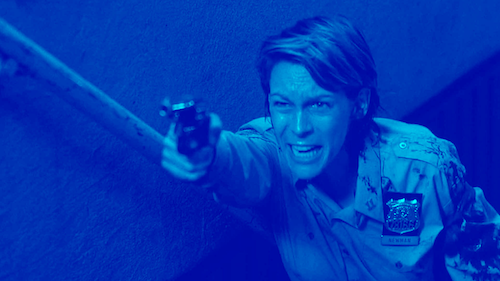
I know many of you already left after my Point Break slander, and now I believe the rest of you are ready to depart after I have ranked Blue Steel above it. Hear. Me. Out. I think Blue Steel is guilty of at least some of my concerns I stated above for Point Break, including the slight corniness (yes, even with that self-awareness Bigelow infuses her early films with), but I find Blue Steel more focused (I know it gets quite silly with its developments, but at least we are mainly zeroed in on Officer Megan Turner, played quite well by Jamie Lee Curtis). I also think that the goofiness of Blue Steel is intentional: as if Bigelow was taking the male-centred action genre and dialing things up to eleven before handing it back and telling the world “This is how your films come off.” You can argue that Point Break is doing the same thing (it very much is), but I find Officer Megan far easier to like and follow than Keanu Reeves’ Agent Johnny Utah in Point Break. Considering the massive following Point Break now has (and has had for many years), I’d like to think that Blue Steel will get that sort of appreciation over time; even with its faults, I quite like this film and its semi-satirical approach to action bravado.

6. Strange Days
We have entered the part of this ranking where Bigelow’s films have taken a major leap in quality. We start off with the most fun action film she ever made: Strange Days. Co-written and co-produced by Bigelow’s ex-husband, James Cameron (hot take: I think Bigelow is a stronger director overall; sorry for the sucker punch, James Cameron), this is a crime thriller that does exactly what Point Break and Blue Steel strive to do: make extreme action cinema profound, exhilarating, and unforgettable. The main difference here is that Strange Days greatly succeeds on all fronts. I find the world building here so rich and grimy, as we see an apocalyptic Los Angeles at the end of the twentieth century (merely four years after Strange Days was even released, so clearly Bigelow and company didn’t have high hopes for the state of the world). In this desolate setting, we find many heightened plot points, eccentric characters, and uneasy conversations: all of these match the extreme action Bigelow was not wanting to let go of (yet, with Strange Days, she finally has a film that feels consistently great). A film that was not overtly well received upon its release by the masses, Strange Days can now be seen as a magnificent blend between the ambitious, gritty action film of early Bigelow and the sociopolitical commentaries of her later career efforts.
5. Detroit
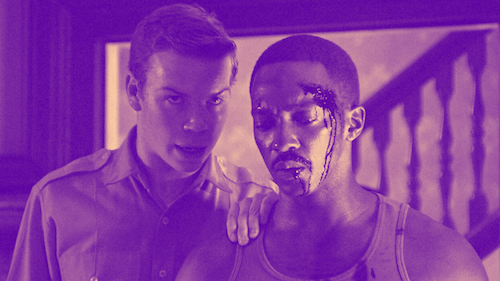
While some of Bigelow’s action films can be considered underrated (especially Strange Days), her most underappreciated film isn’t one that we needed the passage of time to inform us of its mastery. If anything, Detroit was released right in front of our noses, and yet it is still easily Bigelow’s most underappreciated film. This dedicated, thorough recreation of the 1967 12th Street Riot — particularly the events within the Algiers Motel — does not shy around the complicated characters involved, and the hysteria that ensued when one domino fell and sent the rest toppling over. Detroit’s slow-burn pace allows for a buildup of epic proportions: one that feels like a kick to the stomach around the third act, when all is abandoned by the notion of this all being a “misunderstanding” (which is inexcusable when innocent people were tortured and killed). While Bigelow is as intense as she’s ever been with Detroit, something that cannot be overlooked is how the opening chapters of this film showcase Bigelow at her most tender; here she is presenting us her own take on the period piece genre with complete sincerity, but without any false notes or schmaltz. These gorgeous opening moments only make the shitstorm that ensues all the more devastating; how Detroit was essentially completely ignored by most major awards ceremonies is an absolute crime.

4. A House of Dynamite
Bigelow’s first film with writer Noah Oppenheim is A House of Dynamite: a cautionary tale about the impending threat of missile crises and nuclear fallout. The film plays out in three separate parts that are all conjoined by the same foreign missile that is heading directly to Chicago, and we see the same hysteria captured from different governmental and military sectors. There is so much set in stone to protect the American people (and the world), and yet it just isn’t enough. There is no turning back: this is just how society works now. A House of Dynamite lures you in with a thrilling hyperlink narrative (almost as if we are watching three short stories surrounding the same event), only to pull the rug from underneath you and leave you with your own thoughts on the matter; this is a curse that will stay with you well after you are done watching A House of Dynamite. This was hyped up as Bigelow’s next thriller film, but it is actually the closest thing she has made to a documentary yet.

3. Near Dark
The best film of Bigelow’s early career is one that stands almost completely alone stylistically; it only has Bigelow’s debut, The Loveless, to be compared with (and, even then, it would feel like a stretch to do so). Near Dark is impressively inventive: a neo-noir vampiric western that takes the existential dread of all three genres and meshes them into a nomadic nighttime film that feels dialed in from another dimension. Without ever fully succumbing to the tropes of action films, the cheapness of slasher horror flicks, or the self obsession of classic westerns, Near Dark is paradoxically inviting with its holistically alienating nature (as if this is a misfit we yearn to be acquainted with). Bigelow and her writing partner, Eric Red (also responsible for Blue Steel), use the epidemic phenomenon of vampires spawning other vampires as a means of showing characters who are surrendering to the darkness; much like a lone ranger in the wild west, a rebel on their motorcycle exploring the open road, or a wanderer winding up in the wrong bar during the wee hours of the morning. Near Dark is inherently badass: one of the sleekest films of the eighties, and a cult film that deserves its flowers.
2. Zero Dark Thirty
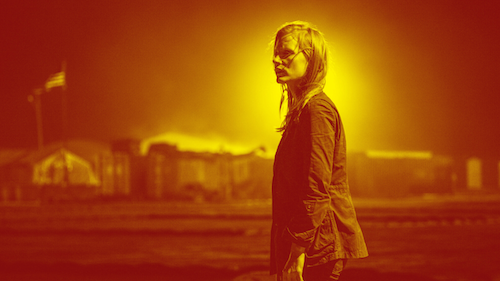
Directly after The Hurt Locker, Bigelow was already aspiring for her next film. Shortly after Al Qaeda’s Osama bin Laden was hunted down and killed by the 160th Special Operations Aviation Regiment (after a long, grueling procedure), it was quickly announced that Bigelow would reunite with writer Mark Boal to create a film about the historic moment; this felt like a questionable choice, and one driven by opportunity and not by honesty, especially since The Hurt Locker had just won Best Picture (many filmmakers and actors turn to weaker projects after giving their magnum opus all that they have). I couldn’t have been more wrong. What transpired instead was Zero Dark Thirty: a political thriller that is riveting and daring. We follow the complicated character of Maya (based loosely on CIA officer Alfreda Frances Bikowsky) from her initiation into the agency to her days as the relentless leader of the mission to capture and kill bin Laden. What kicks off as a quest to honour fallen Americans becomes an act of obsession: one that Maya sacrifices her entire life to fulfill. Zero Dark Thirty concludes with the bold final image of a series of terrifyingly ambiguous questions: was hunting this one person worth all of the blood that came with it; where do we go from here?
Zero Dark Thirty also undertakes the massive gamble of showing the difficult truths to swallow when it comes to the years-long search, including methods of torture (heavy amounts of waterboarding, for instance) in the name of seeking justice (the film leaves you to answer what it presents in your own way). The meticulous multi-year span of the majority of the film’s runtime is beautifully handled with enough information for us to ingest while we see horrific events transpire; all of this leads to the anxious climax that is shown in real time (as close to the actual bin Laden take down as possible); even with a resolution we already know going into this finale, we are left shaken and nervous to the point of feeling nauseous (now that is masterful filmmaking). Not only is Zero Dark Thirty an exquisite and harrowing film, I will die on the following hills; Bigelow was criminally snubbed of a Best Director nomination; Jessica Chastain should have won the Best Actress Academy Award for the role of Maya (her gradual evolution in her character’s personality and mannerisms is a masterclass in acting); Zero Dark Thirty should have won Best Picture over Argo (another political thriller that isn’t nearly as perfected).

1. The Hurt Locker
I remember when The Hurt Locker first came out. It was almost as if Bigelow didn’t exist previously; as if the Kathryn Bigelow who directed Point Break was some other director, and that this director was a brand new face. I feel like the extreme tonal shift with The Hurt Locker — from the stylish action films of old to the massive political dramas — was so abrupt (despite the early warning signs of films like K-19: The Widowmaker) that many barely recognized that this was the same director. Nonetheless, despite the slimmer budget for a war film and the humble beginnings via film festivals, The Hurt Locker grew into the sleeper hit of the year (two, if you include the festival run of 2008, before the 2009 theatrical release): the independent film that could make it to the top. On paper, the plot is quite simple: a maverick-spirited bomb disposal expert is continuously threatening the lives of his new cohorts with his unorthodox practices. The Hurt Locker provides a countdown of how many days are left in this rotation during the Iraq War, and we, the audience, are left to wonder if this squad will survive this duration. In an era where movie trailers give away the biggest moments of contemporary films, The Hurt Locker sees a sequence that is around forty minutes in championed as its moment you do not want to miss: Sergeant First Class William James pulling up seven explosives by one conjoining wire. It only gets more tense from here.
The Hurt Locker is easily one of the most thrilling films of the twenty-first century: a constant heart attack of worry, with the uncertainty of what will happen at any given point. Writer Mark Boal (who would work with Bigelow after this initial partnership) uses his experience as a journalist working alongside a deployed American EOD (explosive ordnance disposal) team in Iraq to create vignettes of horror that paint a fuller picture as the countdown continues, including innocent citizens who are caught in the crossfires of war, and the trauma fighters experience before they are even outside of the danger zone. From a lengthy sniper battle with a creepily ambiguous conclusion to multiple standoffs (where one button press will destroy everything in seconds), The Hurt Locker toys with the concept of time and how precious it is, especially in the heat of battle. Despite all of the above, The Hurt Locker is very much anti-war in sentiment (and the darkness it drives people towards) and in nature (this film is not heavily based on armies fighting armies, and is not a war film in the traditional sense); even here, Bigelow works against the grain to great effect.
While heavily rooted in the George W. Bush era of fear-mongering America (Bigelow tosses in a handful of tracks by industrial metal juggernauts Ministry to make that claim known), The Hurt Locker feels timeless not just because war is an ongoing aspect of politics but also due to two main ingredients: the simplistic delivery of plot, and the deceptive depth of the characters and setting within this basic storyline. I’m not sure how many times I have seen The Hurt Locker at this point, but I feel as sick to my stomach as I did that first watch: when I was a budding cinephile, writing applications to get into film school back in 2009. Many years later — and with the experience of well over ten thousand films under my belt (and likely more) — The Hurt Locker is just as crucial, impactful, spellbinding, and monumental as it ever was for me. A pivotal film of the twenty-first century, one of the great anti-war statements in film, and exhibit A for how suspense and tension can be delivered in a motion picture, The Hurt Locker is also Kathryn Bigelow’s masterpiece.


Andreas Babiolakis has a Masters degree in Film and Photography Preservation and Collections Management from Ryerson University, as well as a Bachelors degree in Cinema Studies from York University. His favourite times of year are the Criterion Collection flash sales and the annual Toronto International Film Festival.