
Minotaur
Written by Andreas Babiolakis
Warning: This review is for Minotaur, which is a film presented at the 2026 Toronto International Film Festival. There may be slight spoilers present. Reader discretion is advised.



Russian filmmaker Andrey Zvyagintsev is my kind of feel-bad auteur: the breed of storyteller who knows how to bring you to the pits of depression. There are two reasons for this. Firstly, he channels the kinds of domestic stories that have forever been plastered on the big screen, so, naturally, he will be tapping into the more disheartening parts of the human experience. Then comes his bigger draw: his love-hate relationship with his motherland. He adores being a Russian but not what has happened to it from a political standpoint; Like Béla Tarr with Hungary or Asghar Farhadi with Iran, Zvyagintsev uses cinema to show how his birthplace — a nation he loves — is slowly dying due to corruption and malfeasance. In his masterpiece, Leviathan, Zvyagintsev explores the inevitable fate of a family whose house is to be demolished against their will. In Loveless, two separated and estranged parents reconnect in effort to find their missing child. Both times, Zvyagintsev explores the hostile, frigid, trash-filled Russia that surrounds them (and doesn’t console them). You feel the weight of a world that keeps on going without us, and the persistence of corruption that we cannot slow down (try as we may); it’s the unstoppable and the inevitable that curse us the most.
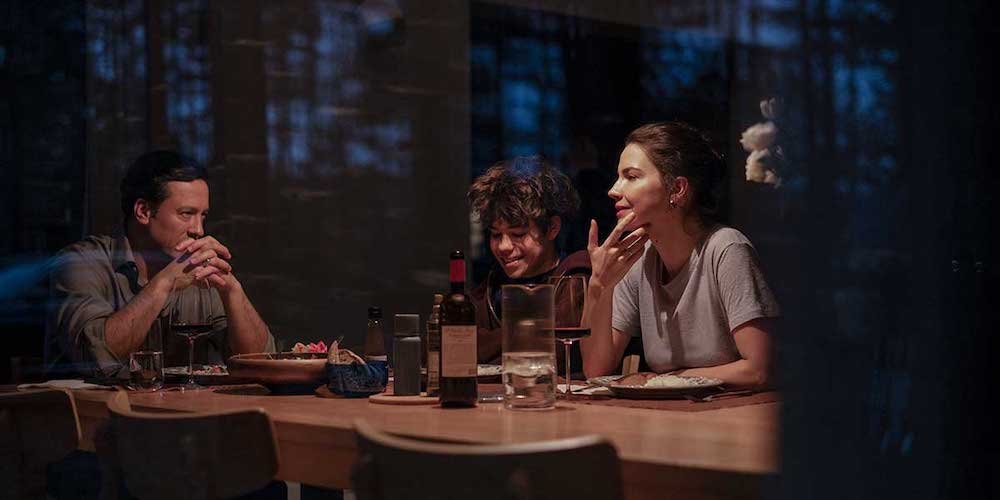
After some time away from releasing motion pictures, Zvyagintsev has returned with Minotaur. The term stems from Greek mythology and is a being who is half man and half bull. It famously was trapped in a labyrinth as a means of being an inescapable prison. Our protagonist, Gleb (Dmitriy Mazurov), is a business executive who is trapped in his own hell. He is tasked with the awful duty of having to lay off a sizeable portion of his team. His wife no longer cares for him, and all of their love is put on so others won’t worry about their marriage (they are essentially staying together for their teenage son). On the topic of their son, he is being bullied and asks his father for advice. It feels like eyes are peering at Gleb from all around, from the menacing portrait of Russian President Vladimir Putin overlooking a meeting room to the propaganda slogans trying to encourage youths to enlist in the attack on Ukraine. These are his labyrinth. He is part man in the sense that he tries to be a provider, a husband, and a father. Minotaur focuses on how he is also a bull, and it doesn’t take much: just what I like to call the cherry bomb on top of a series of escalating disasters.
That final straw comes in the form of Gleb’s distant wife, Galina (Iris Lebedeva), and her unearthed affair with a much younger photographer. With everything else going on, this surprisingly doesn’t really make Gleb snap as much as it encourages him to try and assess the situation in his own invasive way (including heading to the photographer’s house to speak with him). You will know the moment where Gleb snaps when it happens, and Zvyagintsev keeps Gleb’s tantrum to a minimum; all it takes is one wrong move to destroy everything. The domino effect that collapses behind Gleb’s poor choice chase after him like a deadly wind; if Russia’s landscape didn’t look barren and derelict before, then Gleb’s life as a result of his one action will make his backdrop look like anything but a paradise. Much of Minotaur is also based on the concept of identity: how we are perceived by others, and how we perceive ourselves. This concept is brought up early via a telling dinner conversation by Gleb and one of his rich friends; Gleb recommends that his wealthy buddy stops using hired help for once in his life so that he can rediscover bits of himself as a driver, a cleaner, or any other form of labour — his friend disagrees. With the persistent recruitment messaging all over the film, there’s the notion that we must uphold the expectations held by others; Minotaur challenges what these can mean. Overall, on the topic of identity, Gleb may see himself as a martyr or a tragic figure; the rest of us may see him instead as a monster.
Much of Minotaur is strong, but it is its final act that solidifies it as a highlight of the year. It is a moment when Gleb is given the opportunity to make another choice: one that can cleanse his soul as an awful figure. Instead, he chooses to act selfishly again. This time, he is not acting out of panic or via a sudden tantrum: it is a calculated decision that clarifies that he is not only capable of evil — he simply is evil. Instead of helping someone out in the face of the likely fate of fatalistic war (where the youth of today will give up everything because their country expects them to), Gleb thinks that this is a good opportunity to clear his name; he ruined his life because of his own poor self control, and he chooses to fix it. The life he affects didn’t have a say in how they were condemned forever (whatever the rest of their life may look like). This makes Gleb an awful person, so much so that his primary concern — the shattering of his family — is “resolve” (albeit through fear). A final shot of the clouds — looking labyrinthine in nature — shows what we have just gone through. The clouds begin to cascade and collide into one another, becoming a big fluff of indiscernible textures. We know that the maze is still there, even if Gleb decides that he is no longer trapped in a maze; someone who is their own worst enemy will forever be imprisoned, and it is only clemency and surrender that will save him now (if only he could figure this out).


Andreas Babiolakis has a Masters degree in Film and Photography Preservation and Collections Management from Toronto Metropolitan University, as well as a Bachelors degree in Cinema Studies from York University. His favourite times of year are the Criterion Collection flash sales and the annual Toronto International Film Festival.