
The Odyssey
Written by Nicole Cabrera
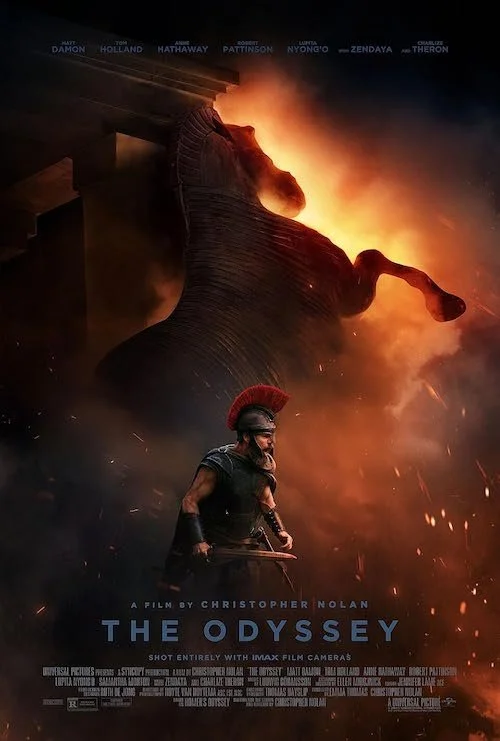

Very few things in life fully earn the title of “epic”’ while many aspire to that title their whole life, in order to be an epic its impact on history can't be fully defined or measured but important none the less and its impact has stood the test of time. The character of Odysseus and his ventures has been passed from tongue to tongue in literature, pop culture and turn of phrase; despite the uncertainty of the epics author Homer — there is certainty in the longevity of this classic sweeping tale of a man’s journey home displaying a spectrum of human emotions , their strength and tenacity as well demonstration the foundation of Greek culture. While the story has been brought to film to varying degrees over the years, it has never been done quite like this by any working director of our time. At its helm is Christopher Nolan, most famous for the Dark Knight Trilogy, mind-bender films like Inception and Tenet and more recently historical tales like Oppenheimer, with the Odyssey Nolan dives into the roots of history to tell us a tale we have heard, but never quite like this.
I've been haunted by The Odyssey by Homer through a lot of my university degree, with a specialization in history I pivoted heavily between American and Hellenistic histories and as a result I ran into The Iliad and Odyssey many times in my time. These tales of oral tradition are used to lay the basic groundwork for Greek society traditions of life, death, respect, battle etc. Within them there is an urgency of having one’s legacy remembered for better or for worse. In many ways Odysseus manifests those qualities as a natural leader; he is a man determined to get his men home and one who deeply loves his wife Penelope and his son Telemachus. On the flip side he is also a man who is reckless, foolhardy, stubborn and haunted by guilt — despite all the supernatural elements and interjections from gods — under Nolan’s hand is surprisingly human.
The Odyssey is at its core a story of finding home even when that home has changed. After playing his role in the fall and sacking in Troy, wayward journey becomes even longer for Odysseus (Matt Damon) and his men — when, a pit stop on an island sets the dominoes in motion as a foolish and dangerous interaction with a cyclops inside its cave leaves the men trapped and with their lives in danger. Desperate and out of options they sneak out disguised as sheep but in true stubborn male fashion, Odysseus can't simply let it go and grievously wounds the cyclops that is Poseidon's child — which leads to Odysseus and his men having targets painted on their backs and their journey back becomes much longer and dangerous.
From here, Nolan sweeps us off to various islands with giant soldiers, to witches that turn the soldiers to pigs, whirlpools and sirens and even a journey to the underworld in the quest to return to Ithika, all the while the men seem to be growing more restless and less trusting of Odysseus. While Odysseus seems to be fighting against fate and trying to wrestle what seems to be already laid out plans for himself and his men from the gods themselves. Likewise, while this is happening Nolan skillfully shows us glimpses of the past — of Odysseus’ love with his beloved wife Penelope, his relationship with his citizens and his mentors showing him as more than a warrior but a man as well.
As Odysssus spends his many years away — the battle at home becomes more restless, the suitors all pining for Penelope’s (Anne Hathaway) hand with the assumption her husband is dead — led by the slimy and cowardly Antinous (Robert Pattinson) does everything in his power to sway her as she weaves and unravels her rug to pass the time while trying to maintain a hold on her kingdom and her son Telemachus (Tom Holland) who is desperate to protect his homestead and fill the shoes of a father he has never known.
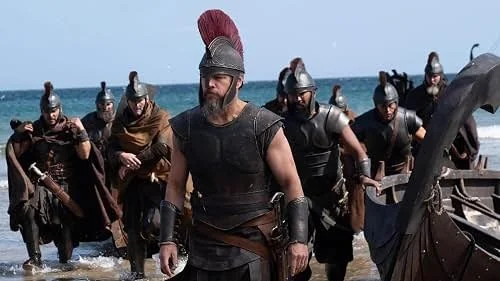
Christopher Nolan’s The Odyssey aims to redefine what the cinematic epic can be; it’s at least a different take on Homer’s frequently adapted source material.
Ultimately Odysseus is able to break out of his stupor and away from Calypso and go home. Finally, on the shores of Ithaca Odysseus is both able to see how the world has moved on without him and questions his place within it; after reuniting with his son and his servant Eumaeus (John Leguizamo) the three hatch a plan to reveal his identity to his beloved Penelope, and chase the suitors out of his home and take back what is rightfully his. Odysseus must reclaim his place and prove to himself as well as his love that he is worthy to lead Ithika and rejoin his family life despite sacrifices, the passages of time — that come what may, no ocean, nor enemy, nor god could stop him from finding his place once again.
Despite the groundwork for all the great acting done within this film; one of The Odyssey's greatest strengths is bringing a story of myth and magic to life; in a world that seems to be foolishly rushing headlong into AI — with the pretext that it makes film making easier — Christopher Nolan has seemed to double down hard against that notion and made his stance on his dislike of AI crystal clear. It is a breath of fresh air to see the creativity and diligence to make scenes that seem visually impossible be in fact wonderfully practical; whether it's casting incredibly tall actors to play ominously tall soldiers, giant puppets for the cyclops or animatronics for a truly frightening transformation of men into pigs, (that was actually visually horrifying and it feels like Nolan was testing the waters to venture into the horror genre) or burying actors alive to make their entrance from the underworld more realistic — this use of practically is seen to impact its cast as they are the top of their game.
As a result of such vivid and stunning visuals the acting that comes along with it was top tier, In particular; stand out performances such as that of John Leguizamo as Eumaeus Odysseus’ servant and watcher of the homestead, he proves countless times through the film the virtue of loyalty, and silent strength being the words of wisdom in many a character’ ear despite not being in every scene. Leguizamo brings heart and humour to a role and is probably one of his strongest in the last couple of years. Smaller roles but equally as impactful were that of Benny Safdie as the legendary Agamemnon who rules by sheer image alone — almost unrecognizable in military garb but carrying the aura and presence of a fierce and mighty warrior and that of Elliot Page as Sinon a fellow soldier from Ithaca who took another place and fought bravely beside Odysseus and acts as a menacing guide in the afterlife.
In Odysseus’ immediate family the roles of Telemachus and Penelope were ones I was skeptical of. As a reviewer, I’ve never been the biggest fan of Holland; but this by far his strongest and most emotional performance, he carries the burden of being the heir of an empire but no ability to step into the position; while having a love for a ghost of a father figure he has no memory of.Holland successfully walks the delicate line of having the fiery rebellious youthful spirit and the boy that needs the comfort from his father. Holland and Damon play wonderfully off each other creating that bond of familial love, especially in the last chapters of this epic. True to Holland and Damon’s chemistry their reunion is not over-dramatic but really a flurry of emotions all at once.
Likewise, Anne Hathaway as the titular Penelope queen of Ithaca Hathaway stood out and flushed out her character. Penelope is not simply a sad pining wife as is often portrayed; a role usually used to weep and worry — but rather Nolan (who it has been argued time and time again struggles to bring female characters to life) here, brings some bite and grit to Penelope. Yes, she is devastated about how long her husband has been lost at sea and growing fear from the uneasy suitors but more interestingly, she is in a place of frustration as well; as queen she has seen her husband rule, she knows how power works and the fragility of her kingdom but because she is a woman. No one even bats an eye at the possibility that she could lead including her own son. While she is driven by the love of her family it brings a depth to her character and highlights a very real life of women at the time. Hathway in contrast to this character trait however has excellent chemistry with Damon, in Odysseus's return to Ithaka and while disguised their longing and love for one another shows clearly and their desire to be in each other embrace once again rings true, showing one another that despite it all. When the love is real no matter how far away they may be — they are still worthy all these years later. At the other end of spectrum of heroes well cast; never to be deterred from being a sleazebag, or a villain Robert Pattinson as Antinous is seen to be a joy as the ringleader of potential suitors partly seductive and scheming it obvious he's having a ball with the role.
Matt Damon as Odysseus has the most challenging role of playing a character from a myth that has been shaped and re-written so many times it's hard to know who he is. While in physicality Damon looks the part of strapping world weary captain and soldier, emotionally much like Hathaway brings depth to a legendary character He and his. He is seen to be noble and just leader and someone that cares for his soldiers (despite his foolish actions and share loving devotion for his wife Penelope (arguably one of the only other people Matt Damon has that much devotion for is his best pal Ben Affleck). On the other end of the spectrum, he shows the follies and stubbornness of man — doing hings despite being warned of the danger, the aspect of doing things alone, purposefully pursuing defying the gods — but below the surface there is a realism: the trip has gone on far longer than it should; it shows there is reason for it and part of it is the guilt of war.Odyseuss is aware of the things he did in the name of victory and glory of war and how the fall of Troy changes the trajectory of history; as seen in him being simultaneously haunted and guided by Athena in the guise of one of the victims of war. Despite this, Damon does an excellent job of making the character feel lived in world weary and tired and when he returns to his precious Ithaca the elation of going home — travel is wonderful but ultimately, going home is its own release.
No film is without its roadblocks however, and though Nolan’s are often few and far between this is no exception- as with previous films Nolan’s films at least under initial screening are a little long in the tooth especially as Odysseus returns to Ithaca. Likewise, while a lot of the casting is well done; the one role that doesn’t fit is that of Charlize Theron as Calypso who at times seemed too modern for the character and out of place and the island on which she resided i expected as completely different environment and those moments took me out of the film.
One of the most intriguing traits about Nolan’s vision of The Odyssey is that in epics past where the gods have crucial roles and often times are seen to move people around like chess pieces and their decisions are almost out of their hands; whether it is due to the gods’ influencing them, backing up their decisions or almost guiding their hands. In Nolan’s world they are shockingly absent and silent, Athena (the wonderful Zendaya) is there almost like a judging guardian angel than a comforting god, and while the gods are seen to step in to establish what is right and within their society traditions — sacrifices, tributes etc. — and punish those who defy them or disrespect them or their, property. Rather, actions and consequences fall to man — Odysseus is responsible for his victories as well as his failures; his rash actions be it with the cyclops, leading his men into danger on Cyres’ island, the battle with the giants in the classic epic land everything oddly falls on Odysseus shoulders — despite everything he did, as stated this version feels oddly godless which is both terrifying and refreshing as it makes man responsible for his action and where there is room for great mistakes, hardships, accidents and pain at one’s own hand there is also equally room for for bravery, reconciliation, forgiveness and love by man’s own hand as well.

Nicole Cabrera is a Toronto-based film enjoyer with a passion for the eighties, horror, and deep diving their favourite actors’ obscure filmography. When they’re not watching movies, they're writing, crafting, cosplaying, going to concerts, working on their podcast (Hollywood Deepdive) and dreaming of traveling.