
Filmography Worship: Ranking Every Erich von Stroheim Film
Written by Andreas Babiolakis
Filmography Worship is a series where we review every single feature of filmmakers that have made our Wall of Directors

If you are a fan of classic cinema, you may be familiar with Erich von Stroheim in or — or maybe two — different ways. Firstly, he is an acclaimed Austrian-American actor, affiliated with beloved films like Billy Wilder’s Sunset Boulevard, Jean Renoir’s La Grande Illusion, and a slew of B-picture works in the forties. More importantly (in relation to today’s article), Stroheim was also a filmmaker and one of the earliest examples of a director who was also primarily a thespian (he also wrote a majority of his own films). Starting his career as a stuntman during the formative years of the industry (in the 1910s), Stroheim transitioned to acting. He was an uncredited part in the ambitious epic Intolerance by D. W. Griffith: a film that saw a number of assistant directors to help the massive vision come to life. Stroheim was one of those A.D.s, and he got a taste for the director’s chair ever since. It didn’t take long for him to start making his own motion pictures, kicking off with his debut, Blind Husbands, after the First World War in 1919. He was one of the earliest auteurs to dare to take major risks, including shooting on location (as opposed to the popular method of utilizing film sets) and pushing the limits of what a motion picture could look like (from duration to narrative).
However, Stroheim was frequently butting heads with studio executives, actors, and producers. His most lauded project, Greed, was infamously ten hours long before being forced down to a more digestible length; this back-and-forth series of arguments between Stroheim and Metro-Goldwyn-Mayer (as well as its brutal initial reception) damaged Stroheim’s career; even after directing a successful film like The Merry Widow, Stroheim was still blemished as an impossible director to work with. After being dismissed from a couple of final projects, Stroheim ultimately stopped directing and remained primarily an actor. Today, Stroheim’s aesthetic, intense, psychological films are clearly adored, and his perfectionist approach has led to the reassessment of the majority of his works. With a couple of his very few films deemed lost (including The Honeymoon and The Devil’s Pass Key), we are left with seven feature films to explore. I won’t include Merry-Go-Round (one of the few Stroheim films that he was fired from mid production) since his involvement with that picture is debatable (it feels more like a Rupert Julian picture, and Stroheim’s contributions may only be around a third of the finalized picture). Let us celebrate someone who boldly questioned the responsibility of a filmmaker and the many hats they could wear during an era where the industry was still figuring itself out. Here are the films of Erich von Stroheim ranked from worst to best.

7. Hello, Sister!
There aren’t many films to pick from and nothing in Stroheim’s career stands out as an explicitly atrocious picture, but Hello, Sister! is still the least memorable picture for me. Stroheim’s final film was technically Walking Down Broadway, but the film was reworked once Stroheim was fired (for the film’s sexual content) and a number of filmmaking hands (like Raoul Walsh and Alfred L. Werker) meddled with the original film before frankensteining it into Hellow, Sister!. The end result is the far-safer, highly typical romantic drama that we can now see here. Even then, Hello, Sister! was barely meant to see the light of day, and even this cobbled-and-hobbled version was lost before being unearthed in the seventies. This film, for what it’s worth, is okay but unimpressionable, and Stroheim’s alleged, intended themes of progressive sexual representation in cinema are beyond impossible to find in this watered-down, passable picture that is only being discussed because of its context.
6. Blind Husbands
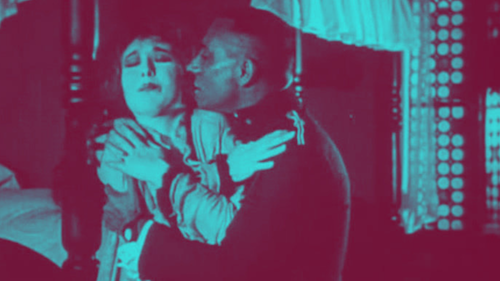
The rest of Stroheim’s films are far easier to recommend, and so we continue with the “worst” of the best: Blind Husbands. Stroheim’s directorial debut in 1919, Blind Husbands is the common tale of two men who are infatuated by the same woman (if you watch enough silent films, you will come across countless amounts of this same story). What impresses me quite a bit about this film, despite its slightly obvious story, is how frequently Stroheim experiments with his film: so much so that he was accurately crowned a leading innovator when this picture was released. The massive budget (by the standards of its time), elaborate sets and photography, and keen style were instantly noticeable, and the atmosphere he created (one that surpasses the industry’s initial conquests of realism and/or illusion amidst spectacle) was undeniable and influential. Today, a film like Blind Husbands is more of an academic time capsule that will inform you of where the filmic medium was at in 1919 and how Stroheim was an integral force in shaping it; you may still enjoy it, but it is strong as an artifact first and foremost.

5. Queen Kelly
A must-watch for any fans of Gloria Swanson, Stroheim’s Queen Kelly is now one of Stroheim’s more popular titles. However, its initial reputation is not a glowing one, what with star Swanson and Stroheim’s constant feuding and the latter’s dismissal from the production towards its final stages (unlike Merry-Go-Round, I do consider this a Stroheim picture, even if he wasn’t able to see it to the very end); Richard Boleslawski was brought on to finish the film. This schism has resulted in two different endings; Stroheims sees the complicated, haunting provenance of the title “Queen Kelly,” while Boleslawski’s (or the “Swanson” ending) is a more tragic yet sudden turn. Even though the two biggest names attached did not see eye-to-eye, Queen Kelly is a fairly sizeable title in either Stroheim or Swanson’s legacies; the two would eventually work together again in Billy Wilder’s masterpiece, Sunset Boulevard (both actors were nominated for Oscars); if Swanson’s silent-star character is a depressing look at a fizzled career, I think Stroheim’s character needs to be a part of that same conversation.

4. The Merry Widow
After Stroheim put everything he had into Greed, he followed up that insane effort with quite a different film: the romantic drama, The Merry Widow. However, he doesn’t waver from his mission to expose the worst traits of people when they are either desperate or poisoned by capitalism; here, wealth is something to take pride in and anyone without it is unworthy. What I love about this fairly twisted picture is how Stroheim doesn’t fall for his own melodramatic cautions (regarding how little value money and prestige holds in the grand scheme of things) but, rather, his ability to lean into the fair amounts of ridiculousness of his own story. It’s this snark — and Stroheim’s signature artistry — that render The Merry Widow a film that is quite ahead of its time: perhaps a precursor to the many absurdist and/or heightened conjurations of sociopolitical buffoonery that would transpire in the century since Stroheim’s smash hit motion picture.
3. The Wedding March
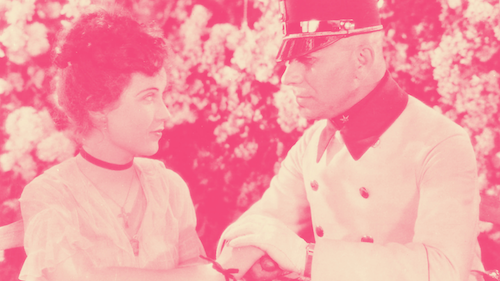
There is a contrast between the two themes that are central to The Wedding March: true love versus what life has in store for us. So many other romantic films chase after that happy ending, yet Stroheim leaves us questioning what that even means in the filmic medium. This picture sees two people — an army officer (played by Stroheim) and the daughter of an innkeeper — falling in love; they are meant to be together, and yet — due to the stupid stipulations of society — they aren’t meant to be together. This early experiment in synchronized-sound cinema sees the world come to life around our lovers, even when they are forced to separate and pave their own paths. I appreciate how Stroheim commits to the unfortunate side of romance: the fact that it doesn’t always work out how we would like for it to. Do we venture forth in the way that is expected of us (within our classes, with the person hand selected for us, finding a benefactor who will grant us the money we need even if we do not connect with them)? Or do we choose true and honest love? Stroheim doesn’t want you to fall into the blind delusions of Hollywood: being in love is not that easy. The sequel to this film, The Honeymoon, is sadly lost; from what we know about the film, it only furthers Stroheim’s focus on the misfortune attached to love.

2. Foolish Wives
It did not take Stroheim long to want to go where no other filmmaker back then dared to; his breakthrough picture, Foolish Wives, was meant to be a ten hour affair (something he would attempt again; more on that in the next and final entry). The film was reduced to two hours and twenty minutes, but it is still an audacious effort: one that was the most expensive film of its time (with a budget of over a million dollars, which was previously unheard of). All of that effort results in a coalescing, swirling thriller about assumed identities (particularly that of a grifter who feigns being a Russian count — and the disasters that ensue from his efforts). Even though Stroheim didn’t quite get what he wanted with his original plan, Foolish Wives is still as complete as one of his films feel: it goes the distance with the kinds of shots, plot developments, and characters that he loved creating (glorious worlds and the worst kinds of people within them). While most other directors were trying to play the ever-developing game of filmmaking in the early days of the industry, Stroheim was already gunning towards the possibility of modernist cinema with works that would challenge both the medium and those wanting to witness it; Foolish Wives is a great example of this (and, if the studios just let him undergo his passions, he was clearly only just getting started, here).

1. Greed
One of the most bittersweet notes in silent cinema is Stroheim’s Greed: a film that never was — and, yet, it is everything. If Foolish Wives wasn’t already a dangerous dance between the auteur and the studio system, then the appropriately-titled Greed was the coup de grâce in that tango. As history — and, at this point, mythology — dictates, Stroheim’s magnum opus here was meant to be ten hours long. It is the ultimate American tragedy: one of the soul-sucking ways of fortune and the rise-and-fall of capitalism in the American landscape (and the supposed dream that is meant to come with it). Our central household strikes gold when its wife wins the lottery; however, if Greed was an optimistic film, it would only be ten minutes long, not hours. Stroheim analyzes the slow-burn art of falling-out that transpires when such a “miracle” takes place, and, before you know it, Greed becomes the study of human beings within a broken, tilted, unjust system. Stroheim’s film takes its time getting into all of the particulates of desolation and its cursed irony; how can we feel so incomplete and alone when we are riddled with tragedies that only multiply? By the end of Greed, this picture — that once promised prosperity — leaves us gasping for hydration in the middle of the driest desert in all of the silent age: a barren wasteland that mirrors the emptiness of our dying characters and their foolish, futile efforts.
However, the legacy of Greed goes far beyond the genius and grandeur. Like Foolish Wives, Metro-Goldwyn-Mayer forced Greed to be lopped down to a two-hour runtime, eviscerating it and dumping out as much of its juicy, pertinent substance as possible in the wake of Stroheim’s masterpiece. Even this highly-incomplete version of the film has since been reappraised as a critical film in the history of the medium (as well as an important take on economic corruption in the United States). As of 1999, there has been a second version of the film (by Turner Entertainment): a middle ground. Many of the missing sequences are now replaced with still images from magazines and/or set photographs, with intertitles used to flesh out what each picture represents (and to connect the story). Even in this bastardized form, Greed is an astonishing watch: one where the damnation of fortune permeates through these sequences (it just so happens that some now feel like frozen snapshots of a family and nation in limbo). Yet, that elusive, coveted, uncut version is still undiscovered; are we no better than those in the film if what we have isn’t good enough — that we must have the very version of the film that greats like Sergei Eisenstein and Jean Renoir have deemed one of the greatest achievements in cinema? I know that I crave the complete version of Greed; I don’t think Stroheim views us as weak for giving in to temptation and the possibility of “more,” and that he is more critical of the world we have grown up in that has made us forever desire.
To me, Greed is highly comparable to the album Smile by The Beach Boys (primarily their mastermind, Brian Wilson). For years, the gestation of these passion projects was more well known than the eventual end results (the two-hour cut of Greed, and Smiley Smile). Both visionaries — Stroheim and Wilson — were stopped from fulfilling their aspirations; both projects were seen as costly, pretentious, nonsensical, and a waste of time. Most of all, neither were seen as profitable: something both Stroheim and Wilson didn’t care about. They both differ in their approaches to how they saw America: Stroheim envisioned this nation as one that can devour us whole, even when we believe that we are in control; Wilson saw adulthood as a playground wonderland for us to explore, and that we all lost our senses of whimsy and glee. How they are similar, however, is that Stroheim and Wilson pictured the American people as ones to root for, even at our lowest and most disillusioned: there will always be goodness in us, even at our most jaded. Going back to analyzing both works as artifacts, both Greed and Smile gained new life in their secondary forms: restoration projects that assembled as much as their respective teams could muster to bring these works back to their original states (with incomplete, yet rewarding, results); both works are life changing even when much is missing. We will never get Wilson’s Smile; we will never get Stroheim’s Greed; the little that we do have is close enough, and even these latest iterations are magnificent and untouchable. Shame on the avarice that comes from the turning of art into businesses, and the casualties of masterworks that occur.
If anything, the three versions of Greed tell their own story. We have the death and pestilence that transpires when money gets in the way (the two-hour cut), the urge to chase after more without ever feeling satisfied (the elusive uncut holy grail), and the mature realization that we can feel fulfilled and be pleased with what is presented before us (the four-hour effort that restores as much as possible). The legacy that this film has is indicative of what it was trying to warn us about: we either already have enough, or we never will. For me, Greed is one of the greatest silent films, and I am at peace with knowing that I will likely never get that ten-hour cut. I don’t need the unethical monkey-paw potential of artificial intelligence to fill in the rest of the missing gaps for me. I get enough from the film that exists (which, to me, is as full as it will ever be). I see a motion picture that inspired many auteurs to keep going, even in spite of the many executives who prioritize grosses over expression. I have witnessed a film that didn’t even feel possible back in the twenties. I can claim that I have seen a remarkable look at the ebbs and flows of western civilization, told by someone who knew that money wasn’t always the answer. In that same breath, I consider Smile one of my favourite albums, even if it isn’t quite what Wilson had in mind before his recording sessions were brought to a screeching halt. Does this not tell the biggest story? That these opuses full of holes are still better, more impactful, and more honest than anything driven for profit? That Erich von Stroheim’s tarnished film, Greed, is still one of the best classics (and is far greater than the countless films that studio heads shit out to make profits)? That art will never surrender to greed? Greed is two sides of the same coin: the ingenuity of creation, and the paralyzation that comes from those in power who operate with rapacity. A Greed in fractions is more complete than those driven by fortune who will wind up dying with regret, hopelessness, and emptiness.


Andreas Babiolakis has a Masters degree in Film and Photography Preservation and Collections Management from Toronto Metropolitan University, as well as a Bachelors degree in Cinema Studies from York University. His favourite times of year are the Criterion Collection flash sales and the annual Toronto International Film Festival.