
Filmography Worship: Ranking Every Mikhail Kalatozov Film
Written by Andreas Babiolakis
Filmography Worship is a series where we review every single feature of filmmakers that have made our Wall of Directors

While some of his films often wind up on lists of the great works in cinematic history, rarely do you see Georgian-Soviet director Mikhail Kalatozov himself appear in similar celebrations. This could be for a number of reasons. Firstly, that — outside of winning a Palme d'Or and being nominated for a slew of other awards, including a Golden Globe — Kalatozov's films were basically forgotten until the nineties, when his works were rediscovered by filmmakers and restoration experts (like Martin Scorsese's world cinema project, and Francis Ford Coppola). Kalatozov experienced a posthumous career resurgence, with a handful of his films being cherished as masterpieces (their legacies only continue to grow). That is the positive side of this question.
The negative is that — all in all — Kalatozov was almost strictly a propaganda filmmaker, which tarnishes his reputation at least a little bit. Of his numerous cinematic accolades he has garnered, Kalatozov was also bestowed the title of being a People's Artist of the USSR later in his life; take from that what you will. Having hopped from job to job, a young Kalatozov eventually wound up in the film industry in his twenties — he even changed titles within the industry, including being a cinematographer at one point (which can explain his affinity for highly-aesthetic filmmaking) before finally becoming a filmmaker. Like, say, Sergei Eisenstein, Kalatozov's government-funded titles became so artistically inclined and ambitious that their original communist-leaning intentions can feel subdued compared to what audiences take away from his works; while this softens the blow for some cinephiles, I cannot argue against those who may have a problem with Kalatozov's films.
So, yes, Kalatozov's filmography has been reevaluated in the past thirty years (not that his films were ever disliked upon their release, mind you). The breathtaking, innovative cinematography in his latter period — mainly thanks to the mastery of his director of photography, Sergey Urusevsky, whose crane expertise, one-shot brilliance, and many other sublime techniques — still feels ahead of our time, never mind sixty and seventy years ago. Kalatozov's intrinsically emotional angle also makes for motion pictures that you feel more than you study (perhaps this is why many of his messages of propaganda got lost on audiences). Even with all of this reassessment, the entirety of Kalatozov's filmography is still a little neglected, save for a couple of titles. I will say that the bulk of his career is visually stunning, but his lows can be decent with far too much cheese. His highs, however, are some of the greatest cinematic works I have ever seen. I hope this list proves to be a valuable resource for you, whether you are partially familiar with his films or completely new to this director. Here are the films of Mikhail Kalatozov ranked from worst to best.

12. Conspiracy of the Doomed
It is true that a few of Kalatozov's propaganda films surpass their intended purposes given their extreme artistry. However, his weakest film is amongst his most blatantly motivated works: Conspiracy of the Doomed. What is essentially a tribute to Joseph Stalin (yes) an a method of fear-mongering, Conspiracy of the Doomed is as technically proficient as anything else Kalatozov has ever directed, but, goodness, is it an awkward watch, considering just how obnoxiously driven this title is. While other Kalatozov works feel otherworldly, this one is theatrical, corny, and kind of pathetic with its obsession. It is easily his worst, and the only one I could not care less about. Pass.
11. Hostile Whirlwinds
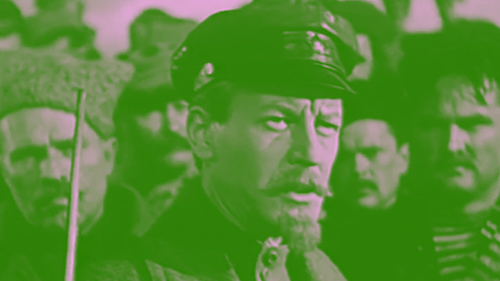
On the topic of blatant propaganda, here's Hostile Whirlwinds: a film about the forming of Soviet power. What is meant to be a tapestry of political and personal relationships across the nation during these formative years instead comes off as filmic ass-kissing that sadly guts many of the stronger moments in the film because of its political coddling. I'd also like to point out that this is not a Kalatozov film that features an actor playing Joseph Stalin like a couple of other works of his have, but I cannot actually do that; the Stalin scenes were removed only after the politician died. If that doesn't tell you anything about Kalatozov and the film's intentions, I'm not sure what will. Overall, this is a bit of a treat to watch until you pay even the slightest bit of attention and feel that artistry dissipate under the weight of weaponized filmmaking.
10. Courage
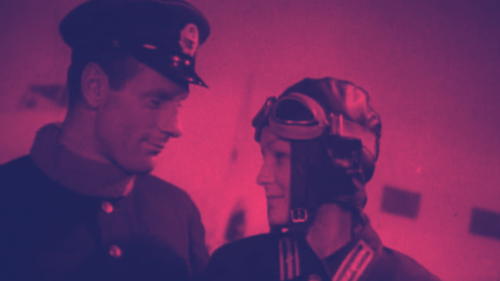
Kalatozov's first talkie, Courage, is obviously a filmic recruitment method to get viewers interested in serving their country — here, we see a master flying ace undergo a tricky mission to intercept a saboteur. It goes without saying that most Kalatozov films will have a similar underlying message, but I do appreciate when his films also strive to be fully-evolved stories in and of themselves. Courage may pale in comparison to his greatest works, but it is still quite a technical marvel for its time: a sign of a director who didn't just want to make motion pictures: he clearly knew how to make them. Maybe leave this one for last when you go through Kalatozov's films, but I also wouldn't recommend you leave it out completely if you have liked what you have seen so far; it's at least decent.
9. Valery Chkalov
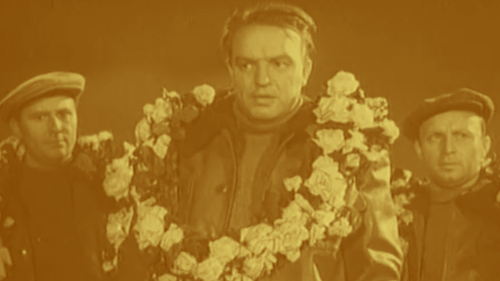
Like most other directors from all over the world around this time, Kalatozov not only had the Second World War on his mind in 1941, he was explicitly forced to speak about it on behalf of his nation. Valery Chkalov (also known as the cheesier Wings of Victory in the United States — perhaps intentionally) is a bit heavy handed as a result, and it doesn't accomplish everything it sets out to do as a depiction of the well known Russian pilot of the same name (I suppose the film was meant to spotlight a man who accomplished a number of flying records as a means of motivation). However, as narratively thin as this film is, it is another exposition of Kalatozov's filmmaking expertise. Just expect this one to be a little frustrating with its propaganda, down to the point that they literally have an actor (Mikheil Gelovani) starring as Joseph Stalin in the film.

8. The First Echelon
Kalatozov's last film before his magnificent four-film run towards the end of his career is The First Echelon: a semi appropriate name given what it marked in his filmography. What is clearly a means of motivating younger watchers to become hard workers and bright spirits comes off as something a little bit more poetic and interesting instead: a depiction of our relationship with the land (as soil, as a geographical location, as a piece of political and cultural identity). What inspired one Terrence Malick during his production of Days of Heaven, The First Echelon is quite a beautiful film (even with its clear intentions); it might not be quite as impactful as Kalatozov's greatest works, but this is certainly cut from that same cloth.
7. True Friends
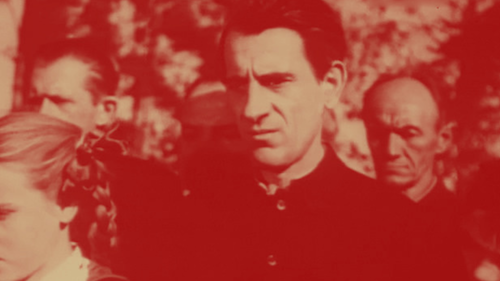
Believe it or not, Kalatozov has at least one film that is not blatantly political in any way. If anything, True Friends feels as antithetical as he has ever been, and I kind of wish he made more films not just like it but as different as this one is from the remainder of his career. His funniest film, this fable of three friends reuniting later in life sees how they connect via adversity and hardship (or, really, the shenanigans that ensue when they are trekking down the Volga river on a raft). To see Kalatozov's lighter side in this rather-underrated film is quite a treat, especially when you don't always feel like there is a message being crammed down your throat. Chances are you don't even know this film; I certainly would have not come across it if I wasn't going through all of Kalatozov's feature films. I would recommend you get acquainted with this lovely outlier in his filmography.

6. Nail in the Boot
A big reason why I cut Kalatozov a bit of slack is because of his narrative feature film debut, Nail in the Boot. Believe it or not, the same man who became a "hero" to the Soviet Union for his propaganda films was in hot water with that very government back in the thirties; so much so that Nail in the Boot was outright banned, and his career floundered for nearly a decade afterward (perhaps this is why he played ball in the end, and it is quite unfortunate if this is true). What is meant to be an allegory of the importance of efficiency — the quality of a soldier's boots, in this case, and the kinetic domino effect of what can transpire — became a cause for concern by the Soviet government: a declaration that Kalatozov was mocking the trustworthiness of his country's military. It goes without saying that one can be patriotic without being idiotic (I mean the act of blindly approving of everything), but Kalatozov's attempt to prove his loyalty within reason severely hurt him. He would try again decades later into his career, however.

5. The Red Tent
Kalatozov's final film, The Red Tent, is almost as beloved as his big-three titles (more on those shortly); it is clearly slightly inferior but still made by a man with ambition. His only film to attempt to bridge multiple nations at once (I Am Cuba is specific to Cuba, I'd argue — it's literally in the name), The Red Tent is a Russian-Italian-English affair that aspires to be a Hollywood epic of sorts. It can come off as a little kitschy despite its intentions, but I am willing to let it slide in a film this grandiose (as we find ourselves circling an Arctic expedition and its fallout). Featuring the eclectic cast of Peter Finch, Sean Connery, Claudia Cardinale, Massimo Girotti, and Hardy Kruger (amongst others), The Red Tent is Kalatozov's first and last attempt to branch out to new audiences around the world. It doesn't compare with the projects he strived to conjure up, but The Red Tent has a bit of an intrigue surrounding it because of who made it; Kalatozov's aesthetic and experimental-esque attempts elevate this film enough that I see something oddly sincere amidst the political heat.

4. Salt for Svanetia
Kalatozov's debut film is a documentary (in fact, he had a few documentary shorts at the start of his career, which I have not included here due to their scarcity and difficulty to find). One of the earliest ethnographic films ever made, Salt for Svanetia is an exquisite look at the Svani people in Georgia and their struggles to survive due to the lack of salt in their region. This documentary is visually astonishing; even with its clearly political tone, this is such a moving affair that I barely feel its intentions (it also helps that it is less than an hour long). If anyone were to accuse Kalatozov of only being as good as Sergey Urusevsky's cinematography made him, a film like Salt for Svanetia disproves this (Kalatozov helped shoot this documentary as well). This is a documentary you feel in your bones and that feels like it was made decades after 1930 (!). If I am pointing out where the essential films of Kalatozov's careers begin on this list, Salt for Svanetia is that film.

3. Letter Never Sent
We have reached the big three films by Kalatozov and the unsung title of the trio, Letter Never Sent. Almost as great as the two masterworks Kalatozov is mainly known for, this quest for diamonds in the Siberia landscape is an eviscerating watch. As we follow our squad of geologists, we see a connection with the world that feels eye-opening: an appreciation of the dawn of civilization at what feels like it could be the tail end of it in this Siberian endlessness. This very much is a survival tale of humanity versus nature in a realm where it feels like we are answering for the damage and chaos we have bestowed upon this planet. What could have been a simple character study on perseverance and obsession becomes a culmination of chaos at the hands of the disruptors: what exquisite madness Letter Never Sent proves to be. If you have only seen the top two films on this list and have called it a day there, you are sorely missing the magnificence of Letter Never Sent.

2. I Am Cuba
For most cinephiles, Kalatozov's magnum opus is a coin toss between two arthouse masterworks. I feel certain of what my choice is, but that should not discredit the mastery of I Am Cuba: one of the greatest aesthetic achievements in cinematic history. A collection of short stories united by the voices of Cuban citizens in times of need, I Am Cuba is clearly a communist commercial in filmic form. Even so, Kalatozov focuses instead on the characters within these vignettes, Cuba as a nation that envelops them, and the psychological mindsets of each tale and what photographical catalysts are required for audiences to feel the weight of each and every moment. The end result is a technical masterclass in storytelling that greatly defies how motion pictures are made now, let alone in 1964. Knowing that this spellbinding and visceral anthology film — one of the strongest examples of the genre — was borderline forgotten about by the masses feels criminal when so many films now are indebted to the power I Am Cuba boasts as visual artistry. In most other filmographies, I Am Cuba would easily come in first place. However, that is not the case here because of one special film.

1. The Cranes Are Flying
All of Kalatozov's other films cannot be placed higher than The Cranes Are Flying, even if they are I Am Cuba; that is because, to me, The Cranes Are Flying is greater than most films in history. While constructed as a Soviet answer during the rise of the Cold War, The Cranes Are Flying is so passionate about its central tragedy (and the war that caused it) that it feels universal and not propagandistic: it reads like an anti-war classic more than a film that is meant to inspire young men to sign up to battle. Kalatozov gets so immersed by the horrors of war that audiences are united, not segregated. At its core, we have a romance that commences before World War II: the young Veronika and Boris. They are separated once Boris goes to fight, and The Cranes Are Flying becomes one primary tale (Veronika's loneliness and her fight against her depression via perseverance) and one minor one (Boris' experience in combat). Their distance is amplified by Kalatozov and Urusevsky's photographical acrobatics: fish-eye lenses to scrutinize focal points, crane shots above mobs to make us feel overwhelmed by a sea of people, and early uses of shaky hand-held camera usage to destroy the cinematic illusion and make us feel vulnerable.
The Cranes Are Flying is an exceptional, revolutionary look at love during wartime. We see the divergence of young people in love and in hopes of a prosperous future, only for the harsh realization that life is short, history repeats itself, and pain is sadly inevitable. Much of The Cranes Are Flying is indebted to the efforts to carve a better road ahead when we are forever haunted by our past. Driven by a terrific performance by Tatyana Samojlova (who I have always considered Russia's answer to one Audrey Hepburn), this film about tragedy, grief, and isolation is more than an aesthetic treat: it is a complete emotional whirlwind that exemplifies a key reason why motion pictures exist (to help your inner feelings feel matched, as they resonate on the big screen). It makes perfect sense that The Cranes Are Flying won the Palme d'Or. It took the older concept of war cinema and showed what the future was for the genre — this went beyond the war films you read and ingest and showcased the war films you feel through and through. This went beyond battle: this film projected the human side of hideous times better than most attempts I have seen. Whether Mikhail Kalatozov intended on having this anti-war stance or not, he created a blistering study of how war destroys people biologically, emotionally, mentally, romantically, and spiritually in The Cranes Are Flying. It was a prophetic masterpiece back then and it remains an influential masterpiece now.


Andreas Babiolakis has a Masters degree in Film and Photography Preservation and Collections Management from Toronto Metropolitan University, as well as a Bachelors degree in Cinema Studies from York University. His favourite times of year are the Criterion Collection flash sales and the annual Toronto International Film Festival.