
How to Make a Killing
Written by Nicole Cabrera
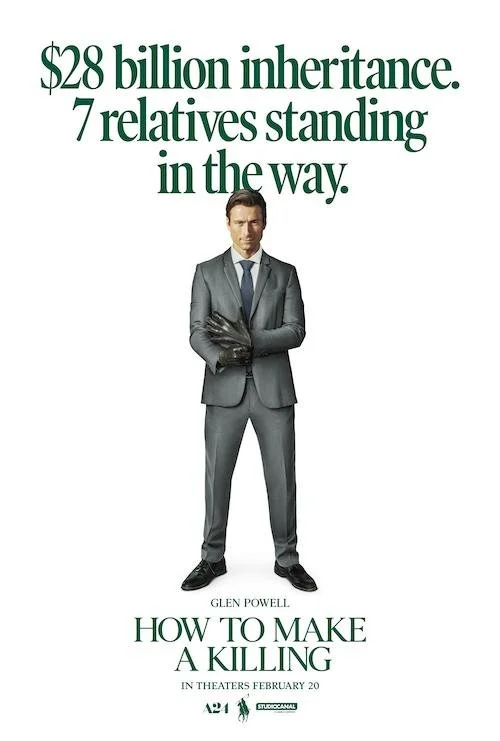


The world has always been divided into the have and have nots’ the wealthy and the working class. As time has gone on the ebb and flow in the distance between those social classes has shrunk and grown till we are in the present time in one of the greatest divides; of a very small percentage of people being in control of the majority of the power and wealth. This divide is frustrating as if one is at the bottom it's almost impossible to climb up and get a slice of that good life. That’s how Beckett Redfellow feels in How to Make a Killing as a bottom a run of a prominent inheritance ladder he takes his future prosperity into his own hands- unfortunately what starts off as a good underdog tale of the little guy coming out on top; turns into a bizarre muddled tone deaf mess.
How to Make a Killing is a tale as old as time, a wealthy legacy family that seems to have everything, till one of the Redfellow children has a whirlwind romance with a local musician playing at their estate, ends up pregnant and is promptly disowned by the family. Leaving Mary and her child virtually penniless by comparison- but still with stake and a dream in the future inheritance. That’s how Becket Redfellow (Glen Powell) grows up, kept out of the lap of luxury but raised to think like someone who does, despite this Beckett assumes he will never see a drop of that wealth. As he grows up,partially motivated by his mother's death to end up in a better “more worthy” place that he feels if only in his heart he deserves. Becket sees very few bright days ahead unless something were to happen to all the other branches of the Redfellow family tree (a family who aren't even aware of Becket’s existence) were to be cut. Despite this, the universe leads Becket to a chance encounter with an old childhood flame and job loss are all it takes to spur him and the notion that he deserves more.

How to Make a Killing has promise but delivers on very little of what it sets out to accomplish.
Thus, after some sleuthing, Becket enacted his first murder drowning one of his cousins on a boat, and starting a chain reaction of revenge. Becket shows little remorse for the abhorrently rich members of his family; which is fair as the Redfellows are painful caricatures of the fat cat rich stereotypes we’ve come to associate with the wealthy. It rings hollow and tries too hard to prove it’s worth, though Killing does take an interesting left turn like Becket's uncle being a decent man who finds him a job and seems to support his nephew and his success. On the flip side, there are also incredibly unnecessary plotlines: the bizarre half-hearted attempt at a love triangle with Ruth (Jessica Henwick) the girlfriend of Becket's cousin Noah; a wannabe poor boy artist who desperately wants to struggle. Ruth herself seems to romantic visions of grandeur of having a working class job instead being trapped in a well paying artistic job (which is almost comical). The silliness occurs by reintroducing Jennifer (Margaret Qualley), his childhood crush and having nothing for her to do but lounge dramatically and seductively put her leg on furniture. Despite Qualley’s best efforts, there is zero chemistry between her and Powell and by the end of the film her character comes off as an annoying plot point that continues to resurface rather than contribute to the film.
How to Make a Killing here has what one wo\uld consider to be too many pots on the stove.Becket plays the double life of fiance bro, doting fiance and still pruning the branches of the Redfellow family tree on his spare time; while also dodging the growing suspicion of the police and a slimy con from Julia who is not back for romance but to acquire wealth. Caught between rock and a hard place, Becket has to steal money from his job to help pay off Julia’s husband’s debt -all things coming to a head when on the night of his engagement party; Becket’s grandfather summons him, wanting to meet.While he is torn, he chooses that meeting which spirals into a poor imitation of a Ready or Not style mad dash through a locked mansion- as Becket’s grandfather is well aware of his grandson's actions- and is trying to beat him to the punch.When his grandfather meets a grisly end, it appears that Becket is left with the fortune for himself and Ruth- but the happiness is short lived as of all things, he is framed for the death of her husband and ultimately put in prison on death row.
Here, the film does a full swan dive into absurdity that it doesn’t recover from, not only is there non existent chemistry between Powell and Quailey as previously mentioned come to a head with the shoehorning the aspect of fraud makes the end of the film unbearable, as Juila makes Becket sign over the Redfellow fortune to her; leaving him penniless, and when he ultimately leaves prison, Ruth is not there to reconnect but just return his mother’s locket. With no other options, Becket is back at square one, swayed by money and desperate once more; despite everything crawls into the back of Julia’s car and rides off to an uncertain future. He has ended up in a potentially better spot as he promised his mother but at what cost?
Ultimately, How to Make a Killing, which had a promising concept, was just a poor photocopy of many great underdog movies that had come before it,its ending in particular leaves a bitter taste in the viewer’s mouth. In the current political climate, knowing how those with immense wealth dominate everything- how heavy corruption can run in those upper circles and how when one has that much wealth you can get away with anything…The film doubles down and almost has disdain for the the working class and seems to rub it in the audience face, that yes it is great to be wealthy, and successful and if you’re not there the problem is you. Even when Becket has potentially had a good life with Ruth, despite questionably not even deserving that- his greed pushes him to an extreme (because heaven forbid he has just a good life, partner and place to live). The message of greed is not lost, but it is muddled heavily by this almost sneering sinister humour of if you're not blind rich life isn’t worth it- In particular, the film feels slightly tone deaf as even Beckett as his “poorest” still has a roof over his head, decent clothes, and food in his belly which a lot of people in the current global climate struggle to obtain. Fundamentally, Killing feels and looks like a movie written by the incredibly rich with little perception of the real world and while there is a mixed message about the dangers of wealth, it gives a sickly impression that being well off and under someone's control is better than being poor and struggling.


Nicole Cabrera is a Toronto-based film enjoyer with a passion for the eighties, horror, and deep diving their favourite actors’ obscure filmography. When they’re not watching movies, they're writing, crafting, cosplaying, going to concerts, working on their podcast (Hollywood Deepdive) and dreaming of traveling.