
David Fincher: The Further Mis-Fortune of AI
Written by Andreas Babiolakis
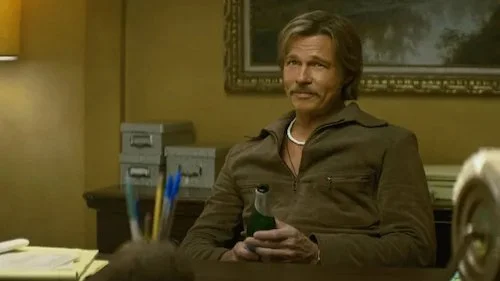
Today's rant comes in the form of an issue that I was willing to foolishly ignore for a few days before it became impossible to turn a blind eye to. I was willing to pretend that none of this discourse was occurring while I was taking a brief hiatus to play and enjoy Grand Theft Auto VI sans spoilers (the playthrough is going well, if you were concerned), but — like most things on the topic — more and more frustrating nonsense kept coming out about this highly-controversial talking point. It has gotten to the point that I feel like I must address the complete and utter stupidity surrounding David Fincher and his use of artificial intelligence in The Further Mis-Adventures of Cliff Booth. Over the course of a week, we have heard multiple versions of the same rumour: that Fincher has clearly used generative AI in this film. I don't mean the minimal-yet-still-damaging amounts of AI flourishing that Danny Boyle had in Ink, or the as-ethical-as-such-poison-can-be finishing touches in Brady Corbet's The Brutalist. The theories first started when trailers for The Further Mis-Adventures of Cliff Booth dropped, and people quickly pointed out how "off" a lot of the footage appeared (and you do not need to have strong sight to notice how bad some of these clips look).
For around a week (leading up to the release of this latest Fincher project), the discourse has gotten more and more rancid. Initially, Fincher shrugged and asked what was so bad about using AI as a "tool" (that's what they all say nowadays) in filmmaking without fully admitting to using it for Cliff Booth. Then, it was revealed that AI was used in the film, although only minorly. That quickly changed again and again, down to this recent revelation that AI was used to fix ninety-five fucking percent of all dialogue fixes; I suppose that the rationale is that it is more convenient to use AI than to reshoot and rerecord scenes, but consider the flippant, rampant amount of use of AI in this film — and this is only what has been revealed or admitted to. Think about how much more we weren't told or couldn't deduce via our own common sense.
This bothers me greatly for a number of reasons, but I will quickly bring up the lesser of the two biggest frustrations. Firstly, I consider Once Upon a Time in Hollywood a contemporary American classic, and one of Quentin Tarantino's finest films. A major reason why is the authenticity of this experience — from the pulpy nature of the cinematography, to the elaborate, and hyper-detailed sets that effectively transport us back to the tail end of the sixties in California. Knowing that Cliff Booth is a sequel to this film (written by Tarantino, yet directed by Fincher this time around), I must ask: what is the point of making a sequel that completely misunderstands the point of the original? While I don't expect a carbon copy of the predecessor (some of the best sequels in film history have been subversions of expectation — like James Cameron's action answer Aliens to Ridley Scott's sci-fi-slasher Alien), a director should still know how to handle what has been carefully placed in their hands with trust. Nothing says "sixties" like twenty-first-century dystopian bullshit that even a blind ant could spot from a lightyear away; nothing says Once Upon a Time in Hollywood like utilizing the very technology that may one day wind up killing it.
My bigger gripe is with Mr. Fincher, who has clearly betrayed much of his legacy's ethos at this point. If being this kind of creator was always in his repertoire, I wouldn't be as bothered as I am now. Let's take a brief look back on Fincher's career, though, because it's crucial to understanding how corrosive this kind of behaviour actually is. Fincher is a part of that class of filmmakers who proved their inventive worth in the music video medium before making it big in the motion picture industry. This was very much a director who worked with what he had to make the most of budgets, short schedules, and limited resources. If anything, Fincher leaned into the grittiness of rough-around-the-edges shoots and embraced the shoddiness as a characteristic that could add realism, lore, and personality to his films (particularly the crime works that he specializes in).
Sure, Fincher was an early advocate for digital filmmaking, but that felt more like an understandable shift that many filmmakers were making rather than a complete act of hypocrisy and self-sabotage. In the digital space, Fincher was using his resources cleverly. Consider the infamous sex scene in Fight Club that was handled completely with CGI — this may feel much more noticeable with modern eyes, but — at the time — this sequence was difficult to pinpoint, and much work and effort was put into making this scene feel authentic. I can see how this would be beneficial to the actors in this scene, so they aren't placed in any sensitive or difficult filming situations like many before and after them. This felt like the use of technology for the greater good, even if it was implemented quite heavily. How Fincher has used AI has been nothing but problematic. Once we reach the groundbreaking use of CGI in The Curious Case of Benjamin Button, we can spot how much worse Cliff Booth feels: what is magical about laziness and unethical practices, compared to the blood, sweat, and tears that made the impossible happen in Benjamin Button?
Continuing forth, we reach what I consider to be Fincher's masterpiece with The Social Network: a film that dives into the atrocities that stem from the tech world (including how well-intentioned creations can be weaponized), as well as the destruction caused by billionaire mindsets; Fincher seems to no longer care about either. If this seems like a stretch, remember how much of the film is about the fallout from what Mark Zuckerberg achieved, and please also consider how The Social Network was once considered a relatively harsh eye-opener about a mogul who many didn't think this much about back in 2010; then realize how, in hindsight, many think that The Social Network wasn't harsh enough, knowing what we know now. Fincher and Aaron Sorkin felt almost like whistleblowers, feeding us information (albeit in a sensationalized, narrative way) that we maybe didn't know in full, and a major theme was how technology (and both the economy and legal-space within this industry) can be intended for progress (and how it is often used, instead, for personal gain without the consideration of others. Fincher is now supporting the very kinds of tech gremlins that he once tried to warn us about.
This brings us to his somewhat divided Netflix era. I, for one, have liked some of these released more than many. I think that Mank is a rather stunning look at the Hollywood of yesteryear, made to feel as though it was an unearthed artifact of revelation that we have stumbled upon (which will enlighten us on the allegedly real creation of the masterpiece Citizen Kane). The film is famously crafted to look like an older film, down to having the cigarette-burn projection cues to tell the projectionist when to change reels (despite being a digitally-created film). I shudder to think about what Mank would look like in the years when Fincher has become AI crazy. On that note, I must bring up The Killer, which I now consider to be one of the most underrated films in recent years. Many disappointed viewers signed up for a serial killer exhibition. Instead, we got a stoic, chilling look at existentialism in the modern age — down to the over reliance on technology to fill all of the voids in our life (and, thus, perpetuating the capitalist machine). This film is only a few years old — how did we go from this kind of ennui-ridden dread to the complete surrender to the very machine that promises to be the end of all as we know it?
With The Killer in mind, I want to reinforce that this is clearly not a one-time sentiment that Fincher has had, but — rather — an ongoing discussion that he has had — from treating the Alien franchise as a metaphor for literal slavery in the face of dystopia in Alien 3 (at the very start of his career), to the dishonesty of the conveyance of media found in Gone Girl. I would be remiss if I didn't bring up the biggest elephant in the room: Fight Club. This is a film that promises a macho excursion into the dens of masculine iniquity and brutality but winds up becoming a huge talking point on the dangers of hyper-consumerism and capitalism (so much so that many of the film's unintended audience members perceive it to be the deepest film that they have ever seen). This is a film that coaches viewers to not trust what they see (lest we forget the phallic exercise where Brad Pitt — the very Brad Pitt who now stars in Cliff Booth — literally tells you to keep your eyes peeled for any cinematic deceptions). Fincher is now the one trying to pull the wool over the eyes of his audience despite him being the one who once tried to caution us on these practices. You can say that Fincher has been open about his use of AI, but only after he was called out on it — and his highly-defensive stance has reeked of guilt and worry that his film may not perform well.
Why should it? In a field that is begging for originality (the kind that Fincher used to offer in spades), Fincher — someone who used to be a bastion of the future of Hollywood — is now supportive of its continuous decline. I didn't think too much of Fincher's heavy allegiance to Netflix over the past fifteen years when many others called him out for selling out, but — ironically, at the end of his tenure with the streaming company — I finally see what everyone else was complaining about. Since I enjoyed what he was making with Netflix, I was too foolish to accept that Fincher was the kind of director who would be in it for himself without a care for what would transpire after his actions. It would be idiotic to put the sole blame on Fincher, but I do firmly believe that Fincher being a major supporter of the streaming company (especially in its formative years, based on his work in producing House of Cards) marked a shift in power dynamics in the film and television industry. To be fair, if it wasn't Fincher, it would easily have been somebody else, but that isn't my point. My concern is that the same Fincher who was a part of this once questionable partnership is now at the centre of something even more nefarious and harmful.
So, no, Fincher, no one expects you to be a "luddite" (his own words), but you of all people should understand the responsibility of being in such a prominent position in American cinema, especially when the industry is wounded, shivering, and barely able to even look up at the road ahead. We should be healing it, nurturing it, and helping it walk again. When a Ryan Coogler can bring audiences to the cinema and help initiate many newcomers to the wonders of seventy-millimetre splendour, or Corbet (the same who came under slight fire for minimal AI enhancement in the aforementioned The Brutalist) can reignite the need for audacious epics, there doesn't seem to be any excuse for Fincher; I bring up Corbet again because, yes, he was chastised for the use of AI in his film, but I would argue that he handled the situation well and — while any use of AI is taboo to most — Corbet's seldom use (and his far-slimmer budget) make his use far more understandable (The Brutalist was made for less than ten million and is nearly four-hours in length, compared to the Netflix backing and over one-hundred-and-fifty-million-dollar budget that Cliff Booth has). If Curry Barker can muster one of the biggest breakthrough films (Obsession) for less than a million bucks without resorting to AI nonsense, then Fincher could easily make a buddy-comedy-drama romp like Cliff Booth without it.
When the industry is looking for guidance during this low point, someone as visible and coveted as Fincher should know better (in principle, and in actuality — considering his oeuvre and many years of stances that apparently meant nothing). Upon doing some reading for this think-piece, I came across the revelation (to me) that The Killer implemented a teensy amount of AI; star Michael Fassbender had recorded a line of additional dialogue into his iPhone and sent it to Fincher, who deemed the recording unsuitable for the film (which was near completion at this point). Fincher then used AI to clean up the recording quickly while in the last stages of post-production. While any use of AI is frowned upon, at least you could argue that you can understand his use here (and that no jobs were greatly affected in this minor instance). However, this was clearly the first flag of the many to come. I think the reason why you can look past the use in The Killer and The Brutalist is because these examples feel like special-case scenarios in time-and-budget-sensitive predicaments; sure, any use of AI is concerning, but some examples are at least slightly justifiable, even if they permanently mark the films associated with them.
The excessive, unapologetic amounts used in Cliff Booth, and Fincher's hostile response to the media is a whole different story. This isn't someone who was in a jam — this is someone using AI knowingly and carelessly while in complete control. Considering that Fincher is one of the biggest names in contemporaneous Hollywood who many look up to, this is beyond worrisome. Furthermore, his latest film looks worse off because of the use of AI (whereas a number of the aforementioned examples, particularly The Killer and The Brutalist), you likely wouldn't have even known that AI was used if we weren't told. It's true that it is likely impossible to fully escape AI now that the "cat is out of the bag" (or whatever other tripe maxims these tech-bros want to feed to us as if we are imbeciles), but we should at least expect some decorum with the use of it. When I see something like Cliff Booth, I see that awful Coca-Cola Christmas commercial that was condescending: an indication that the masses are so useless in the eyes of corporations, that they are to be fed AI slop and like it. When I see the AI examples in Cliff Booth, I see the very capitalistic abominations that Fincher once hoped to warn us about. When I hear about the extent of how bad the AI usage in Cliff Booth is, I feel as though Fincher believes that his audience is stupid enough to fall for it or not care about it (remember, this is the same audience that may have been introduced to philosophy and psychology in cinema through works like Fight Club, Seven, and Zodiac). So, no, Fincher. No one expects you to be a luddite, but don't be a loser, either.


Andreas Babiolakis has a Masters degree in Film and Photography Preservation and Collections Management from Toronto Metropolitan University, as well as a Bachelors degree in Cinema Studies from York University. His favourite times of year are the Criterion Collection flash sales and the annual Toronto International Film Festival.