
You Can See Everything
Written by Andreas Babiolakis



Warning: The following review contains blatant spoilers for You Can See Everything, as well as triggering topics like sexual assault. Reader discretion is strongly advised.
I have been a fan of Nathan Fielder's for a number of years now. I was a little late to the party for Nathan For You, but one can never miss the boat in discovering this excellent, non-fiction series. The series finale — a one-off special titled Finding Frances — is of a different tone than the rest of the silly, absurd business ventures that are ridiculous on paper (and even crazier in execution). Finding Frances felt like a new path that Fielder wanted to take instead of the farcical reality programming that he was synonymous with. In Finding Frances, he bonds with an actor-for-hire from a previous bit and hopes to try and help this new friend find the love of his life that he let slip away. He found innocence in discomfort, and beauty in the abnormal. Most importantly, he developed the mindset that would determine the best phase of his professional life: that reality and fiction are not that different from one another, and that this blurred line could sometimes bring out the most information than when the documentary or reality mediums shot their subjects as straight as possible.
Fielder would continue down this line of thinking. His next series, the even-better The Rehearsal, bends the middle ground to the point of having audiences question everything that they are seeing (this is precisely the point). It seems highly likely that Fielder has learned how to fly a plane in his spare time to commit to an experiment for The Rehearsal, but how much of his flight — captured in the season 2 finale — went exactly as he showed us? It goes without saying that Fielder — like many comedians — is constantly playing a part (at least to some degree), and so we are never certain of when we are witnessing the real Fielder as a human being, or when we are being put on by Fielder the character, entwined in all of these social experiments. His underrated narrative series, The Curse, similarly left audiences befuddled as to what they had just seen, albeit in a drastically different way (more in the line of how logical boundaries could be shattered in a fictional television series).
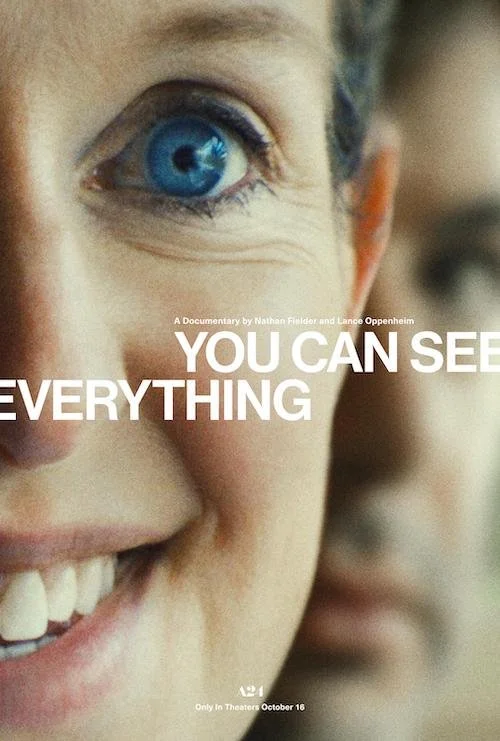
This brings us to the highly discussed film of the season: one that was surprise-jettisoned into existence at the 2026 Telluride film festival, where an audience watched the motion picture before it was even announced to the world. Instantly, the word of mouth spread. Now, I am used to Fielder's zeitgeist-esque tendencies, but the response that this latest project received felt like something that was well beyond his capabilities. Even people who had no idea who Fielder is (or how his style functions) were anxious to watch this latest venture. Its very foundation sounds like a pure lie made up by an over-exerted dreamer: Fielder crashing at the house of scorned Theranos CEO Elizabeth Holmes for the final thirty-four days of her freedom before she is sent to a Texan prison for eleven years (after being found guilty of defrauding investors). This concept felt like a Fielder joke. It is anything but.
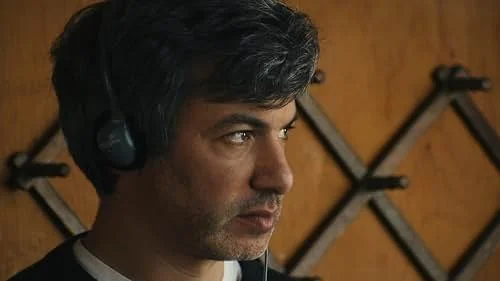
Nathan Fielder is up to his usual tricks with You Can See Everything, but this exceeds even his typically high standards.
The co-director of what we now know as You Can See Everything is Lance Oppenheim, whose previous film is still in some theatres around the world: Primetime. I found the film entertaining but a little too thin and meatless when it came to examining its subjects to a connective and informative degree. His work couldn't be any more different this time around, with Oppenheim playing the fly on the wall as Fielder and Holmes awkwardly try to connect (like two plus sides of a magnet being smushed as close together as they possibly can be, with the impossibility of them ever actually attaching to one another). Fielder is arguably always in the body of an unbreakable character. Holmes, who has been attacked time and time again for being uncanny and inhuman, wants this opportunity to prove that she is as normal as people get. These two worlds collide in a cinematic implosion that will leave you suspended in the air for three hours. How truthful is either party being?
Most documentaries are pieced together to educate audiences on a subject or to declare a statement. You Can See Everything may leave you questioning Holmes' mythos and predicament even more than when you first started watching it, but this most certainly is not a problem. To simply know about Holmes and her elusive, hard-to-read nature is one thing, but to spend hours with her and still feel befuddled almost feels like a revelation. If anything, the confusion is the explanation. There is no further digging needed: this is Elizabeth Holmes, plain and simple. Take from that what you will. Apparently, Fielder and Oppenheim had carte blanche to take as long as they needed to make this film, or to even scrap it entirely if they wound up with nothing. Thankfully, both filmmakers worked with what they had. I would assume that most directors would look at this footage and would surrender to the openness — that they had nothing. Fielder and Oppenheim saw that they had everything.
Fielder was meant to be behind the camera for this project, but no one could deny the accidentally hilarious rapport between him and Holmes — like two aliens from opposing galaxies trying to figure out how to stop an asteroid from killing both of their species (think Project Hail Mary but with far more crossed wires and misconceptions). Therefore, by around the tenth day within the Holmes household, Fielder began to interview her directly. With her is partner Billy Evans and their two children. At first, the willingness for Holmes and Evans to have complete transparency is beguiling: why would they be fine with Fielder and his team showing literally everything in their film (down to — and I am not joking — Evans fully naked in the shower)? What could they gain from this when, firstly, Holmes is heading to prison for over a decade in about a month, and, secondly, neither she or Evans are being fully truthful? There is a difference between being shown twenty-four-seven and actually being open.
The first hour of the film is devoted to the thirty-odd days in the Holmes domicile in San Francisco. Fielder tries to get down to the bottom of everything: the Theranos scandal (this single device — meant to be able to diagnose countless illnesses and ailments via a single drop of blood — that was thought to be a scam), Holmes as a person, and her relationships (to Evans, and to former Theranos COO Sunny Balwani). Fielder and company seem to make significant ground at first, with Holmes talking about her ambitions, what she hopes will come from the documentary, and other self-facilitated revelations. You even learn a bit about Evans, including how she and Holmes met and his mission to help her keep Theranos going (the only two people who could believe in this objective). However, You Can See Everything is efficient in telling you how the days are dwindling. There are still roughly two hours of film left. Fielder tries to get into the hardest-hitting details in the final days, and we don't get the answers we seek. What happens next?

You Can See Everything is nothing short of extraordinary and stunning.
Act two is when things go to the next level (the fact that a documentary has acts should tell you everything). We learn some left-out information that took place before the events at the start of the film, including some major bombshells that explain a bit more. For instance, Evans coerced Fielder, Oppenheim, and A24 to make a profit off of the distribution and sales of You Can See Everything (suddenly, his comfort with having his penis showing for the world to see makes more sense). The film jumps to two years later, and we barely see or hear from Holmes again once she is in prison. However, as you can imagine, we see a lot of Evans. The first hour of the film shows minor red flags coming from Evans, like how he butts in to interviews, distracts Holmes and pulls her away, and shifts the topic of conversations frequently. Knowing that he, essentially, wanted the film to be something that benefited him, his hyper-involvement makes more sense now, and his continuous gaslighting and manipulation once Holmes is in prison is even worse. If we never fully figure out who Holmes is, we certainly get a great read of Evans: a Charlie Kirk apologist, a narcissistic jackass, and the makings of a cult leader. He also isn’t above referring to pleasuring himself as being acquainted with “Pamela Hand-erson”, which made my entire crowd laugh not in the way that he intended (at him, not with him).
Around halfway through the documentary, we get the first major dose of Fielder's obfuscation between reality and fiction. In the film, the Holmes narrative miniseries The Dropout is alluded to and even shown, with Holmes watching her Theranos scandal play out in skewed, dramatized form; she eventually wishes for the show to be stopped when it becomes too much for her. Well, leave it to Fielder to get in touch with the actor who played Holmes, Amanda Seyfried, and have her come in to You Can See Everything. Seyfried watches Holmes watching her and gets a bit of a clearer picture of who her subject actually was (Seyfried admits that she had interviews and key pieces of footage to work with — then again, did Holmes ever show as much of herself as she does in this documentary beforehand?). Thus begins one of the most fascinating talking points of the film: the importance of artistic integrity when it comes to sensitive topics and real people.
Actors try to get into the minds of their characters or subjects on every project. Curiously, Seyfried has the opportunity to do so again after her series has been long concluded. Fielder and Seyfried go to Evans' house to chat with him, resulting in the biggest unveiling of Evans' true nature. Now, I will turn the article on myself for a second. I have had the fortune of crossing paths or even meeting A-list celebrities time and time again; this is not meant to be a flex, but, rather, a declaration of who I deal with when attending or working for a major film festival. I have had the fortune of meeting Seyfried twice now, and anyone could tell you that I have sung her praises for a few years now. She is one of the realest, kindest, most down-to-Earth actors I have ever witnessed. I've seen her stay for an hour to sign autographs for the Toronto public, cutting well into her own personal time. I've seen her bring a young fan with various accessibility concerns onto the red carpet with her to give her a movie star moment. She even told me that my shoelace was untied because she was concerned that I may trip (while this is super embarrassing, I will never forget that this beloved film star cared enough about some rando to want to help them). I have nothing but nice things to say about her, and I feel like — after at least two hours of real-world exposure with and around her — I have a great read on who she is as a person.
I bring all of this up because of Evans' callous, disgusting attack on Seyfried (and good for her for standing up to his bullshit). Evans calling Seyfried "performative" is not only dead wrong — it is clearly a form of projection. His intention to devalue her as just an "actress" is a personal jab that is proof of his arrogance. I always work without bias, but — in a film that aims to blend reality and interpretation together — I feel like I had this extra layer to work with: the hideous slandering of someone who I know is a sweetheart and a humble spirit. Fortunately, I don't think anyone would leave You Can See Everything thinking that Seyfried looks bad in that argument. Before you accuse me of taking sides because of my past, I would have felt this way anyway even without my couple of experiences with the actor: #TeamSeyfried, and fuck Evans.
Seyfried's involvement is more than just this post-Dropout closure: it's to reenact moments that happened before cameras rolled. However, this opens a doorway to something spellbinding: the ability to recreate even more. In the final act of the film, Fielder wants to get the absolute truth from Holmes — especially since she is now behind bars, and Evans is clearly trying to steer the ship. He repeatedly tries to set up an interview with Holmes either by phone call or in the prison itself. Naturally, these efforts are thwarted by Evans, whose attempts to divert the facts only tell us even more about him than he would like. Finally, Fielder gets his way (as he almost always does in all of his experiments), but recording devices and crews cannot come in to the prison with him. So begins the mystifying, pivotal, conclusionary chapter: recreating his final interview with Holmes with Seyfried.

You Can See Everything leaves you questioning the culture surrounding Elizabeth Holmes more than ever before.
What makes this extra special is how Seyfried now has more context for the person she previously performed as. She saw Holmes as a strange, reptilian husk of a shell who felt anything but human. By the end of seeing the preliminary footage of You Can See Everything, she understood Holmes as someone who is continuously being controlled by other people (especially by Balwani previously, and now Evans). In the same way that Holmes wanted that second shot at being perceived differently by the world, Seyfriend has this second chance to portray her. I was a fan of her in The Dropout already, but I would argue that she is ten times better in her brief sequence in You Can See Everything: a stint that is already getting buzz for being potentially the first acting nomination for a documentary film in Oscars history (we shall see in a few months time).
The final shot of the film is Holmes in the prison yard, walking to see her family who are visiting her. Fielder and Oppenheim's camera team watch from afar, and you can see the prison gate "jailing" them in. However, the better metaphor is how distanced we still are from Holmes. We have watched her — or experienced her — for three hours, and yet we still only know so much about her. Her father blurted out that she was once raped (not that this was his business to share with Fielder at all) and insists that this explains much about her (also a disgusting insinuation to make, especially about one's own daughter). It does seem like she is continuously puppeteered by the men in her life time and time again, whether it's Balwani throwing her under the bus for much of Theranos' controversies, or Evans ruining her legacy (by tweeting hateful things as her, using her likeness for AI and not caring how she is digitally exploited, or not caring about the use of her least favourite photoshoot in promotional materials).
With that in mind, Fielder eventually recognizes that he is one of these men. Seyfried confronts Fielder and asks if he, too, is shielding her like Evans is — she asks outright if Fielder is trying to protect her because he cares about her. He denies doing so, but You Can See Everything asks us to decide for ourselves. I think that, yes, Fielder is protecting her, but he's also not sugarcoating what is happening in her life. He recognizes her as — and depicts her as — being a bit simple: someone who can be a brilliant, lateral thinker, but also incapable of understanding why the most iconic sketch joke of all time is funny (or why something she said could be understood as a lie). He sees the love that she has for her kids and for Evans, and what she perceives as transparency. Fielder never comes to a complete conclusion on who he thinks Holmes is because even he is unsure. Is Holmes a lying mastermind? Is she permanently being led astray by manipulating men? Is she genuinely naive and a gold-hearted woman who winds up in unlucky predicaments time and time again? We have been presented with everything, and yet we know nothing.
However, it is the journey that is far more plentiful than the finish line. By taking this route, we question the depth of cinema, either as a narrative or documentative medium. How much do we learn from either? How fabricated are these depictions of true people and real events? Is there any correct and ethical way to represent accuracy? Fielder has tried time and time again to find out, and he seems to always succeed not in his end results but in his efforts to get there (You Can See Everything may be his crowning achievement, even with everything else considered). To feel like you are dangling in the air for nearly one-hundred-and-eighty minutes is an indescribable experience. There were times where the documentary footage felt like a constructed film set with professional actors, and times when the Seyfried-led recreations felt real. To be constantly bemused and enthralled is not easy, let alone for a documentary of this nature.
It is obvious that a film like this would be funny, given Fielder's history, but You Can See Everything is hysterical — how could it not be when two of the strangest people in contemporary pop culture are going head-to-head (or, rather, eyeball-to-eyeball)? Then, the film reveals its greatest assets: that it is one of the most thrilling pictures of the year. My stomach churned and felt like I was on a roller coaster; in hindsight, it almost feels silly that I felt this anxious by a documentary spearheaded by Fielder, but being tossed around in the moment made these sequences (a weird word to associate with non-fiction filmmaking) feel like a spy thriller. The periodic gut punches, where we were hit with gasp-inducing discoveries, never got any easier. I think anyone would expect this film to be entertaining and interesting, but no one can prepare you for the galvanizing nature of this one.
At the end of all of the chills and spins is the truth: that this is a film about an actual person and the hardship that she has gone through (and the long road ahead). There is no sullying that. To study Holmes is to already have a great source of exploration, given the tricky and peculiar nature of her life. To then get into the difficulty of representation is a whole different ordeal. How do you best represent someone who has already been yanked around by stigma, social media, hate, parody, and many other avenues? What is the right way to showcase someone's plight when they have already been through hell? Do you try to force your own conclusions — thus perpetuating the stereotypes and potential misconceptions (and, additionally, the lies of your subject, should they be lying)? Or do you let sleeping dogs lie? At the end of the day, I will admit one key fact: that You Can See Everything did something that most representations of Holmes failed to do — present her as a human being.
Fielder and Oppenheim allow Holmes and Evans to do the majority of the talking (with Seyfried when needed) in You Can See Everything: a documentary that is monumental and intricate at the same time. This goes beyond just being a documentary; there is a reason why there is chatter that this could be the first documentary to be nominated for Best Picture (it also hardly feels like a documentary at times). This is the kind of film you watch and know instantly that you have just seen a moment: something that will be discussed and debated for years to come. There's a reason why this film was just dropped into the Telluride Film Festival without warning: because it could be. Everyone attached knew how strong the word-of-mouth affiliated with You Can See Everything would be, and this has been proven time and time again; it has only been known about for about a month. I don't even know if I have gotten into the crux of what makes this film so special, and yet I clearly cannot stop talking about it; neither will you, I'm sure. Like Elizabeth Holmes herself, You Can See Everything defies explanation and description.


Andreas Babiolakis has a Masters degree in Film and Photography Preservation and Collections Management from Toronto Metropolitan University, as well as a Bachelors degree in Cinema Studies from York University. His favourite times of year are the Criterion Collection flash sales and the annual Toronto International Film Festival.