
Obsession
Written by Andreas Babiolakis

Warning: This review contains blatant spoilers for Obsession. Reader discretion is advised.
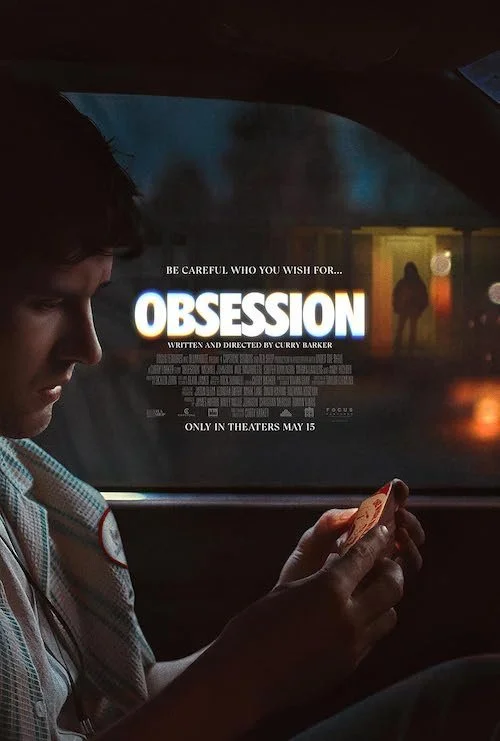
Here it is, ten thousand years too late: a review for Curry Barker's Obsession. Part of me wanted to get around to this film once the dust settled, but it never seemed to, did it? Released at the Toronto International Film Festival last year (as a part of its Midnight Madness program), Obsession became the sleeper hit of contemporary horror and independent cinema. It had all of the markings of a Midnight Madness horror romp: a low budget, a focus on jump scares, and some uncanny sequences that you are not sure how you should react to. Upon my first watch a few months ago, I could not understand the overwhelming fixation that everyone had with this film: how was this different than most other Midnight Madness cuts that you scream to and then shake off the next day? Well, the key difference is that Obsession stuck with me in the pits of my mind. Suddenly, that staying power makes more sense. This is how Obsession could be released in May 2026 and take on a whole new life; how the film could be re-introduced at TIFF this year and have a sold out crowd; how the film could be in talks for Academy Awards contention despite defying the odds in many ways (a horror film made for less than a million dollars with a festival release from 2025); how Obsession wound up becoming one of the most profitable films ever made.
This film is very much a story of two responses: my immidiate, and my reflection afterward. The former is far less flattering, and the latter feels like a better indication of the film (I must emphasize that the opinions of others had zero influence on my thoughts; some films really do work better when they stir within your contemplations over time). What I first saw was an indie film with a small cast and a fairly good use of resources (limited sets, key props, a focus on the mystery of horror rather than what you do see). We have Baron "Bear" Bailey (Michael Johnston) who wants to ask out his co-worker and friend of some considerable amount of time, Nikki (Inde Navarrette). Bear is impossibly awkward and solipsistic — he really wants Nikki to go out with him. I appreciate that Barker never gives Bear any leeway to look like a good guy who needs some encouragement; Bear's worminess is evident from the jump. Had this film been made ten years prior, there would be a focus on making Bear look like an innocent soul who is in love, and both Nikki and society are out to get him. He must accomplish his quest of making Nikki realize that they are meant to be together. Thankfully, this is 2026, and Barker isn't an idiot with incel tendencies.
I'm going to be similar to Bear and make things about me for a second. When I was in my early twenties, I was friends with someone who I had feelings for. I was a nervous wreck for months, as I stumbled through every hangout and was more focused on how I could try and ask my friend out rather than enjoying the time we spent together platonically. One day, I eventually bit the bullet and found the "courage" to ask her out on a date. She politely declined, and then proceeded to apologize for putting me in that buzz phrase that permeated through the twenty-tens: the "friend zone." It wasn't until this moment that I realized how contradictory and problematic such a term was. Here was someone I cared about having to say sorry that they only saw me as a friend. What about me? What about the fact that I saw this other person as something more (thus, not exactly a "friend") and proceeded to sabotage months of our shared memories and time spent together? Did I not place her in the "girlfriend" zone? Did I not make things even more difficult? This is not to say that one cannot ever have romantic inclinations for their friend (you cannot help how you feel), or that trying to take the next step is always the wrong choice. However, it is through my own experience that I recognize the hypocrisy of how society has dealt with such a situation. A woman should be able to see someone as only a friend, and it is far more damaging for people to only view others as potential life partners.
This time of my life also gave me some much-needed perspective: love can feel overwhelming, but asking out someone is not the end of the world (despite it feeling that way). To Bear, asking out Nikki feels like the only thing that makes his life matter at all; this is a Bear problem, not a Nikki one. If you have not given yourself purpose, you cannot force the person you care about the most to carry the burden that they never signed up for. Bear believes that he adores Nikki, and it is the insistence that he must have her that proves that he wants to date Nikki to have meaning in life. This is not why you date or get married to people. This is similar to the kinds of people who buy pets as Christmas or birthday gifts and then get tired of them after a short while. The life of another is not for your enjoyment, fulfillment, or existence. How selfish is it to even suggest that someone should be a part of your life? If anything, you should be offering to be a part of theirs. That is true love. Obsession explores the antithesis of this — one that many people (especially men) are privy to.
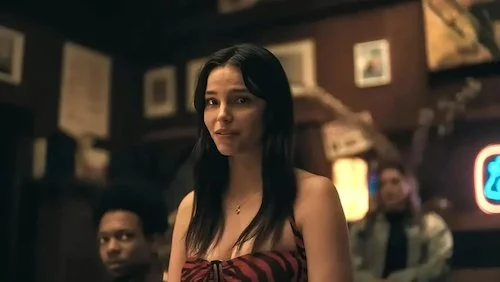
Obsession feels like a much-needed spark in the indie horror space, during a time where creativity feels helpless.
Going back to the story, Bear wants to be with Nikki. He keeps chickening out whenever he tries to ask her out. Navarrette does a great job of being an everyday woman who simply exists (yet you can see why Bear sees something special in her); she never goes too far with being an object of desire, because, well, this film isn't about how alluring women are: it's about how possessive men get. Bear has a few cringe-inducing run-ins with Nikki and he ultimately gives up on trying (to an extent). He purchased a One Wish Willow as a gift for Nikki; this cheap, novelty toy apparently grants you one wish when it is snapped in half (additional willows cannot be used by the same person if they wanted to have more wishes granted). The toy was meant for Nikki to make a wish; instead, Bear — after getting nervous around Nikki and fumbling yet again — snaps it himself and makes the damning wish for Nikki to be in love with him more than anyone else in this world. He doesn't seem to put too much thought into what he has just done. To be fair, he is going through a little bit. His cat has just died, and he leads a considerably lonely life. That doesn't excuse his behaviour, but it does explain his, well, obsession.
Even though Bear shrugs off his wish-making outburst, the audience can tell instantly that Nikki has had a switch go off in her brain. She returns to the car to see Bear again, and it's as if his dreams have come true. She doesn't just love Bear, she seemingly worships him. She does what any rational person would do and make a memorial with her new partner's dead cat's remains. Sure. They date for a little bit, and the film jumps ahead. Naturally, Nikki's behaviour worsens, and her addiction to Bear becomes deadly: she will do anything for him, and I do mean anything. For most of the film, I felt like we had a decent premise that wasn't fully explored. Bear was insufferable to watch (no fault of Johnston's performance), and I feel like even the slimiest of protagonists should not be this annoying to follow (I believe that an irritating character should only bother others in the film, not the audience — you should never lose your crowd). It also felt shallow to see Nikki just lust over Bear to the point of delirium, wish or no wish. I rolled my eyes a couple of times, and didn't quite see the same film that everyone else was pining over.
That is until the very last sequence in the film. Before this point, Bear is now freaking out and buys more One Wish Willows for others to sacrifice their own opportunity so that Bear could be saved (he wants someone else to veto his wish). At this point, Nikki has spilled blood and will do so again. Bear gives up on the One Wish Willows ploy and takes enough medicine to overdose and end it all. Nikki goes through his stuff and finds the remaining One Wish Willow. She makes an identical wish to Bear's: that Bear loves her more than anyone else in this world. Bear snaps into place and not only goes back to loving Nikki — he has never been more into her. Unfortunately for him, the oxycodone kicks in and kills him. Here comes the pivot point: once Bear dies, Nikki regains consciousness, and it is at this point that Obsession plays its best card. Nikki never changed: she was trapped in a body and mind that she could not control. Suddenly, Obsession seemed a little interesting. Once it stewed in my brain, Obsession became fascinating. It begged to be watched again.
Now that I knew that Nikki was unable to control herself at all, and that she had to watch herself fixate on Bear, there was something far greater than what I thought I had just watched; a standard indie horror flick felt elevated. This is not a horror film about poor Bear and his stupid, insipid needs: this was a horror film for Nikki who could not say no — who, due to being the fantasy of a man, had to give up all agency and freedom, without even having a say in the matter. Many men are scared of being placed in the friend zone (Bear was outright panicking at points); do you know how much worse it is to be placed in the girlfriend zone? One where you have to play the part and feign attraction just to keep safe and unbothered? Navarrette is highly efficient with her ability to play two parts: the Nikki that everyone sees (who is acting out in unrealistically strange ways), and the Nikki who is hidden (behind her possessor's eyes). Nikki is frozen in a bodily vessel that operates on its own. What a curse this is. In the way that Nikki could be affected by the proverbial flick of a switch, it should have been Bear who was changed. I'm fortunate and grateful that my past experience flicked that switch in my mind (to stop seeing this as me being inconvenienced when this is a difficult situation for both parties). It's clear that Barker wants to help viewers have the same revelation.
This realization also makes Bear more tolerable. I do not view it as his film, but, rather, Nikki's which he wants to overtake (even when he gets his wish of Nikki's affection, he seems to project main-character energy and nonsense). In the day and age of horror films with social commentary (where many filmmakers can lose their audience by getting caught up in the semantics of genre tropes), it is kind of remarkable that Barker works with such layers — even if he risks pushing viewers away via the initial viewing of Obsession (clearly, that deterred no one, considering how it may be the most popular film of the near next to, say, The Odyssey). Barker's background in being a YouTube content creator also seems a little contradictory; this kind of instant consumerist media doesn't typically go hand-in-hand with a film that is willing to reveal itself further on subsequent watches. Barker is only twenty-seven as well, and this kind of restraint and self-awareness is admirable at his age. While my brain should be thinking about what he can accomplish with a budget, I also believe that many of Obsession's successes come from the lack of a budget, if anything: the previous ambiguity of how well One Wish Willows can work (until the eventual discovery in the final act), how dangerous Nikki can be while possessed (again, the biggest effects and concepts are used at the end of the film), and more (from less).
I previously thought that Obsession was an over-hyped film by either horror fanatics, or those who weren't too familiar with the genre at all. However, I cannot deny when a film refuses to leave my thoughts (unless I think it is appallingly bad, which I knew Obsession wasn't). That alone proves staying power. I am also fond of a film forcing you to rethink its entire existence once credits roll; it is not an easy gambit to pull off, and yet Obsession does so. I can see why it is a highlight of 2026 for many. In the day and age where we cycle through countless amounts of content, knowing that something sticks with you has to mean something. To achieve this permeating, pulsating memory with very little means is special. To pull this off with actors who became household names overnight (especially the tour-de-force work of Navarrette) reminds us what filmmaking is all about. It isn't about rehashing the same old nonsense time and time again; it's about forging new paths and testing the waters to see where else we can swim. Could we have Navarrette if we cast the same actor appearing in ten thousand different projects? We need more films that feel real in this day and age — in the face of hostile artificiality. Thematically, conceptually, and metaphorically, a strange, fantasy-horror picture like Obsession is one of the realist motion pictures of the year. It deserves its flowers, and it humbled me and my hasty judgement. Whether it’s a debut film or a human being in a film, one shouldn’t jump to conclusions right away. Despite its apparently surface-level nature, Obsession is just like its character Nikki: both dig deeply under your skin and refuse to let go.


Andreas Babiolakis has a Masters degree in Film and Photography Preservation and Collections Management from Toronto Metropolitan University, as well as a Bachelors degree in Cinema Studies from York University. His favourite times of year are the Criterion Collection flash sales and the annual Toronto International Film Festival.