Cover-Up
Written by Andreas Babiolakis
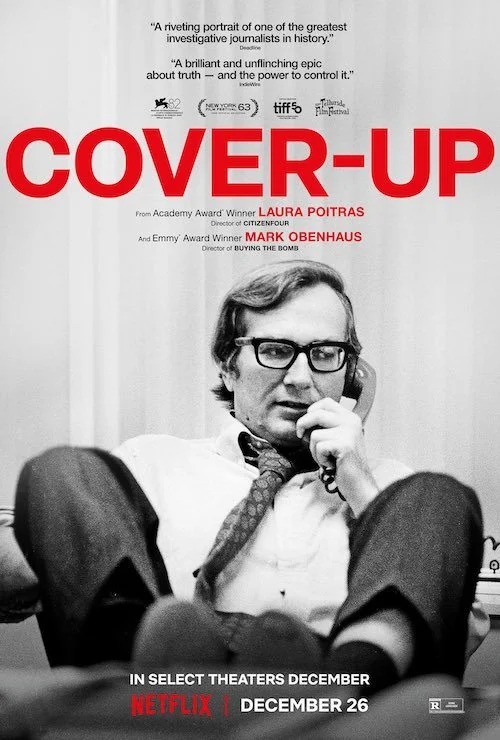
Laura Poitras has been one of the finest documentary filmmakers in recent memory. The bulk of her work has felt impossible to conjure up, from how these films were even made to just how insane their revelations are. Her breakthrough film, Citizenfour, placed us with whistleblower Edward Snowden literally as his findings went worldwide; to be on that side of the media storm is unreal. Her greatest achievement, All the Beauty and the Bloodshed, is an unnerving look at both the AIDS crisis and the opoid epidemic through the eyes of activist Nan Goldin (her past and present converge in shocking fashion). Her latest film is a co-directed effort with Mark Obenhaus and it is similarly as risky and unimaginable as her greatest works. Cover-Up is a shaky sit down with journalist Seymour Hersh (it's clear it took a lot of convincing for him to take part in this documentary; you can see the lengths Poitras is willing to go in order to spotlight these major talking points). Hersh is best known for his Pulitzer Prize-wining work on covering two different atrocities: the My Lai massacre, and the Abu Ghraib tortures (during the Vietnam and Iraq Wars, respectively).
When you see the images from Hersh's report (they possess that same stoic, horrifying gut-punch that Poitras' other films account for), you see why he is so hesitant: not only was it crucial for the world to see what Hersh discovered, but the extent of what he saw is a curse that will follow him for the rest of his life. It's almost as if these reports unburdened his revelations just a tiny bit (but not enough, seeing as he is forever afflicted; who wouldn't be?). Cover-Up explores even more than just those two notorious moments in American history, as it spotlights Hersh's findings in Cambodia and during the Watergate incident (and, believe it or not, even more). There is an overall message on the extent the U.S. government (and, let's be honest, most, if not all, governments) are willing to go in order to mask brutal information; the fact that Cover-Up feels scandalous to even exist proves that very point.
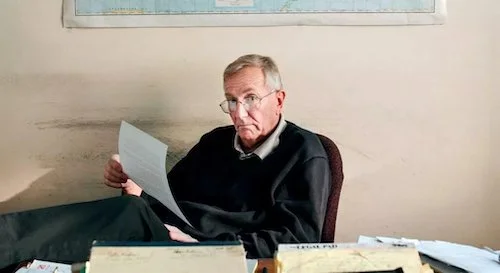
Cover-Up is the feel-bad documentary of the year.
I will say that Poitras' films usually feel like a rush because of how impossible her involvement — and our viewing — feel; as if these films should not have been possible whatsoever. Cover-Up is still as unnerving as her documentaries have ever been, but I feel like Hersh has done the majority of the heavy lifting with his work; of course, Cover-Up shows us even more than Hersh was able to release before (much of it is from his archives of discoveries), but that rush I usually get from Poitras' works isn't quite as present here. However, the dread remains: the revelation of just how deep this rabbit hole goes is sickening and impactful. Seeing as Hersh's work spans over decades, there is never a moment in time where there is actual transparency between the government and its people (again, this film is American centred, but this can be applied to pretty much anywhere). At least Cover-Up goes provide even more information than Hersh already has so it never feels futile, but — like many other Poitras films — it is sure to ruin your day, so be prepared to be furious (not at Poitras, Hersh, or Obenhaus, mind you).


Andreas Babiolakis has a Masters degree in Film and Photography Preservation and Collections Management from Toronto Metropolitan University, as well as a Bachelors degree in Cinema Studies from York University. His favourite times of year are the Criterion Collection flash sales and the annual Toronto International Film Festival.