
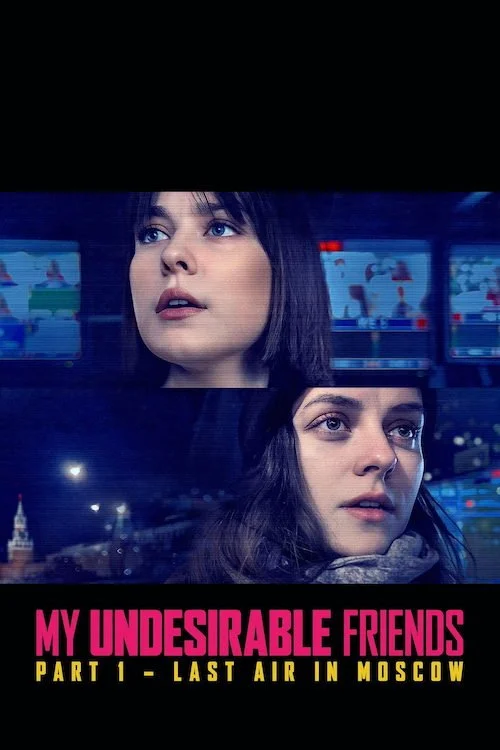
My Undesirable Friends: Part I — Last Air in Moscow
Written by Andreas Babiolakis


"The revolution will not be televised."
-Gil Scott-Heron
Julia Loktev's latest documentary is a long-form exercise in precision, patience, and tempo. It is My Undesirable Friends: Part I — Last Air in Moscow: an appropriately long name for an incredibly long project (this part is five and-a-half hours long, and is only the first segment of an even longer series). Before you click "back" on your browser, I think that this documentary epic deserves its duration. Not every documentary does; filmmakers can often get lost in the details and insist that everything is important for the overlaying message (this is often not the case). With Loktev's film, you live and breathe with these subjects. Who are they? Journalists working in Moscow working during the early days of the Ukrainian invasion. We spend every waking moment with them for a few months, and it does feel like we are right beside them with closeups in almost every sequence, claustrophobic shots at every turn, and the presence of being watched throughout this documentary.
Do you know that feeling where you can see a slowly sinking ship that you cannot stop from happening despite your best efforts? Of course you do. This has been life for billions of people for the past number of years. We have seen many countries tip and struggle to keep afloat. We have witnessed awful leaders get into their positions of power and continuously make matters worse while no one who can stop them bats an eye. This is what watching Last Air in Moscow feels like. We spend so much time with these journalists at first that we get to know them, what they stand for, and what odds they are up against. Then, you see a lot unfurl, including the war in Ukraine, the rise in journalistic censorship, and far more. It begins to feel like a race between this team of reporters and, well, the government. This film plays the slow game, with a humble release that most film lovers have not had the opportunity to watch yet (but, believe me, word will spread).
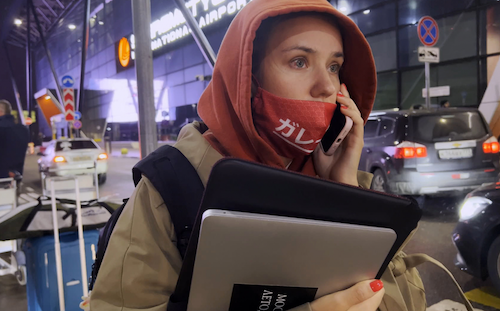
Last Air in Moscow is as in-depth as a novel, as chilling as a thriller, and as upsetting as receiving awful news (over the course of over five hours).
As the film proceeds in all of its five chapters, Last Air in Moscow becomes a frustrating affair; as our journalists have their backs against the wall, and the rest of the country (nay, the world) sits idly. The turning of a blind eye is one of the most dangerous killers in contemporary politics: it's as bad as fully agreeing with what is going on. Essentially, Last Air in Moscow is the realization that this complicit complacency is responsible for a lot. You get little red flags (that are much more obvious in hindsight) that creep their way into the lives of all before, like a parasitic infection, it is too late: we are forever changed (and for the worse). At five-and-a-half hours long, you can see in this film the glacial stalk of embedded manipulation and what it takes to make civilization not know this is happening nor be able to do anything when we are past the point of no return. How did we let this happen to us? Last Air in Moscow shows you how.
As the film proceeds even more, Last Air in Moscow feels like a ticking bomb, especially when Vladimir Putin's administration is breathing down the necks of these reporters. Still, you do not want them to back down, even if most of the world didn't even stand up in the first place. Some of our reporters try to keep working like everything is normal, whereas some others do not care to play dumb. Is either tactic useful in a regime that knows all? By showing us as much as possible, Loktev's film also refuses to hide any of the journalists' efforts, so we can see just how much they have gone through in the name of truth. When much media is against their reports (especially with the threat of censorship), it feels futile; this is why it is important for films like Last Air in Moscow to exist. When documentaries are threatened because of their lack of financial sustainability in the day and age of TikTok abrasion and zero attention spans, that possibility for censorship becomes even more potent. Where will we be able to get any truth from?
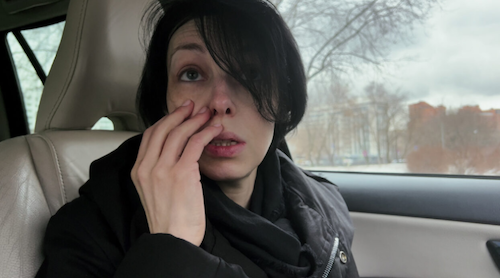
The longer it goes, the more Last Air in Moscow reveals just how easy it is for an entire nation to be blindsided and never even realize it.
So, no. Do not be deterred by the insane run time. Instead of doom scrolling on your phone for five hours, you can spend it with these journalists who have risked their lives forever for the betterment of the world. Last Air in Moscow is a big ask, but the warning is an essential one to hear: most forms of corruption happen without you even knowing. Who knows what else has gone on behind the scenes elsewhere; consider how much we know due to whistleblowers. Last Air in Moscow alerts us to what we already know but via the myriads of details we are certainly not privy to. The way Loktev lays out the film and its many facets makes this feel like a bit of a game, and it becomes exciting (yes, even when the film is so long). It almost feels like a quiet thriller at times, and the dread becomes unbearable (maybe because the film is so long). When people who want to protect others are deemed "undesirable," that's all you need to know. For us, not only are Loktev and company beyond welcome for their findings, they are the crucial truth speakers necessary in the day and age of fake news, hostile politics, and digital scrutiny. Their hard efforts at their smallest have led to the best documentary film of 2025; at large, their research and sacrifice can only be deemed heroic.
I have a feeling I, too, have now been flagged as "undesirable."


Andreas Babiolakis has a Masters degree in Film and Photography Preservation and Collections Management from Toronto Metropolitan University, as well as a Bachelors degree in Cinema Studies from York University. His favourite times of year are the Criterion Collection flash sales and the annual Toronto International Film Festival.