
Palestine 36
Written by Andreas Babiolakis
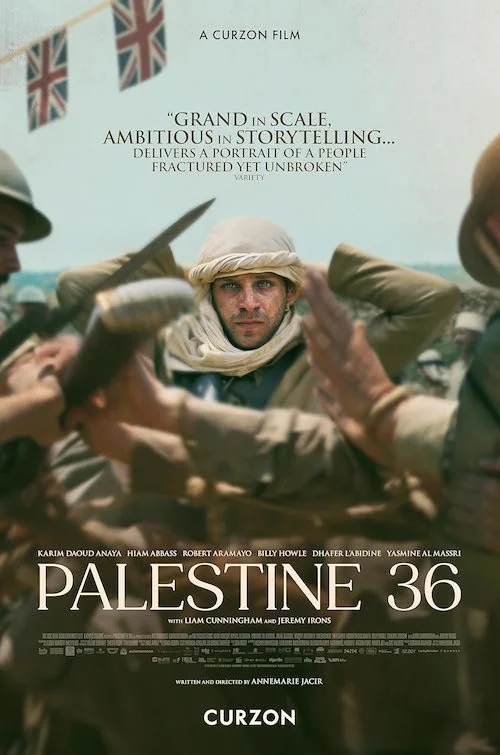


Films can often be used as reminders of the past: to show that history repeats itself, and to warn us that these events have either happened again or are going to. This is the intention of Annemarie Jacir's Palestine 36: an attempt to mirror the ongoing struggles in Palestine with the British colonialism of the thirties. What is meant to be a powerful reminder is sadly reduced to a lukewarm, by-the-numbers picture, perhaps as a means of making such subject matter accessible to the masses (instead, we get a rather forgettable film with what should be unforgettable subject matter). There is an intention for our hearts to connect with those who made this film (and who the film is about), but the film just feels derivative to the point of us not feeling united with the fearless participants in the Palestine Revolution of the thirties. A film about fighting for what's right should never feel as safe or as rudimentary as Palestine 36 does. I don’t think anyone intended for Palestine 36 to come off this way, but, to me, it does. All cinematic history lessons should possess their own electricity. All of these historical epics that copy tonal and narrative notes from one another make all of these important moments in time bleed together.
Jacir and company do try their best to add life to what feels like tomes of research (the inclusion of found-footage news material certainly helps add realistic context to what we see), and a number of other efforts are made for this film to truly blossom. These include the casting of huge names like Jeremy Irons (as British Army colonialist Arthur Wauchope), Liam Cunningham (as Officer Charles Tegart), and Palestinian superstar Hiam Abbass, whom I am always thrilled to see. There's also the atypical choice (which I commend in a film as traditional as this) to hire experimental electronic producer Ben Frost to compose the score: an effective choice that adds a bit of character in a film that otherwise feels like many tonally. There is much here that makes me want to like the film more than I do, because this is an area in history that is not discussed enough (in fact, it is often hidden or rewritten), but everything from the writing to the action to even the colour grading just feels downplayed or simplistic. This is a film about perseverance and overcoming the odds; going against what was expected of Palestinians by the colonialists who wanted to claim their nation. I wish the film stood out more than being your average historical epic.
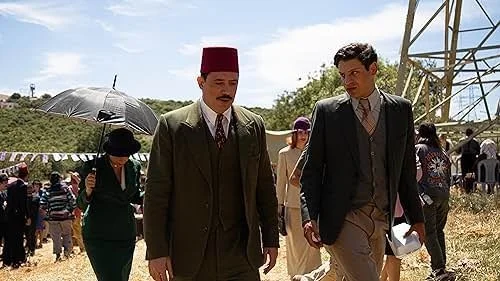
Palestine 36 boasts an important message, which is portrayed via a film that feels like your average historical epic.
Then again, I feel like in an instance like this, my opinion hardly matters. Film festivals are notorious for their standing ovations, but the Toronto International Film Festival is not really the kind of place that gets crazy with them (compared to Cannes or Venice). However, Palestine 36 had a twenty-minute ovation during its premiere which feels unheard of for TIFF. What reads as simplified to me is a necessary crowd-pleasing lesson for the masses. Maybe my expectation for something else is unimportant when it comes to how strongly this film has resonated with many viewers. Perhaps it is okay to take something robust and dial it down a bit if it means more people will connect with the end result. Maybe art doesn't always have to be challenging when the history at the root of the subject matter has been challenging enough. I strongly appreciate what Palestine 36 is conveying but just not how it is conveyed. I think Palestine's history deserves a representation that is more culturally intrinsic and less reliant on Hollywood's mold; a narrative is unafraid to go even deeper with the extent of the sociopolitical complexities and what colonialism did to a nation and its people; aesthetics that elevate this material even more so to the point that you feel at one with the heart and soul of the Palestinian people. Then again, having a film like Palestine 36 that feels accessible and applicable to the point that the film's reputation and popularity only continue to grow is remarkable enough, and maybe it existing will be enough for you, too.


Andreas Babiolakis has a Masters degree in Film and Photography Preservation and Collections Management from Toronto Metropolitan University, as well as a Bachelors degree in Cinema Studies from York University. His favourite times of year are the Criterion Collection flash sales and the annual Toronto International Film Festival.