
2000 Meters to Andriivka
Written by Andreas Babiolakis
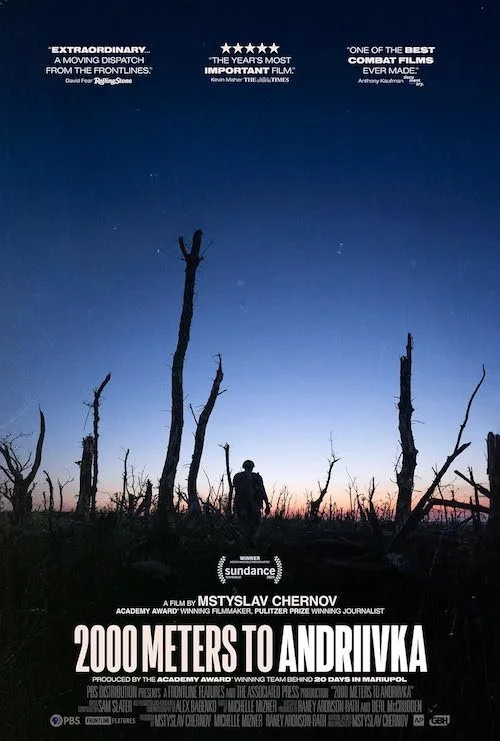

Russia's takeover of Ukraine has been monstrous, to say the least. Most would agree just from the bare facts alone. However, to see such a crisis via recordings really puts into perspective how brutal it all truly is. When Mstyslav Chernov's film 20 Days in Mariupol made waves in 2023 and 2024 (including winning an Academy Award for Best Documentary Feature Film), the extent of ruination was impossible to ignore. Not that we would need any extra context as to the severity of this invasion, but just one film documenting the early days of the Russian fleet storming into Ukraine wasn't enough. This leads us to this sister film, 2000 Meters to Andriivka, where Chernov brings us back into the thick of it. If 20 Days in Mariupol was about the initial strike, 2000 Meters to Andriivka is about the perseverance of the Ukrainian people in the face of adversity. Just like the previous film, we follow a team of journalists and their no-nonsense, upfront footage of the frontlines. This time, they join a Ukrainian platoon during the second year of the war and their efforts to rescue a village which has been converted by the Russian army. 20 Days in Mariupol is a mission to escape; 2000 Meters to Andriivka is to venture into darkness. Going deeper may be the only way out.
What is especially upsetting is how the village of Andriivka was once liberated by Ukrainian soldiers, only to be seized by Russian forces again; if that is not a metaphor for what is going on over there, I don't know what is. To fight for what was once yours is one thing; to see what it has become (beyond recognition of what is held in your heart) is another. What feels highly deceitful about this film is how thrilling it can be, before you have to warn yourself to hold your horses and rethink what is happening. This is not some Hollywood picture. This is real life. Every scare, "action sequence", and event is real, and a film like this presents it all without a single flourish or post-production sparkle. That split-second of thrill becomes an anvil at the pit of your gut, and your sickness is justified. How frequently does Chernov and company come seconds away from a possibly fatal move? They do it in the name of getting their message out. Documentaries like this one astound me as to how they even get made.
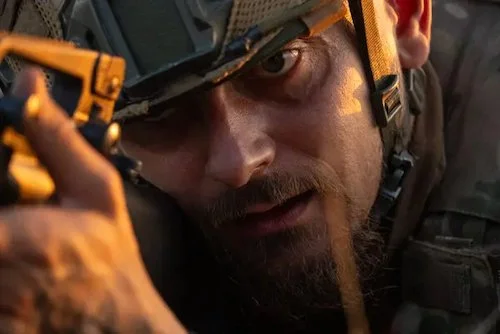
This documentary feels impossible to believe; unfortunately, it is all too real for the many who are fighting to reclaim Ukraine one village or city at a time.
There isn't much here that I haven't already mentioned in my 20 Days in Mariupol review, and part of me feels a bit frustrated about reiterating these same points of praise and subject matter. How fucking dare I. Shame on me. When people like Chernov risk their lives to just make a film about a concern as important as this, I am a coward. When the platoon goes into the weeds to reclaim their stolen property, I am nothing. All I can do is hope that my review spreads even more awareness for those who are actually fighting. Then again, maybe my difficulty with covering a film like 2000 Meters to Andriivka stems from how difficult it is to even recognize it as a motion picture. Just like 20 Days in Mariupol, this documentary was not meant to be entertaining, or even appreciated on an artistic level (although both films greatly excel in these ways). These are proofs of war. In that sense, I never feel like I am watching a film, and so it is hard to accurately describe what 2000 Meters to Andriivka is like as a film (although I can tell you that it is astounding). Critiquing this film feels so wrong; perhaps it is the doubling-down of Chernov and company returning to Ukraine after I have covered a film of theirs before that is really driving this home for me. What I can surmise is that 2000 Meters to Andriivka is pulverizing, essential, and honest. It is an excellent documentary of atrocity. While it is built into me as a cinephile to traditionally look forward to follow-up projects, I sadly don't think this will be the last film in Chernov's series of this nature.


Andreas Babiolakis has a Masters degree in Film and Photography Preservation and Collections Management from Toronto Metropolitan University, as well as a Bachelors degree in Cinema Studies from York University. His favourite times of year are the Criterion Collection flash sales and the annual Toronto International Film Festival.