
Tron: Ares
Written by Andreas Babiolakis
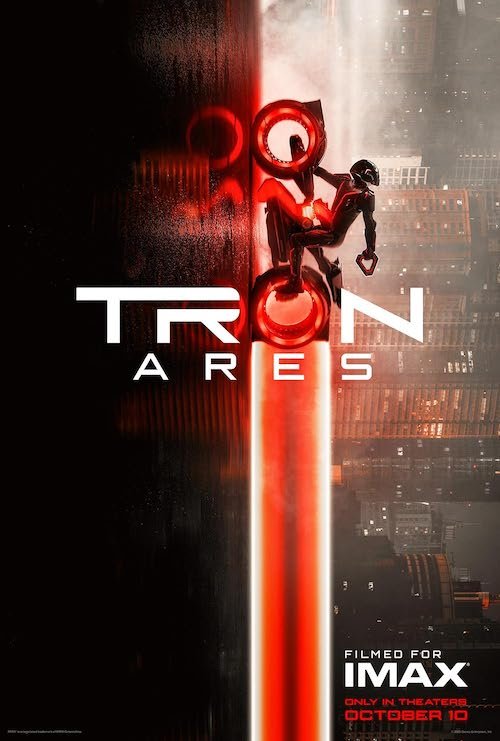


Tron, Tron, Tron. What are we ever going to do with you? This is a film franchise that keeps trying to be revived despite the fact that the films — yes, all of them — have always been a visual display, an illustrious soundscape, and that's about it. The very first Tron helps us don our nostalgia goggles when celebrating it thanks to its dated-but-endearing effects and a great performance by Jeff Bridges (but aren't they all great performances by Jeff Bridges?). Tron: Legacy was a means of trying to revisit this realm with twenty-first century technology (and a killer score by Daft Punk to boot); it simply could not capture lightning in a bottle again since it was a recreation of how the first Tron felt (as opposed to trying to be its own thing). It isn't a terrible film, but it is a dazzling misfire. This brings us to Tron: Ares which feels like Tron: Legacy after it has been left in the fridge a little too long so it has that hint of funk to it. Needless to say that — at this point — the conversation of lightning and bottles is non-existent; I'd be happy if they captured rain in the back of a pickup truck during a downpour, but, even then, we only got a couple of dribbles.
This film reeks of being a passion project by a super fan that was over-funded as an act of relentless insistence that this film needed to exit. Effectively, it was: that fan is Jared Leto who produced the hell out of this picture, stars in it, and has done everything in his power to get Walt Disney Pictures to try and risk their money yet again on a franchise that continues to fail financially. I mean, I get it. Blade Runner is one of my favourite science fiction films of all time, and its miraculous sequel, Blade Runner 2049, is also fantastic. Having said that, neither film did well financially, and these films are essentially massive gambles. Science fiction is a very niche genre that, unless it is boiled down to being a tame, mainstream version of itself, usually won't pick up the funds back that went into it (especially the effects necessary to bring these concepts to life). Avatar is essentially an action adventure film that happens to be seen through a sci-fi lens. Star Wars is a blend of many thrilling genres, including western, war, and samurai pictures. You get the idea. When something is staunchly sci-fi, it will have a far smaller audience. When that project is led by the highly controversial (and, let's be honest, maligned) Leto, that audience will be even tinier.

Tron: Ares is just like the other Tron films, for better or for worse.
To be fair, it wasn't only Leto who had faith in this project. Stars like Greta Lee and Evan Peters do try to give this film their all. We also have a score by Nine Inch Nails (no, not Trent Reznor and Atticus Ross who make up Nine Inch Nails, they're actually labeled as Nine Inch Nails, perhaps because of the use of Reznor's vocals throughout the film), which, I have to be honest, is actually quite good. The effects, in typical Tron fashion, are special as well. If you focus just on the way this film feels, Tron: Ares isn't too shabby. However, a film is far more than that. It is a conveyance of sharing a story, an experience, or some other purpose (depending on the film). In that respect, Tron: Ares is a barrage of information (and not necessarily compelling information to boot). I could go into reiterating the plot, but it hardly matters. To me, trying to revisit the story weeks after watching Ares is like trying to unscramble a pile of cables that I have left to get worse over the course of five years. I could try to go through it all again, or I could just accept that I need new cables and move on.
The plot honestly isn't that complicated at all; if anything, it’s far thinner than it leads on. It's essentially your typical story about a sentient AI and the tug-of-war battle as to how it should be used. That, plus action. Tron: Ares overly complicates itself and not in an interesting way but as a means of adding more stuff so it can justify existing (again, fake depth to try and appear not shallow). This is where I do not care to revisit what it all means. It's just a lot of Leto as Ares (the combat program generated as a means of defense) being menacing (or trying to), action sequences, extreme close-ups, and other doomsday-esque cinematic devices for two hours. The film is marginally fun but it isn't fun to think about or reminisce on; those two hours during the film feel a bit like a lie (as if the film is worth more than its sheen). I don't want to be too harsh because Tron: Ares is the two-hundred-million-dollar version of your child running up to you to tell you about their favourite TV series. Every word they say just flows through your ears like water through a hose, but you feel a little bit of excitement because you can see how much this series means to your child. We can see how much Tron means to all those who are involved, but all of these best efforts have not won me over because I feel more convinced now than ever that the Tron series is sci-fi rambling and aesthetics. The end.


Andreas Babiolakis has a Masters degree in Film and Photography Preservation and Collections Management from Toronto Metropolitan University, as well as a Bachelors degree in Cinema Studies from York University. His favourite times of year are the Criterion Collection flash sales and the annual Toronto International Film Festival.