
Primate
Written by Dilan Fernando
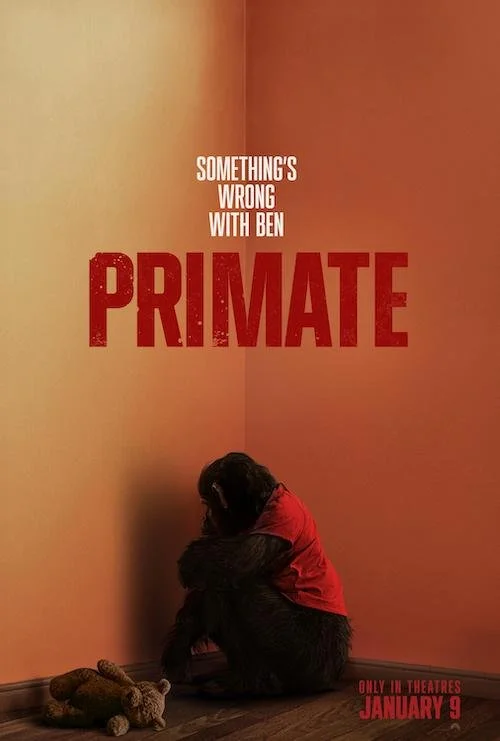


PETA would hate this movie. Johannes Roberts’ latest film, Primate thrills, chills and spills as it’s made to do; same as primates, perhaps? The film does some interesting things besides being another entry in the animals gone mad sub-genre. Primate’s eerie and ominous opening, shows the titular primate Ben, whose enclosure is opened by a caretaker-doctor (the first to underestimate). The scene effectively replicates an audience’s emotions of a zookeeper feeding an animal in its habitat – confidence with an undercurrent of suspense. This begins Ben’s rabies induced rampage before a cutting to a title – ‘36 Hours Earlier’ with the group of vulnerable partygoers all assembling on an airplane to Hawaii. The group consists of best friends Lucy (Johnny Sequoyah) and Kate (Victoria Wyant), Kate’s lonely friend Hannah (Jess Alexander) and some frat-type dudes Drew (Charlie Mann) and Brad (Tienne Simon) eyeing the trio with a carnal gaze.
Kate’s brother, Nick (Benjamin Cheng) picks the trio up from the airport and is reunited with Lucy after so long. Being childhood friends Nick considers Lucy to be like a sister to him while being coy with his attraction to Hannah. The feeling is mutual as Hannah also reciprocates the affections, while vocalizing all that Lucy tries to gesture with her body language. As the film progresses, the subtleness and effectiveness of the characterization gives us enough sympathy to care for the characters while also knowing how expendable they might be. Arriving at Lucy’s luxurious cliffside home, she greets her widowed deaf father Adam (Troy Kotsur) a successful author of novels with titles like ‘A Silent Cry’, ‘A Silent Scream’ and his latest ‘A Silent Death’. Trying to reignite a stagnant conversation with her younger despondent sister Erin (Gia Hunter). There’s an interesting skill that the family-family friends (Kate and Nick) all share and that’s the ability to sign. Once Ben begins making his way through the house and dismembering each member of the group it seems like this is their only way of communicating apart from speaking at very low volumes. There’s also mention of sign language when Hannah asks Nick what happened to Lucy’s mother, who before passing away from cancer was a linguistic scientist hoping to discover a way for humans to communicate with primates. Nevertheless, in theory this is interesting and gives the film some unique elements but it would’ve been more interesting if Roberts and co-writer Ernest Riera wove it into the script better.
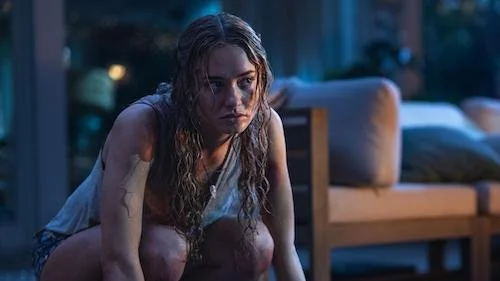
Primate is better than your average animal horror film, but not by much.
s one would expect, the film goes to extreme lengths to illustrate the brutality and volatility of animals while also underscoring why not every animal should be kept as a pet. The characters underestimation and over-confidence of knowledge both about Ben’s rabies and the primitive instincts-mannerisms of chimpanzees is both funny and pitiful. If primates resemble or (depending on some viewpoints) are the basis of human evolution, would it not be conceivable that they could also swim too? Ben’s superhuman qualities proves how easy he bites, tears, bludgeons, batters and uses brute strength to dispose of all who are standing in the way of his rampage (all thanks to a bite from a rabies infected mongoose). The sound design and music in the film creates a palpable tension and suspense, specifically when there are scenes from Adam’s perspective, complete silence. It may be abrupt at times and also gives the film moments sudden shock while adding to the ever-growing suspense, dismay and terror present in the ongoing nightmare. With moments of dark comedy that may induce hysterical laughter, Primate is a fun watch and its predictable plot keeps the viewer both invested and entertained. After all the carnage, the film poses the question, ‘What does domesticating animals prove?’, that humans are an easy target? Depends on which side you’re looking at them from.

Dilan Fernando graduated with a degree in Communications from Brock University. ”Written sentiments are more poetic than spoken word. Film will always preserve more than digital could ever. Only after a great film experience can one begin to see all that life has to offer.“