
One Battle After Another
Written by Andreas Babiolakis
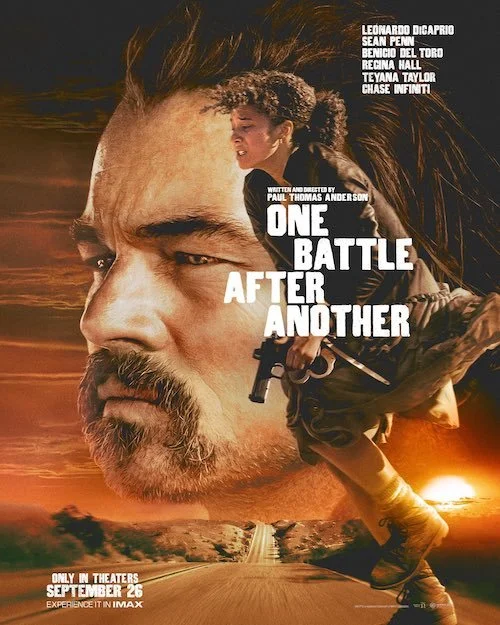



Warning: This review contains minor spoilers for One Battle After Another. Reader discretion is advised.
“Shaking hair back out of her face, ‘Does your mother know you’re out like this.’
’My mother is the war,’ declares Roger Mexico, leaning over to open the door.”
-Thomas Pynchon, Gravity’s Rainbow
The reclusive Thomas Pynchon is all but a secret to literary nuts everywhere. We know little about him, but we can piece together as much as we can through his robust writing. He operates on a completely different echelon than most, with the intelligence of an absolute genius and the ramblings of a rampant mind and spirit. When reading most of his novels, it’s easy to not be able to keep up with precisely what he writes about but being astounded by his grungy-yet-philosophical and scientific prose. It’s easy to understand Pynchon’s brilliance without being able to speak exactly the same language. One director has tried to decipher Pynchon’s madness before: Paul Thomas Anderson, who adapted the murky aimlessness of Inherent Vice to notable effect. This film captures the spirit of a Pynchon novel, but it almost feels like a painter recreating what they have seen, not conjuring up their own equal. With One Battle After Another (loosely based on Pynchon’s novel, Vineland), Anderson not only achieves the impossible (translating the author’s postmodern sensibilities into tangible cinema), he transitions this Nixon-era story into something far more contemporary without missing a beat. Perhaps this is a testament to Anderson’s talent, or the unfortunate truth that American society will always have a hideous side sociopolitically.
Perfidia Beverly Hills (Teyana Taylor) and "Ghetto" Pat Calhoun (Leonardo DiCaprio) are members of the far-left revolutionary group, the French 75. This unit frees detained immigrants from the clutches of military oppression using immense tactics, including the bombing of political offices and the robbing of banks. During this efforts seen early in the film, Perfidia comes across Colonel Steven J. Lockjaw (Sean Penn): a detestable opposition who stops at nothing to get what he wants. Forced to be emasculated by Perfidia, Steven vows to exact his revenge via a developed fetish for the revolutionary (while also trying to hunt down the rest of the French 75). Roughly half an hour into the film, Perfidia gives birth to Charlene, and a major thought runs through the viewer’s mind instantly: that child better be Pat’s, and not Steven’s. After a bank job goes wrong and Perfidia is captured (by, who else, but Steven), Pat and Charlene are now forced into a sanctuary city to remain in hiding with new identities (Pat becomes Bob Ferguson, and Charlene is Willa Ferguson); Perfidia escapes to Mexico when the opportunity strikes and becomes estranged from her family and the French 75. Pat (now Bob) crowns her a war hero in the eyes of their daughter; Perfidia is otherwise known as a rat who gave up much of the French 75.
Fifteen years later, Charlene is a hip girl in high school, a master student at karate, and just as tough as her mother. Before they were separated, Bob was warned by Perfidia’s mother that they would not make a good couple, because Perfidia is a “runner” (who will never give up fighting), and Bob is a “rock” (who becomes the support system for those who need it). Naturally, Bob aims to be Charlene’s rock as an effort to keep her from running just like her mom, but it has rendered him a pot-headed basket case. Meanwhile, Steven is living on top of the world, having been promoted numerous times for his efforts and is now invited to join the Christmas Adventurers Club (a masonry-like club full of white supremacists). Steven is quizzed by the Christmas Adventurers to make sure that he is right for the community, including being asked if he has ever engaged in romantic or sexual relations with anyone who is non-white; Steven lies, and decides that it is up to himself to ensure that he finds out once and for all if Charlene is his child. The French 75 intercept this ambush, and thus begins a cat-and-mouse chase that lasts for well over an hour.
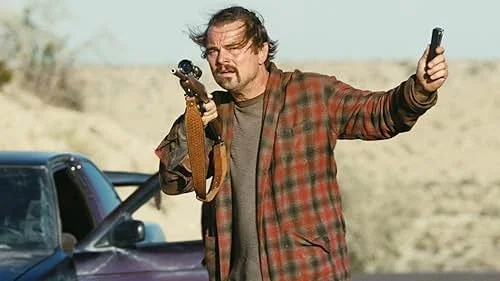
One Battle After Another is magnificently thrilling, thanks to a well-established first act and an immense amount of moving parts during its relentless second and third chapters.
The first act is so rich in context that the nothing-but-hysteria sequences that last for a vast majority of the film all feel worthwhile (and not for the sake of stringing the audience along for a pointless ride). There is much to champion about this expositional opening chapter, but the major talking point is Teyana Taylor’s brief but fabulous performance: one that is so strong that her presence ripples throughout the remainder of the film. You feel her fight throughout Bob’s surrender as a drug-addicted recluse. You see the resemblance in her teenage daughter. Throughout much of One Battle After Another, because of Taylor’s dynamite acting, you are left with the feeling of what all of this is for. While some see Perfidia as a rat, we viewers can understand what she did to protect her family (even if it slowly feels more and more as though she is out of the picture for good; she strives not to be). In the context of Steven potentially being Charlene’s father, we get the full quote that is often botched by loudmouths who do not know that of which they profess: “The blood of the covenant is thicker than the water of the womb.” We see this in Leonardo DiCaprio’s complicated father role, especially because he isn’t even aware of the possibility that Charlene is not Bob’s blood-related child; Charlene understands what a real father is. This is present with an exquisite sequence towards the end: one where Bob is trying to prove he is not an enemy to Charlene. He no longer speaks in code. He wants to be recognized as a parent; Charlene reciprocates. Love is stronger than protocol.
So much of One Battle After Another is kinetic, with chain reactions that make plausible sense narratively but feel so impossible that they’d have to be real (you know what they say about truth being stranger than fiction). Another factor is that the bullshit (yes, bullshit) that ensues in this film is reality to so many people who are stripped of their livelihoods and domiciles because other people deemed them unfit to live or to reside in the United States. To see Steven go through the lengths that he does not to acknowledge who may be his daughter but to attempt to eliminate her (all so he can be approved by a racist cult) is a stark reminder of what the American experience is in the eyes of bigoted people: an effort to cleanse those they don’t agree with or understand the histories of. Sean Penn does a fantastic job at making Steven repulsive but also understandable as a character. You get the importance of feeling accepted and his refusal to quit, but you are still more than able of judging his monstrous nature. Penn makes Steven feel truly unstoppable as well, to the point that he takes on the allegorical stature of representing white supremacy, political corruption, and even the dishonourable title of being death incarnate throughout One Battle After Another; a late scene confirms this to a nearly impossible degree.
The other details of the American experience include Benicio Del Toro’s Sergio St. Carlos: Charlene’s karate sensei who we see a snippet of the life of. Sergio has his own battle to fight, with hideaways and protocols set in place for when the local Latin community are threatened. We may focus on the efforts of the Ferguson family, but One Battle After Another cleverly hints at the ongoing struggles of millions of citizens of all walks of life. This film does feel like an incredibly rough twenty-four-hour period for the majority of its duration, but it plants the seed that there are countless days just like this in the grand scheme of things. If you felt so gripped by what you have just seen, you must understand the gravity of how frequently this kind of suffering and selfishness takes place, and why revolutionaries like these do exist (and why they feel as though they must act in the ways that they do). America is a highly conflicted nation (especially right now), and two citizens who understand this well enough to describe the friction in great detail are Anderson and Pynchon.
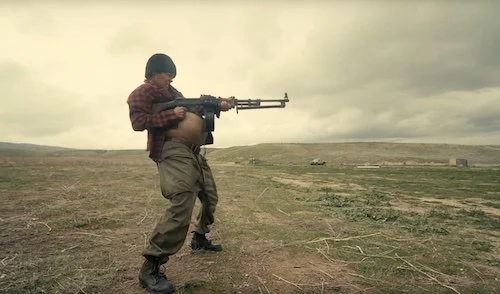
One Battle After Another is both a timely and timeless film, given the never-ending sociopolitical conflicts it describes.
Cast as one of the nuns is Pearl Minnie Anderson: Paul Thomas Anderson’s daughter with partner Maya Rudolph. Both of these women in Anderson’s life are mixed race. When you feel the rage radiating off of the screen in One Battle After Another, particularly when Charlene is referred to as a “mutt,” this is as personal as Anderson has ever gotten with a film. He sees his loved ones as the affected women in this film, so much so that his own daughter makes an appearance; he made this film for her. Anderson has detailed so many of America’s concerns and identities with his film; the hyper-capitalistic rat race via There Will Be Blood; the ability to exploit vulnerable persons and the obsession with cultish release with The Master; the addiction to fame and the inability to readjust after one fizzles out in the entertainment industry through Boogie Nights; et cetera. Look at most of Anderson’s films, and you will see a different face of the nation: one that he loves but can also find fault within. With One Battle After Another, he is at his most furious. He loves this land, but he cannot fathom what has become of it. Anderson is not hiding behind period piece settings: he faces the present with gusto. Anderson has tackled American issues before, but with One Battle After Another, he is at his most noble.
Anderson is a director of many natures; the Robert Altman, star-studded casts of his early works; the Stanley Kubrick-inspired artistry of Anderson’s mid-era; the amalgamation of the two since Inherent Vice. One Battle After Another is certainly not a Hollywood film (one should never expect Anderson to play ball that shamelessly), but it is definitely one of the auteur’s most approachable films (yes, even with the strange, psychological sexuality that is present for much of the film). Somehow, Anderson achieves both of his past natures in full here: the never-ending electricity of Boogie Nights and Magnolia, and the aesthetic, meditative breathlessness found in There Will Be Blood and The Master. If anything, One Battle After Another feels like a tribute to the New Hollywood movement of the seventies, as if to say that we are in dire need of a New New Hollywood (and, believe me, we are). Anderson’s frequent collaborator, Radiohead’s Jonny Greenwood, uses his score as an homage to the greatest political thriller of all time (The Battle of Algiers, which actually gets referenced at one point in the film) with threatening percussion and soaring strings. You are forever on the edge of your seat with this film. Editor Andy Jurgensen takes the ten thousand scenes that were probably written and makes complete sense of it all, with a nearly three-hour effort that, miraculously, never feels like it is missing a beat.
At the epicentre of it all is the young star Chase Infiniti, who stays afloat with some acting and filmmaking heavy hitters just fine; her terrific performance is indicative of a promising new generation (the kind we must find hope in, given how badly the past generations [and our own] have failed time and time again). The title One Battle After Another resembles the ongoing tribulations found in the film’s plot, but, really, it is a statement that there will always be political rebellion in the face of tyranny. This is just one such fight, and we don’t even see the end of the war (because, as stated, it sadly will never end as long as abhorrent oppression prevails). If we stop fighting, we will let evil win. We must never give up on our own freedoms. Whether you are a runner or a rock, be present and an ally. In a nation as divided as the United States is right now, we needed a film like One Battle After Another, and it had to be good. Fortunately, Paul Thomas Anderson has delivered us one of the greatest films of his illustrious career: a breathtakingly nerve-wracking film that will keep you gripped until the very end. It is this staying power that’ll inform you of what it’s all for: the faith in a future that continues to never quit, be it in the face of a government that eliminates freedom, or a film industry that is eating itself alive. One Battle After Another has won its battle, but the war is far from over.


Andreas Babiolakis has a Masters degree in Film and Photography Preservation and Collections Management from Toronto Metropolitan University, as well as a Bachelors degree in Cinema Studies from York University. His favourite times of year are the Criterion Collection flash sales and the annual Toronto International Film Festival.