
Weapons
Written by Dilan Fernando
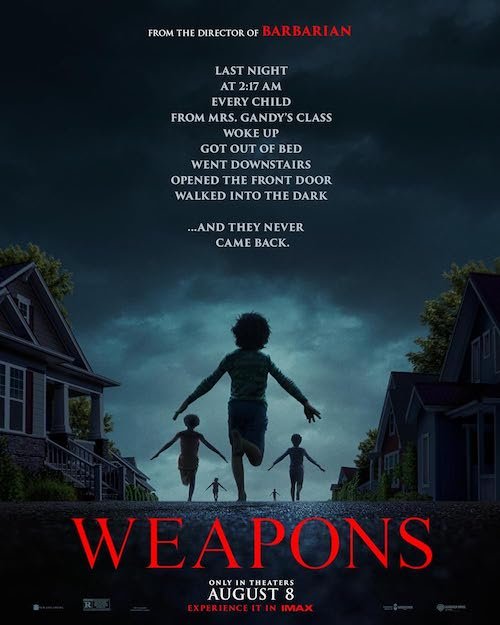


Zach Cregger’s latest film Weapons is an entertaining thrill ride. Though, there are moments throughout the film that could’ve been expanded upon more. Thematically the film is a wonder, however, Cregger’s preference is to give the audience an enjoyable experience in the theatre without having anything to ponder after the credits roll. At the center of the film is family, the overarching theme that brings many other elements and ideas of what is required to stay together and endure life’s tribulations – gun violence in the education system, police brutality, substance abuse, stranger danger and the navigation of childhood. Cregger, who wrote, directed and produced the film – can be read as having similar duties of parents or guardians when raising children. Cregger’s wife, actress Sara Paxton also stars in the film playing the role of a mother, bringing another familial quality to the film.
The film begins with a child’s voice-over narration, (one of the few moments where the ambiguity in the film works) leaving the audience to wonder where is the child telling the story? The child retells the story of an eerie and mysterious event when 17 children from a third grade elementary school class got out of bed early one morning at 2:17AM and left home; except for one Alex Lilly (Cary Christopher).
Cregger’s structure in the film is to divide each of the five protagonists who are affected by the event – teacher Justine Gandy (Julia Garner) whose students vanished, Archer Graff (Josh Brolin) a concerned father whose child vanished, Paul Morgan (Alden Ehrenreich) a young cop whose department is looking into the disappearances of the children, James (Austin Abrams) a local drug addict who possibly knows of the children’s whereabouts and principal Marcus Miller (Benedict Wong) who tries to console the outraged parents during this difficult time. Each character has their own intertitle that describes their days surrounding the event before folding them into the progression of the ongoing mystery. Cregger’s division of the characters to slowly have them come together to solve this mystery is interesting as an idea though it doesn’t translate as well as it could’ve. What’s left is a dark Scooby Doo episode with a disjointed structure.
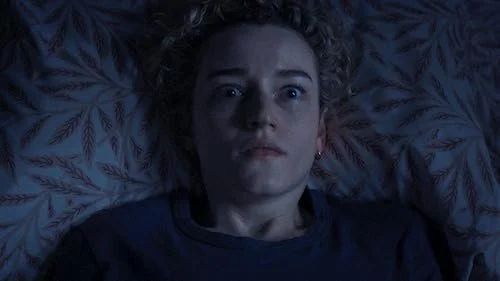
Weapons does its best to be layered but, in its efforts, winds up stunted by its sequencing and structuring instead.
The film does have its qualities like the characterization of its protagonists, Cregger’s visual literacy which enhances some of the ideas that are established early on and the performances by its cast. Garner, Brolin, Ehrenreich and Christopher bring a great deal of emotion when shaping their characters, creating lived-in performances that exceed the material they are drawn from. Christopher outshines the rest of the cast in his role as Alex who has a great weight to carry in the film, doing so with grace and composure. As the film progresses Alex’s routine is so cyclical that he ironically becomes a zombie parent caring for his own parents whose trancelike state mirrors infancy. These are the characters that separates Weapons from many other horror films that seem routine and have protagonists that are caricatures of horror archetypes.
The most confusing thing about Weapons is all that Cregger adds to these characters and their lives in the film only to focus on more banal plot elements. Some examples include Justine and Paul reconnecting after having been a couple long before the event. Both characters have had difficulties with alcoholism, though Cregger nor the film illustrate why. Could it be that they tried to conceive a child which led to a miscarriage causing them both to drift into alcoholism? Is this why Paul is unable-unwilling to procreate with his current partner? What about Archer? Who has one scene with his wife after the disappearance of their son. Archer, sleeping in his son’s bed clinging to a pillow hoping that it’s all a nightmare, is awoken by his wife who tells him that she’s going to work. Does she have any concern for her son? Is their marriage stronger or weaker because of the event? Finally, Principal Marcus Miller, who sits at home with his partner watching television while the entire town is in calamity. Sitting behind his desk and preaching that they should keep together and be hopeful. Empty platitudes from an individual who is a surrogate parent at school, resolving issues with temporary solutions to anyone who’ll listen, similar to a soapbox politician.
Maybe Cregger doesn’t have all the answers if any to these concerns which is fine as the film proposing them is something, but if the expectation is for the audience to find their own solutions without giving them any tools to try and use to solve them then what depth does the film really have? Ask yourselves, does the film try to rationalize an inexplicable event that is beyond itself or does the audience prefer to trivialize something so bizarre as there are many events like it?


Dilan Fernando graduated with a degree in Communications from Brock University. ”Written sentiments are more poetic than spoken word. Film will always preserve more than digital could ever. Only after a great film experience can one begin to see all that life has to offer.“