
The Fantastic Four: First Steps
Written by Andreas Babiolakis

My favourite release by Marvel Studios is easily the WandaVision miniseries. Up until the final episodes, it is the most daring project the comic book company had released in any visual medium. Its balance of nostalgic-based satire (in the form of showcasing the evolution of comedic television), nightmarish dread, and superhero drama felt like a step in the right direction for Marvel, as if the studio was shedding its obsession with pedestrian homogeneity: every film used to abide by the regulation that they must feel the same in tone, scale, and outcome. WandaVision was unique. It depicted the complicated life of partnered super figures within the diorama of the nuclear family dynamic, and the evolution of the American sitcom depicted the phases of these lives. Of course, Marvel couldn’t just let WandaVision exist on its own. It had to devote an episode or two to bringing things back into the same old Marvel style, undoing the efforts made before in what was once a fresh release by the studio who has become as predictable as playing a game of Rock, Paper, Scissors with Edward Scissorhands. I bring up WandaVision because it was a major project by director Matt Shakman: one of the only filmmakers to bring at least some sort of a new perspective to anything under Marvel Studio’s purview (Ryan Coogler’s Black Panther and Wakanda Forever would also fall under this very small umbrella). A new film by Shakman could be what Marvel’s Cinematic Universe desperately needs: something different.
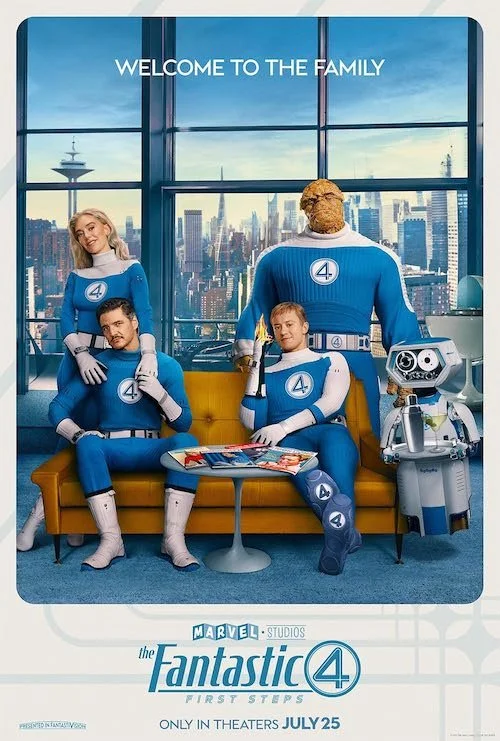
You can tell in microseconds that The Fantastic Four: First Steps is different. It is clearly a superhero film by Marvel, and the blue, retro Marvel title card may seem like a desperate effort to throw you off of the stench of repetition, but The Fantastic Four: First Steps quickly makes two bold choices to kick things off. We meet Reed Richards (Pedro Pascal) and wife Sue Storm (Vanessa Kirby), otherwise known as Mister Fantastic and the Invisible Woman, respectively. Sue reveals to Reed that she is pregnant: a magnificent accomplishment that many couples aspire to experience. This is followed by a televised depiction of how the Fantastic Four came to be: a choice that I love. Firstly, we forgo the need for an origin story that has already failed twice before (three times if you include the Roger Corman-produced film that never got formally released and was abandoned); Shakman makes sure to avoid falling into the same trap. We’ve also seen origin stories ten trillion times in the past fifteen years from Marvel, so maybe this was getting quite stale. Secondly, I feel like placing the exposition of how the Fantastic Four came to be — from a trip to space that permanently changed these four astronauts — after the pregnancy news creates a strong pairing; the pregnancy humanizes two of the unbelievable beings we’ve just learned about, and the history shown in the broadcast provides much needed context that proves how far Reed and Sue have come.
There will soon be trouble in paradise, however, but what a gorgeous paradise this is. Shakman’s aptitude for using retro styles effectively comes into full effect as this universe’s version of sixties Manhattan is exquisitely immersive. The film blends past depictions of the future (think The Jetsons’ versions of flying cars, for instance) with contemporary science fiction lore to make one of Marvel’s most fascinating settings to date. To help this world feel palatable, The Fantastic Four: First Steps boasts one hell of a visual effects team who — this time around — understand that great imagery is more than just spectacle or graphics: it stems from strong composition. There are some key shots in First Steps (like Silver Surfer in front of the moon at the start of the third act) that wowed me. I can’t believe it either. A Marvel film actually had me blown away by how it looks, including moments that felt rich artistically. I never thought I’d see the day. It sounds great as well, with the standard crunchy sounds you’d come to expect from Marvel; it may not have been elevated in the way the cinematography occasionally is, but the sonic palette here is great enough.
First Steps may showcase a world I’d love to explore, but, again, there is trouble afoot. Shortly after we meet Reed and Sue, we learn about the other two members of the Fantastic Four: Ben Grimm (Ebon Moss-Bachrach) — or The Thing — and Johnny Storm (Joseph Quinn) — or Human Torch. Again, they all garnered superpowers after their trip to space; Reed can stretch himself to any length; Sue can turn invisible; Ben has become a rock-like being with super strength; Johnny can set himself ablaze and can even fly using his fire capabilities. After they return with these powers, it is stated that the Fantastic Four have used their abilities for good to try and better Manhattan and create progress. All is well until the city stops still at the sight of Silver Surfer (Julia Garner) who brings a message of doom like she is Klaatu from The Day the Earth Stood Still: she warns that the divine being Galactus (Ralph Ineson) has marked Earth the next planet he is to consume. The Fantastic Four investigate this dark promise and confront Galactus who creates a morbid compromise. Galactus states that Reed and Sue’s unborn son will satiate him and Earth will be spared: a deal that is instantly rejected. Earth is doomed.

The Fantastic Four: First Steps may be a little confused narratively, but it is at least different and engrossing enough to not feel like the exact same ride from Marvel yet again.
The themes all stem from major concerns back in the sixties; nuclear family life; the space race; the quest for technological progress; political uncertainty and the potential threat that is posed to the American people. That isn’t to say that these topics don’t span through history, but First Steps ensures that the talking points here always maintain the focuses of yesteryear, helping transport us not just to a different reality but a familiar point in time as well. While we follow a squad of heroes aim to save the world once more, we are also looking at a family coexisting, anticipating a new member any day now, and also have to parent the city of Manhattan during their biggest crisis to date. I couldn’t help but think of Brad Bird’s The Incredibles throughout First Steps as a result: a worthy comparison, I’d argue. However, where The Incredibles is consistently thrilling, entertaining, and layered, First Steps — as per its name — feels like a preliminary version of what could be. I don’t feel like I get to know the Fantastic Four members well enough as individual people, including what makes them tick or even ticked off. I understand them best when partnered, either romantically (Sue and Reed), or as friends, family, or squad mates. I’d like to learn more about these superheroes. I feel like the biggest priority of the film is the baby storyline, which — in turn — makes the Silver Surfer and Galactus threads feel quite thin. This is a film with Silver Surfer, and yet I feel like she is in the film for maybe ten minutes (she is likely more prevalent, but this is how it feels).
It’s at this point that I should turn your attention to the fact that First Steps is essentially one hundred minutes (if you cut the credits). That’s it. It’s no wonder that many topics are so hurried and not fleshed out when First Steps vows to take on so many concepts in barely any time at all. I feel like the origins of the team being displayed in a recap was clever, but the rest of the film shouldn’t possess the same kinds of rapidness and shallowness, seeing as I wouldn’t want an entire feature to feel like the Coles Notes of a larger, grander film. First Steps contains some of the most epic shots in all of Marvel, and yet they don’t feel as massive as they should because we must zip to the next point and not waste any time. I know our attention spans rival those of ants on cocaine nowadays, but if any Marvel film could have afforded to be two and a half hours, First Steps is that film: a feature begging to be slowed down and lived in. This leads to the film’s conclusion of which I will not spoil, but I will warn that it feels cliched (the only part of First Steps that does, sadly), rushed, and clumsy. When the credits rolled, I was fully expecting another battle sequence or two, but I was instead hit with the realization that First Steps feels more like a demo of a larger Fantastic Four film. I wanted more. I won’t be getting it outside of the forms of sequels and Avengers followups. Dammit.
As much as I genuinely love elements of First Steps, I also cannot shake off how distraught the narrative gauntness and forced ending made me feel. I grew attached to these figures because of the charismatic and self-aware performances. I loved this version of Manhattan and its cheeky allusions to a future world we — the people sixty years later — know won’t happen. I was into the retro commentary, the right amounts of cinematic cheese, and the hints of promise in artistry that feels next to impossible to find in any Marvel film (works that often play for entertainment above anything remotely stirring). I feel like there is something remarkable here, but we just didn’t get it. The worst part is I can’t even blame Marvel for taking over and sabotaging the film like I usually can, because First Steps is so different from what Marvel usually churns out in feel and in style. This just feels like a film that was an experiment in one way, but boiled down to a brief gamble as to not overstay its welcome. No. This should have been as bold as possible, and proudly so. This feels like someone getting away with standing up to a bully because they ran away quickly afterward. First Steps should have been a statement, not a “what if” scenario. I was rooting for this film throughout its entire runtime, only to feel like I partially got what I wanted. While this is clearly the best of the four released Fantastic Four films, First Steps sadly isn’t quite fantastic. It kicks off in tremendous fashion and winds up gasping for air at the finish line; it sprinted during a fifty kilometre marathon. It finished the race, but not in the winning fashion it easily could have.


Andreas Babiolakis has a Masters degree in Film and Photography Preservation and Collections Management from Toronto Metropolitan University, as well as a Bachelors degree in Cinema Studies from York University. His favourite times of year are the Criterion Collection flash sales and the annual Toronto International Film Festival.