
The Secret Agent
Written by Dilan Fernando
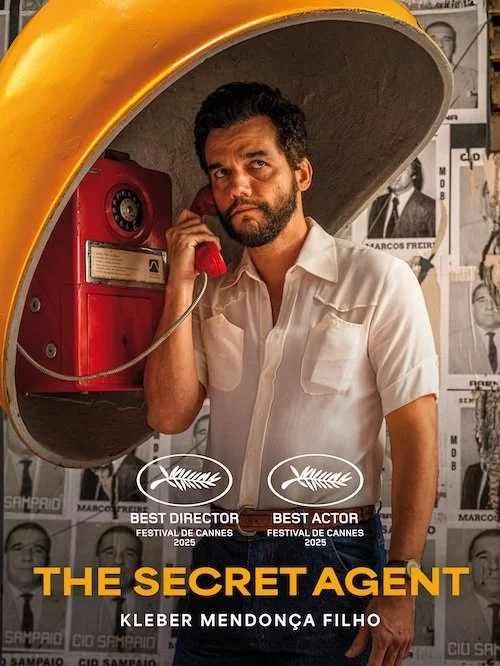



Kleber Mendonça Filho’s latest film O Agente Secreto isn’t a literal title as one may expect, rather it’s a comment on the lengths one must go to for survival in a corrupt society. The film opens with an upbeat woodwind tune playing over stills of various television and films, likely those that influenced or that Mendonça Filho recalls from childhood. A caption explains that the film is set in the Brazil of 1977 during carnival time where a great deal of corrupti– mischief tends to occur. The titular secret agent is Marcelo-Armando (Wagner Moura), whose yellow Volkswagen Beetle pulls into a secluded service station next to a busy highway. Looking ahead through the windshield lies a bloated rotting corpse baking in the hot sun, covered in cardboard weighed down by a rock as flies and dogs hover about gnawing at the remains. The attendant of the service station is a hefty man, Frentista (Joálisson Cunha), who’s so big that his shirt can’t be buttoned (a visual representation of the Brazilian government); greets Marcelo-Armando right as he’s about to leave, explaining that the corpse is of a man who tried to steal oil cans with a knife before meeting the barrel of a 12-gauge. The policia civilia arrives and drives around the corpse before checking Armando’s car only to find no contraband, asking, ‘Have you made a donation to the policeman’s fund?’ This unsubtle way of asking for a bribe has more depth to it as it also purposefully shows how the government isn’t averse to manipulating or leeching from what little its citizens have to live off. Marcelo-Armando ultimately acquiesces, knowing that the policia must receive something, offers up his cigarettes. This opening scene sets up the greatest antagonist of both Marcelo-Armando and Brazil, corruption.
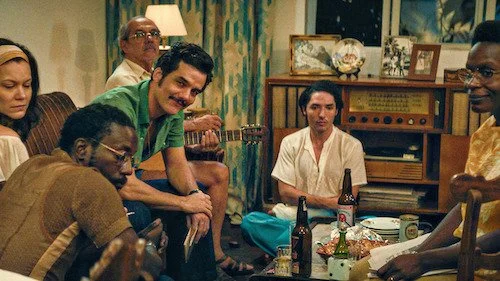
Marcelo-Armando continues on his journey through to the Northern town of Recife (pronounced heh-see-fay) which appears cleaner but still harbors violence like any favela. Arriving in Recife, he’s greeted by Dona Sebastiana (Tânia Maria) a vivacious woman who owns a boarding house colloquially referred to as the ‘Ofir Madhouse’ for displaced individuals. Among the residents of this place includes Dona Sebastiana’s young right-hand man Clóvis (Robson Andrade), a young mother Cláudia (Hermila Guedes) with a young daughter Débora, married couple Tereza Victória (Isabél Zuaa) and husband Antonio (Licínio Januário) and injured Haroldo (João Vítor Silva). Dona Sebastiana initially lived in Italy during World War II before escaping to Recife. Her performance brings levity and is the emotional base for the Ofir residents, giving them hope and knowing that in spite of all the corruption in the world safe havens exist thanks to empathetic people. One of the warmest scenes in the film is when Marcelo-Armando returns one night to Ofir and partakes in a going away party for Tereza Victória and Antonio. All of the residents are gathered around drinking, listening to music and conversing; each giving a glimpse of their struggles while sharing their content for friends who understand them. Many of the residents have been subjected to persecution or death threats for their social and political beliefs feeling vulnerable alone but as the saying goes there’s strength in numbers.
With Dona Sebastiana’s help, Marcelo-Armando gets a temporary job working at the Institute for Identification under the assumed name Marcelo. On Marcelo-Armando's first day of work he’s asked to come in early by Dona Sebastiana’s friend Anísio (Buda Lira) who knows nothing of his life before coming to Recife. The reason for them coming in early is to turn the office into a makeshift police station for the deposition of a wealthy socialite after her negligence led to her housemaid’s daughter being hit by a bus while the housemaid was out shopping. The one who orchestrated this entire plan is the sly and pompous police Chief Euclides (Robério Diógenes) along with his sons (goons) deputies Arlindo (Ítalo Martins) and Sérgio (Igor de Araújo). While Euclides gives the impression that the two are his family, really it’s because he can control them to do his bidding. Notice the introduction of Euclides, he’s called away from carnival to an Institute for Oceanographic research covered with confetti and lipstick (another subtle jab at the domineering government representatives of Brazil). The oceanographic institute recently captured a tiger shark and while going through its stomach contents found a human leg.
While the lead doctor carefully tries to extract the leg, in the background sitting at a desk is a journalist. As Euclides waits for the removal of the leg, notice how he takes the notebook and scrutinously reads through the article. The doctor trusts that Euclides will help clear this matter up by retrieving the leg – ironic that the hairy leg be brought in to claim the remnants of their mischief. Mendonça Filho’s handling of this scene shows one of the purposes for making the film, for those in power in Brazil to realize that its citizens are no stranger to the ongoing corruption. Now compare the oceanographic scene with the one in the makeshift police station while the deposition goes on. Euclides sets his sights on Marcelo-Armando and asks him if he’s a cop which Marcelo denies, returning to his newspaper, the headline says that the death toll during carnival is 91, which Euclides smugly assumes will reach 100 soon. Euclides also mentions that he knows what the newspaper will say even before it is written (another cost of maintaining title as Chief).

O Agente Secreto depiction of Brazil is one of love for its people but concern for the overbearing corruption that controls it.
Throughout the film there are various portraits of government officials hanging on the walls of each office and building as a sign of respect or point of pride but can be read as a tribute to the dead. Respect is given to those like Marcelo-Armando for how he tries to sacrifice everything for his son Fernando and deceased wife Fátima (Alice Carvalho). Fátima’s parents, mother Lenira (Aline Marta Maia) and father Sr. Alexandre (Carlos Francisco) who cares for Fernando after Fátima’s passing and while Marcelo-Armando sorts out a way to bring his son with him and leave Brazil. They don’t demand respect, they know what it takes to earn it, living by that philosophy every day. While Euclides demands respect by flaunting the pistol hanging on his hip, presenting himself as a person of power with his chauvinism and by asking (bullying) those in the neighbourhood for favours like an elderly tailor named Hans (Udo Kier). Considering themselves to be good friends, Euclides insists that Marcelo come along to meet his friend Hans, a German soldier of WWII as Euclides puts it (who was really a Jewish POW) who escaped from Austria. Being the puppet master, Euclides demands that Hans show his bullet-holed leg to Marcelo. After some reluctance Hans eventually does out of spite standing with a bold defiant look of affirmation, as the group looks on, shocked by the horrors of war etched across the leg Hans goes further to show the scars across his chest. Hans and Dona Sebastiana are the living proof of those fortunate enough to survive after standing up to corruption.
There is also Henrique Ghirotti (Luciano Chirolli) who is the wealthy head of a successful engineering company who makes deals with other research institutions across the world for new research that he can patent for his technology. When tasked with visiting the university where Armando works as a researcher Ghirotti tells the members of the research team that their funding is severed and division will be closed. Armando mentions over a dinner with Ghirotti that some of the research he’s patented was because it was a way of keeping the research within the institute and potentially getting them more funding. Ghirotti sees this as Armando realizing what Ghirotti’s dealings are with regard to research institutions and how it can jeopardize his profits, leading to Ghirotti killing the members of the research team. Armando and Fátima who attended the dinner to sever ties with Ghirotti and air their frustrations with his interference and character. Ghirotti ultimately hires two contract killers, a former soldier Augusto (Roney Villela) and Augusto’s son Bobbi (Gabriel Leone) to hunt down and murder Armando.
Sympathetic to his situation is Elza (Maria Fernanda Cândido) who along with Valdemar (Thomás Aquino) are part of an organization that helps displaced people start anew. Elza mentions during a taped conversation with Marcelo-Armando that the funding for their organization is from the daughter of a wealthy Brazilian official who has taken vast amounts of money from Brazil’s citizens, the organization being the daughter’s way of reparation. Assuring that Marcelo-Armando will get the fake passports necessary to take his son out of Brazil, Armando leaves the discussion room in the attic of a cinema where Sr. Alexandre works as a projectionist; walking-dancing through an ongoing block party as part of carnival – a cathartic expression of the gamble that Marcelo-Armando has taken with all his sacrifices, potentially leading to the trouncing of corruption.
O Agente Secreto is an exhilarating film steered by Kleber Mendonça Filho’s nuanced direction and Wagner Moura’s magnificent lead performance.
Moura’s performance is one of emotional depth and intelligence (which is near impossible to illustrate without dialogue). It’s one of quiet power that demonstrates his position in the world and who he is as a person. Marcelo-Armando’s cunning and strong will to survive is what propels him throughout the film. Every time he sees his son Fernando or thinks of him, it fuels what he must do to ensure that Fernando’s life will be better. Here is where Mendonça Filho explores the power dynamics within the characters, trying to have them distinguish if power is used for their survival or corruption? Augusto and Bobbi hire a lowly day labourer in Recife, Vilmar (Kaiony Venâncio) to hunt down and kill Marcelo-Armando. Why? Their hands are clean and it shows the hierarchy of corruption that is present throughout Brazil’s society, where the underworld meets the upper crust. Vilmar sets his own price for the job and asks for respect when discussing the job’s details, reaffirming his status and position. Same goes for Ghirotti when hiring the contract killer duo.
Mendonça Filho uses a framing device to better understand the story as it progresses cutting back and forth through different times in Marcelo-Armando’s life; two women, Flávia (Laura Lufési) and Daniela (Isadora Ruppert) who work as part of a research institution in modern-day Brazil, reflecting on and also giving power-awareness to stories of those like Marcelo-Armando. Armando’s adult son Fernando (also played by Moura) grew up to be a doctor and didn’t know what happened to his father hence why the researchers took it upon themselves to help bring some closure regarding his father’s life and memory. This parallels Marcelo-Armando’s request to be placed in the Institution for Identification as he was hoping to get some closure and find one remaining document of his mother, scouring the archives for her death identification. O Agente Secreto, is a dense, entertaining, poetic film which rewards multiple viewings. The performances are so well crafted that they sparkle in the sunlight, carrying that radiance from scene to scene. The writing is meticulously crafted in a manner that illustrates Mendonça Filho’s passion for cinema and the gravity for what has become of his beloved country Brazil.
The direction and cinematography which is masterfully done gives the film a sense of energy and urgency all within a landscape that is somewhere between the past and present. Finally, the period specific set and costume design that immerses the viewer in 1970s Brazil. This is one of the best films of the year with one of the greatest performances of the year. It’ll have you feeling a plethora of emotions, sometimes all at once or individually. Mendonça Filho does with this film what he’s been practicing throughout his filmography which is providing a reverent portrait of Brazilian culture and how culture is instrumental in forming us. A arte apaixonada é a sobrevivência contra a corrupção em massa.


Dilan Fernando graduated with a degree in Communications from Brock University. ”Written sentiments are more poetic than spoken word. Film will always preserve more than digital could ever. Only after a great film experience can one begin to see all that life has to offer.“