
Sirāt
Written by Dilan Fernando
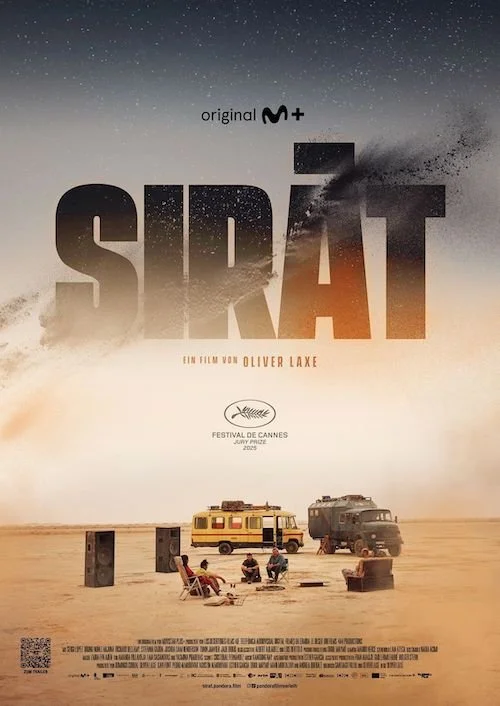


While watching Óliver Laxe’s latest film Sirāt, it seems that there’s only one character Luis (Sergi López) who has a goal that he will sacrifice anything striving to achieve, finding his daughter Mar, who has left home and immersed herself deep into the rave culture that overrules the deserts of Southern Morocco. The film shows the preparations for one of the desert raves as the wall of speakers-subwoofers are set up and the music radiates the ground and surrounding rocky cliffs. Luis hands out flyers to the zoned-out of the rave walking further out of his element and closer towards an outcome carrying a sense of doomed hopefulness. It’s here where Luis’ faith sets him off on his journey and is what he leans on to carry him throughout. Is it enough?
Luis is accompanied by his son Esteban and their dog Pipa, the trio drive around in a van looking, familiarizing and slowly immersing themselves in rave culture, wading through the sea after sea of jivers. This slow indoctrination into the culture mirrors the pair's growing emotionlessness and lifelessness. Notice the way that Laxe composes shots of the ravers dancing, showing them overcome by an unknown spirit; moving more in possession with a feeling to dance their sorrows away and escape reality. The drugs fuel them as a means to keep them moving because in a strange way they appear to be closer to death if they were to stop – raving is beyond a lifestyle. Laxe’s illustration of the exhilaration from raving makes it believable that Mar would leave her home life, also leaving the audience to wonder if Luis’ search for her is out of guilt or being a dutiful father.

Sirāt does so much with its premise outside of fulfilling its characters enough; it dazzles, but it can still leave you wanting more narratively.
Traveling with a band of ravers in a makeshift convoy, they repeatedly tell him that she may be anywhere and that the further he continues to look for her that he won’t be able to survive. Luis disagrees and continues along learning to survive the desert terrain and living amongst the societal outcasts that make up the convoy. As they continue on their rave tour, the army is dispatched to round up the citizens in the surrounding desert areas as the threat of a war is said to begin. Luis and some of the other members of the convoy manage to slip away high in the mountains and continue on. However, this is only the beginning to the pitfalls and setbacks of their journey – Luis’ van gets stuck when crossing a river, Pipa has a trip after eating some feces laden with LSD and when trekking a mountain trail the van rolls off a cliff. While the first half tries to create suspense it has a tendency to drop the tension rather than continue to build it. The film’s slow descent into madness tries to juxtapose the catharsis from raving; however, the film’s pacing lags behind the progression of its characters. Once, the second half of the film moves from an adventure-road film towards more of a survival film, it’s here where the suspense works wonders.
The final sequence of the film is a set-piece that more than makes up for its pitfalls. Ask yourselves, are the remaining members of the group so deeply woven into rave culture that it usurped their identity or has become their only identity? If so, how far gone are they with there still being hope to return? The desolate, dry desert tests their endurance and places them in a pitiless hellscape. This unforgiving landscape mirrors Franco’s reign over Spain. The minefield, the army’s use of heavy artillery to round up the citizens and the post-apocalyptic members of a Mad Max-like society struggling to survive, all emphasize this allusion. If the journey is designed to make or break Luis and his faith, what is he left with by the end of the film?


Dilan Fernando graduated with a degree in Communications from Brock University. ”Written sentiments are more poetic than spoken word. Film will always preserve more than digital could ever. Only after a great film experience can one begin to see all that life has to offer.“