
Avatar: Fire and Ash
Written by Andreas Babiolakis
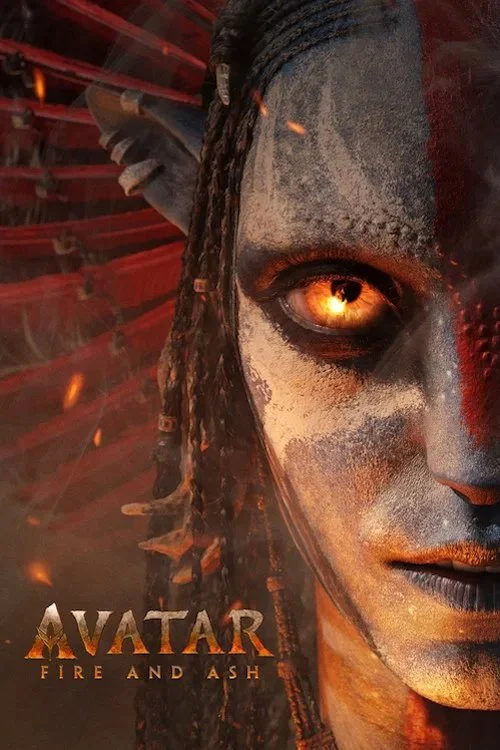


It is round three of Jake Soo-lee and his Na’vi family and friends to go through the same song and dance, and James Cameron’s Avatar franchise — while still a treat to watch and experience — is truly starting to feel like it is sprinting in circles now. The very first film remains a benchmark of special effects, CGI implementation, and action cinema excitement. Thirteen years later, The Way of Water proved to be not too shabby as the planet of Pandora was explored in a myriad of ways; the depths of the oceans; the extents of all families and their dynamics. However, this second film gave me a bit of a weird feeling when Colonel Miles Quaritch (Stephen Lang) returned in The Way of Water, not because I felt like that storyline didn’t fit that film but because I foresaw the excuses to keep bringing him back again and again; I know that he is a Na’vi recombinant now, but how this guy does not finally die is beyond me. When I began the latest Avatar film, Fire and Ash, it was clear that this was going to be yet another three-hour epic between Jake Sully (Sam Worthington) and Colonel Miles as opposed to, say, the countless different things that a plentiful world like Pandora can provide; Cameron has clearly spent a lot of time building this planet to feel authentic, why doesn’t he explore it beyond the same song and dance so many times over?
Fire and Ash begins shortly after The Way of Water, with Jake, Neytiri (Zoe Saldaña), and their family still in a heavy period of mourning. Jake wants to seize the opportunity to gear up before any future potential threats, which poses to be a problem for Neytiri; it is not the way of Pandora to use firearms on others. Blame is shifted around as to who is responsible for some of the tragedies of the previous film. Then, there is Miles, known as Spider (Jake Champion): Quaritch’s son who was adopted by Jake and Neytiri. He is a human who behaves like a Na’vi but is in need of the proper equipment in order to survive (like a mask to breathe on Pandora). Cameron uses Spider as another talking point in the Avatar series’ endless discussions on civilizations coexisting, race relations, and identity crises in society. As for Quaritch (the macho-man who just won’t quit), he still wants to claim Jake and complete his mission. However, he will eventually get wrapped up in the Mangkwan clan (also known as the Ash people), and he even grows a bit of a fixation on their leader, Varang (Oona Chaplin); together, they will both try to get what they want (Varang feels like her tribe’s complicated history has lead them to a place of bitterness and vengeance; they behave accordingly).
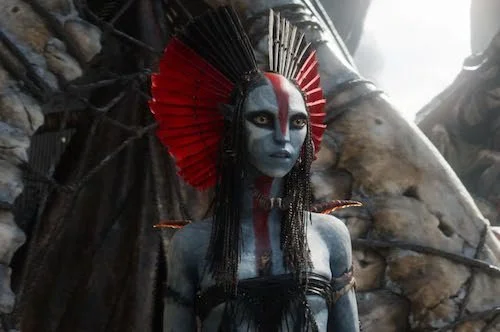
Tonally, Fire and Ash is what you would expect from an Avatar film. This is a good thing. Narratively, Fire and Ash is what you would expect from an Avatar film. This, however, isn’t good.
Without going too deeply into the film, Fire and Ash feels more similar to The Way of Water than it does the first Avatar film, especially with the deep diving on these established families. There are so many Na’vi characters to follow at this point, but Cameron and his team have done an excellent job at letting them all stand out in precise ways (from the different colours and body marks of each tribe, to the minor genetics that make no two Na’vi look alike). The action sequences are as magnificent as they’ve ever been, and Cameron hasn’t lost his touch in this respect; the effects and CGI are also immersive, allowing us to bypass the parts of the film that might not flow as well as they should. On that note, Fire and Ash sadly feels derivative. This is the first time that I have felt like Cameron was spinning his wheels and not bringing us anything new, and I don’t mean the inclusion of fresh characters. Fire and Ash has a handful of battle sequences, and most of them are nearly identical when it comes to what narrative purpose they serve. Often enough, a sequence will prematurely end for a silly reason (like a character backs down from going for the kill, or there is an agreement to settle the score later), only for us to return to a similar position later on in the film. This feels like padding. We already want to be in Pandora (if we are watching the third film in this series). Cameron doesn’t need to artificially keep us here by trying to sell us the exact same notions again and again.
When Fire and Ash finally finds moments to progress, it succeeds. This film’s version of how the living can connect with the dead is lovely, and it sells the detailed structure of Pandora’s provenance a little bit more. I feel like this film furthers the family dynamics that were kickstarted in The Way of Water, so it at least works as a sequel in that respect. I just with that Cameron would cool it with the repetition. He is an action director first and foremost, so I don’t suppose that my recommendation for him to take a step back and allow his franchise to tell us other kinds of stories (outside of combat and unrest) would ever happen. Instead, I implore him to find other reasons for action in this world. I understand that humans are still destroying the planet; that nations are still killing one another; that bigotry is still prevalent. Even these topics can be explored at least differently than the same beaten paths that we have taken for over nine hours collectively now. At least Fire and Ash is still quite the ride to partake in. Then, there is this thought to end on. Do you remember that sensation where people were yearning to remain on Pandora after watching Avatar? It feels a little sad that Fire and Ash is electric in the moment but is next to instantly forgettable as soon as you leave the theatre; it’s even sadder when we all know that it doesn’t have to be this way. The film just doesn’t do enough to stand out from the other Avatar titles, nor does it stand on its own two feet without them.


Andreas Babiolakis has a Masters degree in Film and Photography Preservation and Collections Management from Toronto Metropolitan University, as well as a Bachelors degree in Cinema Studies from York University. His favourite times of year are the Criterion Collection flash sales and the annual Toronto International Film Festival.