
Nuremberg
Written by Nicole Cabrera
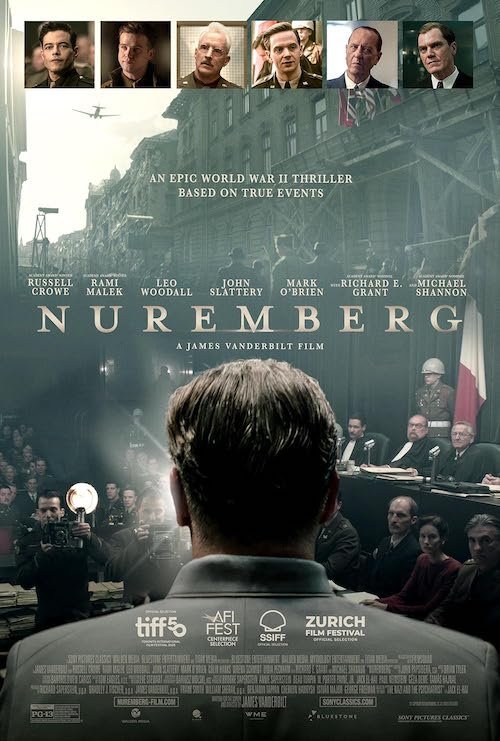



The notion that history is a circle — events, patterns and human events repeat over time is one that is questioned greatly within society. The desire within mankind is that we have learned from past atrocities; in some cases we have, putting our foot down firmly about what is an irredeemable act and yet… despite our best efforts, history has a tendency to repeat itself. One of the most prominent events to come out of the horrors of World War II was the political fallout of the war — who would pay for these crimes? What would punishments be? While it is easy to simply divide matters into black and white, good and evil — rarely are events ever that simple. In the case of the Holocaust, what followed was seeing that those responsible got their punishment without spiraling into countering violence. Director James Vanderbilt is up for the challenge in his new film Nuremberg which looks at that post war period through the eyes of psychiatrist Douglas Kelley as he works prominently with Hitler’s high command most notably, Hermann Göring.
The end of WWII May 8 1945, effectively saw the end of several things: the face of warfare was changed so abruptly and stretched human cruelty to a point not seen often before — but with the death of Hitler; the Nazi party was like a snake with its head cut off. While some fled, 21 of Hitler’s top military officials were captured and forced to stand trial for their unspeakable crimes, amongst them were men like Rudolf Hess, Baldur Von Schirach and Julius Streicher. The wanted outcome was clear- a death sentence but in order to not simply mimic the Nazi cruelty these men were put on trial in front of the world in the first international tribunal in history. While there are many deplorable men in this group; Vanderbilt focuses on Göring (Russell Crowe) because of the enigma he was — charming, well spoken, highly intelligent, narcissistic to a fault - and on the surface, a family man who loved his wife and child. The military calls in Lt. Colonel Douglas Kelley (Raimi Malek), an army psychiatrist whose purpose is to see that Göring and his fellow men are mentally fit to stand trial.
It quickly becomes clear how complex a man like Göring is, a man that hides behind multiple shields, at first refusing to speak to Kelley except in German — fortunately Kelley’s comrade and translator Howie Triest (Leo Woodall) is there to help. Kelley is able to see past his tricks but getting into the mindset of the other man is complicated — Göring passes blame claiming he didn't know what was happening with the Holocaust as that was out of his jurisdiction. The more they talk the more Kelley and Triest are dragged deeper into this world, through conversations, Rorschach tests, magic tricks etc Kelley is determined to see how these men tick, as Hermann exposes more about himself, his family (who Kelley also creates a bond with) his relationship and loyalty to Hitler, a cat and mouse-esque relationship commences leaving the watcher wondering who’s really in control because as well Kelley can see Göring, Göring can equally see Kelley; his insecurities, his desire to be someone important, even his ability to sympathize. Kelley is seen to be swept up in Goring’s charm even when he’s analyzing him for his fellow soldiers — he can't help but speak about how intelligent, imaginative and personable Göring is, making others question him.
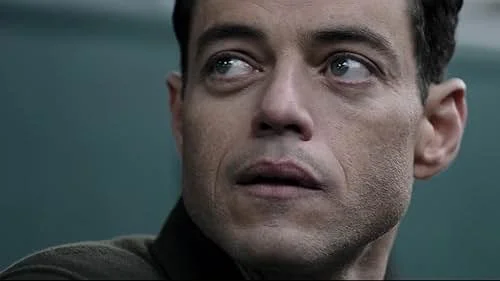
Nuremberg features superstar performances from its acclaimed actors, creating a compelling depiction of historical events.
The other element of this film is the trial itself, when the men are deemed fit, the trial begins spearheaded by different lawyers and speakers from the allied countries. Here, a powerhouse of great actors are present, but by far Micheal Shannon as Robert H Jackson (lawyer and future associate justice for the US Supreme Court) and Richard E Grant as David Maxwell Fyfe (who helped draft the European Convention of Human rights). Grant and Shannon play well off one another and bring some small humour to a serious topic; While Fyfe is whipcrack smart and calming, Shannon in particular shines for upholding the morals of a country post war, wanting to unite the allies and even going to the Pope for his approval in order to proceed with the trials in Nuremberg. Justice Jackson's ability to uphold the law while having the humility to understand that no country should be above the law is humbling and relevant to political climates of today.
However, a truly silencing scene of the film is when the court is shown footage of what occurred in the concentration camps — Vanderbilt chose to use actual footage; which while a contrast to the more polished look of the film it's quite shocking no matter how many years since the war it's been. The atrocities that were done are still chilling to the bone — while some of the Nazi men look uncomfortable, Göring in particular seems unmoved and is given an opportunity to repent when asked after seeing all the heinous acts — if he would still stand by Hitler? and Göring avows Hitler’s actions despite everything.
While from a modern perspective it is easy to take a stand on Nazism, and Kelley’s struggle to not see this man as someone friendly may seem odd to an outsider, forget Göring's ability to act like a well adjusted if not highly intelligent man who simply had different opinion… and with that he could easily sway masses.Within the court room he is seen to trip up Justice Jackson, who almost loses his edge when Göring cunningly remarks he is solving “the Jewish Question” by having all the Jews emigrate (a chilling reply). Douglas is also brought to his own crossroads- of whether he releases confidential doctor notes and helps the allies find a weak point in Göring’s armour or keep what he knows a secret. Justice Jackson confides in him the importance of not turning men like Göring and company into martyrs; no statues,no song of praises for them- to ensure that it can’t happen again, putting an emphasis on the fact: “the war ends in the courtroom.” Kelley comes to a decision after seeing the video of the camps and the sheen seems to be gone from his view of the other man- that Hermann Göring is capable of atrocities with a seemingly clean conscious.
Göring, despite everything, sees Kelley as a friend and warns him of the future and how he fears that he and his comrades will not be seen as men in the future, As the court seals the men’s fate and decides upon the death sentence by hanging with one press representative from each of the Allied nations- but before Hermann Göring can get the same fate, he takes his own life by cyanide. The end of the film sees a despondent Kelley several years later clearly struggling, his book is a commercial failure, he bitterly warns the United States that Nazism is far from gone and within the country — only to be ignored. The end of the film is chilling and sits with the audience long after as its timing is impeccable and eerily reflective of the world issues and leaves that bitter taste in one’s mouth as history is once again repeating.
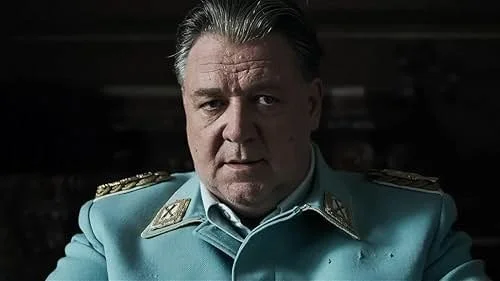
Nuremberg is an urgent film that encourages viewers to take note at how history is, sadly, repeating itself.
While it can be argued that the film glosses over the fine details of the horrors of World War II at large, the film does an excellent job of covering the overall political fallout of the court. There had never been until that point a multifaceted trial of this scale and as Fyfe alludes, anything short of victory is a failure when it comes to the Nazis. The films would benefit from expanding the examination of the prisoners outside of Goring as they were as equally as important figures for telling the full story of the Nazi party. While the film has its bouts of exposition, for those who only know a baseline or casual knowledge of history — Nuremberg does an excellent job of filling in the gaps of what happened post war.
By far Nuremberg's strength lies in its cast — Malek and Crowe own every scene they're in together as they struggle for dominance, while Russell’s performance is collected, soft spoken, it’s clear he’s observing, thinking and plotting adapting to Malek’s Kelley who, on the opposite end of the spectrum is hot blooded, quick to action, arrogant and equally as intelligent. Both men’s performances shine and are built up by their fellow cast, in Malek’s case Leo Woodall as Howie is a perfect foil for Douglas as a soldier and translator of German descent who knows first hand how the Nazis can tear apart someone’s life; yet Howie carries a kindness for his fellow soldiers and even when he is given the opportunity to seek vengeance, he chooses humility.
Nuremberg’s importance as a film exists in the fact that while we have seen hundreds of war films and will see many more in the future, its pushes the importance of knowing one’s history.Once a battle is done, there is much that comes after in order to assure that peace that is fought for remains steadfast, Learning from one’s past though painful, is crucial.While for some it may be a simple Oscar- driven movie; for others it's the spark to expand their horizons about crucial points from our global past. Movies like Nuremberg help remind us of the fragile balance we exist in and what we needed to sacrifice to achieve the peace we had.


Nicole Cabrera is a Toronto-based film enjoyer with a passion for the eighties, horror, and deep diving their favourite actors’ obscure filmography. When they’re not watching movies, they're writing, crafting, cosplaying, going to concerts, working on their podcast (Hollywood Deepdive), and dreaming of traveling.