
Blue Moon
Written by Dilan Fernando
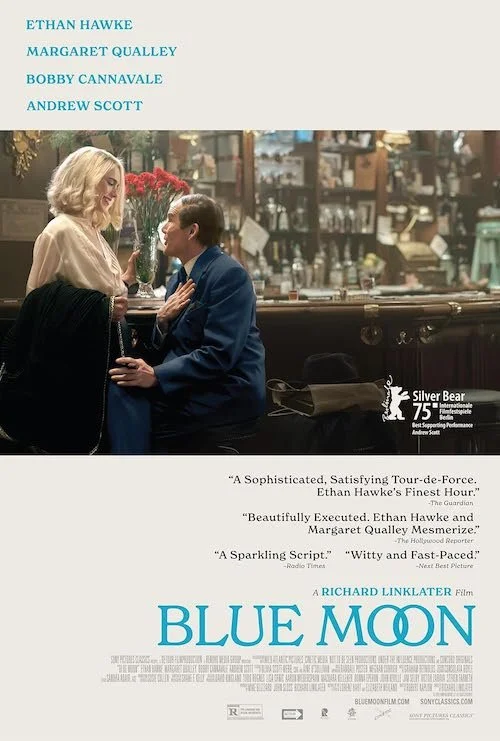


Richard Linklater has made two films this year – Nouvelle Vague (the making of Jean-Luc Godard’s Breathless) and Blue Moon (of songwriter-lyricist Lorenz Hart’s contribution to Oklahoma!). Each film is a companion piece to the other, showing the difficulty of expressing one’s genius. Blue Moon depicts it as a gleeful tragedy, while Nouvelle Vague shows it as a triumph through perseverance.
Blue Moon opens with Lorenz Hart (Ethan Hawke) walking down an alleyway clinging to a rain-drenched trenchcoat before collapsing. An intertitle appears on screen that is a succinct and unmemorable eulogy before cutting to Lorenz sitting in the balcony at the premiere of Oklahoma! – March 31, 1943. Lorenz watches as the audience laps up the drivel that stems from the remnants of his quality lyrics. Lorenz gets up and leaves, demonstrating the degree of his artistic integrity. Retreating to the safe haven of Sardi’s (home), Lorenz settles in, awaiting admiration and recognition that he projects like a falsetto to whoever will listen.The characters that make up the remainder of this bottle movie includes – bartender Eddie (Bobby Cannavale), G.I./amateur pianist Morty Rifkin (John Lees) and author E.B. White (Patrick Kennedy). Sardi’s acts as a purgatory for artists waiting for something or someone to awaken them.
Lorenz and Eddie have an interesting bartender and patron relationship. Eddie expresses care, likely after having a front row seat to Lorenz drifting further into alcoholism. Lorenz knows that he’s got a dependency for alcohol specifically, bourbon however, even without it he’s as jaunty and outgoing as ever. What Lorenz needs is for someone to lend an ear, given his profession one would think that’d be easier than it sounds. Lorenz places his bag, coat and hat on a barstool next to him before settling into his seat, where he believes Sardi’s and all those in it revolve around him. Notice how Linklater composes shots around the noticeable height difference and sense of isolation that Lorenz possesses. The compositions move to either edge Lorenz out of the frame or make him seem like a bigger presence than everyone else.
Though Linklater didn’t write the screenplay alongside Robert Kaplow, his sensibilities and perspectives on art, philosophy and life are prevalent throughout the film. The Lorenz character could reflect the angst and inner turmoil Linklater has felt within his career, with hopefulness and joy helping in his perseverance. Love, poetry, literature, music, film, sociology and psychology; each a platform for these individuals to vent and connect. Leave it to Linklater to make a period piece hangout movie. However, despite the many characters and everyone getting some screen time the performance that anchors the entire film is Ethan Hawke who astounds as an individual who is comedic, vivacious and tender. Lorenz bares his soul and watches as people shudder, wince and console his overly hopefulness.

Blue Moon taps into the genius of Lorenz Hart while also understanding why his brilliance acts as his weakness.
From the moment Lorenz sits down he begins cooing and celebrating his young ingenue Elizabeth Wieland (Margaret Qualley) who brought a sense of rejuvenation after entering into his life. Elizabeth is about 30 years younger than Lorenz yet her interests which are also based around music and theatre have been enough to woo Lorenz. There’s a sense that yes Elizabeth values her friendship with Lorenz but also the possibility that she needs him for his contacts in the industry (despite her mother being a person of note in the theatre union). As all the other bar patrons listen carefully to Lorenz description of her they realize that it’s a one-sided affection. Lorenz takes a drag from his phallic-like cigar and exhales, his face clouded in smoke says, “You must see her the way I see her.”, unintentionally conveying his obsession. Later on during a scene where Lorenz provides an anecdote to E.B. White of a mouse (who he’d name “Stuart with a U.”) that he keeps capturing and releasing in his kitchen, he describes the look in the mouse’s eye, “A doomed hopefulness.”
After the premiere of Oklahoma! concludes, the bar is jumping with theatre-goers and members of the cast and crew. Amidst the crowd are the dynamic duo that brought Oklahoma! to the stage, Richard Rodgers (Andrew Scott) and Oscar Hammerstein II (Simon Delaney), watching from afar is Lorenz. Whose contributions won’t be one for celebration by the patrons, or the deserved recognition in their time. Something Lorenz is bitter about but also embarrassed to receive credit, given his thoughts on the final product. There’s tension between Lorenz and Richard, their feigning of pleasantries and half-hearted compliments shows the problems that were present during their collaboration years earlier. Lorenz drifts around the bar the same way he’s been drifting to life, with a song in his heart. Lorenz has a line that encapsulates his entire being and life when discussing Sommersett; “There’s always someone who loves and someone who lets themself be loved.” Who’s to say who is which?

Dilan Fernando graduated with a degree in Communications from Brock University. ”Written sentiments are more poetic than spoken word. Film will always preserve more than digital could ever. Only after a great film experience can one begin to see all that life has to offer.“