
Tender Loving Care
Written by Dilan Fernando
Warning: This review is for Tender Loving Care, which is a film presented at the 2026 Toronto International Film Festival. There may be slight spoilers present. Reader discretion is advised.
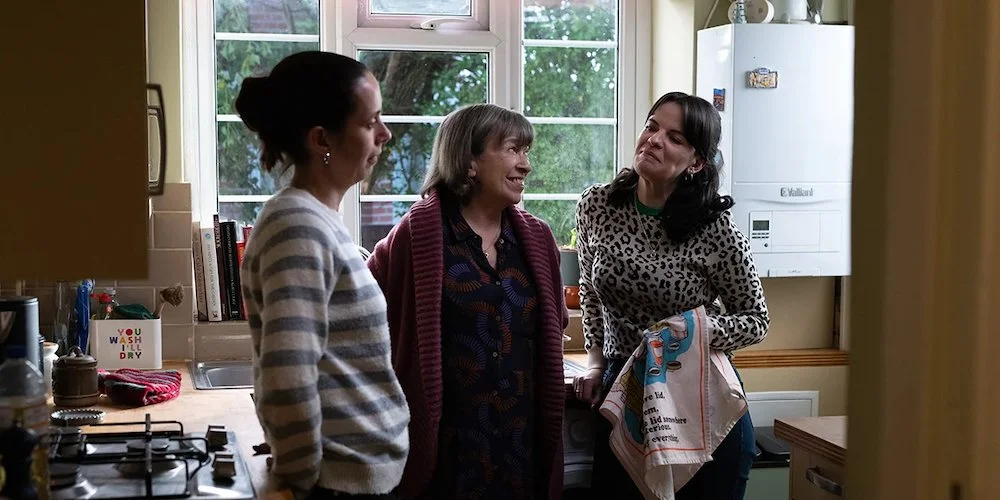
Image courtesy of the Toronto International film Festival.


There is a great deal of care and affection that exudes throughout Mike Leigh’s latest film, Tender Loving Care (2026). As the film’s title suggests, people need people to help them be seen as people. Like many of Leigh’s films there are so many wonderful performances and characters that Leigh could’ve possibly made this film as an exercise proving whether great filmmakers can still make good films or if it’s time to hang up their viewfinders.
The film opens with an extreme close-up of George Fletcher, a displaced man who’s been recovering in the hospital until social services can find him a place to inhabit. George is quiet, sparingly responsive and keeps to himself. Leigh’s use of a close-up to introduce George captures all his small facial details and intricate features. The white beard and hair are reminiscent of director Mike Leigh; perhaps, Leigh’s cheeky way of indicating his life in review, his understanding of mortality and realization that life and films are so synonymous that once he’s unable to do one the other will follow suit. The close-up and zoom-out of George’s weathered face shows and indicates to the audience that introspection is the first step in caring — seeing is beyond skin-deep.
Tasked with finding George a place to live is Rosie (Alice Bailey Johnson) whose optimism and perseverance are instrumental to her and those she helps in her profession as a social worker. Rosie’s personality shares similarities with one of Leigh’s most memorable characters, Poppy, Sally Hawkins’ character from Happy-Go-Lucky (2008). Rosie understands that while life has its share of tribulations and obstacles it's how you overcome and live through the experiences that affirm your character. After a long day of work, chasing, trying and struggling to help elderly people who've been neglected, ridiculed, forgotten and abandoned to find some solace in knowing they are cared for; Rosie returns home and giddily prepares for her best friend Amy (Kate O’Flynn) to arrive. Amy moves back in with Rosie after having been booted from her previous place by her controlling ex-boyfriend who’s soon to return to his ex-wife. Amy is also a social worker who’s primarily tasked with helping adolescents understand and try to adjust to lives with their foster families while also trying to reunite them with their biological parents by creating a healthy domestic environment.
The duo of Rosie and Amy seem like two peas in a pod as both are funny, quirky, silly, determined, thoughtful, diligent and show deep affection towards each other as well as those they work with. Rosie and Amy, alleviate their stresses and life’s problems by dancing around, lip-syncing and drinking bottle after bottle of wine (excessively drinking in moderation). Amy shows signs of high-functioning alcoholism as she knows when it’s time to work and time to dance around, approaching each with a dedication that shows how balanced she can be. However, there’s one scene in a bar where Amy, Rosie and Amy’s Mother Birdie (Marion Bailey) all go out for drinks. Notice how Amy mentions each of the stories that her mother recants to Rosie. After Amy mentions the title for a story, Leigh cuts to a reaction shot of Amy who downs more and more of her glass. Every glass indicates both the mundanity in the cyclical nature of Amy’s life while non-verbally indicating how she feels about it by drowning her feelings more and more with each sip.
Amy’s parents Birdie and Geoff (Paul Jesson) live in a small apartment complex, filling their days by reminiscing about stories of old friends and comparisons of life in pre and post-Thatcher England. Birdie and Geoff are always ecstatic whenever Amy comes to visit. They try not to be invasive with Amy’s personal life however, they speak with a gentle tenderness to her hoping she opens up. Amy’s negligence and apprehensive nature about divulging her personal life with her parents shows that even caretakers don’t know when they need to be cared for. Leigh’s presentation of the day in the life of each of his characters may seem pointless in a plot driven sense, however it’s very effective in helping to create a strong connection to the characters. Look at one of the film’s stand out scenes when Geoff and Birdie’s friend (Tilly Vosburgh), still grieving the loss of her husband, comes to visit. Leigh’s skilled craftsmanship is on full display here taking a serious and heavy scene beginning with their friend displaying the different stages of grief on her face while speaking the dialogue as more of a social formality rather than a need to continue the conversation, before breaking down crying, realizing that it’s her fault for her son’s absence at the funeral while asking to be forgiven for her relationship with her sister-in-law. Leigh lightens this mood by having Birdie retell a story about how her and Geoff had to deal with a teenage Amy who refused to be told how or what to dress and the tension of which resulted in a comical understanding.
Leigh’s signature slice-of-life analysis is on full display here as he closely observes the various idiosyncrasies of those who have and need affection, care and tenderness in their lives. Within this study of human nature is a subplot that will evolve and culminate helping to emphasize Leigh’s findings while also showing their practicality when people are put into a life-changing situation. Throughout the film, Geoff is shown to be forgetting certain details while also reiterating random facts or non-sequiturs. Given Geoff’s age it is conceivable to think that naturally he’ll forget things or lose focus during conversations without jumping to conclusions about whether he shows early signs of dementia. Sadly, the latter is true and Birdie must accept that she and Amy will have to care for Geoff in a way they never anticipated or imagined. However, one thing that doesn’t diminish is the level of affection for Geoff despite his affliction, their love for him grows with every gesture, look and song, giving the film one of its warmest bittersweet moments. During the Q&A at the Toronto International Film Festival (TIFF), Paul Jesson mentioned that, “One thing I learned while developing the character is that people with dementia show a great memory for remembering song lyrics.”
Leigh proves that his wit, grit and spirit all continue to burn strongly as they did when he began his career. It’s remarkable to see a craftsman who’s still able to give material the tender loving care it deserves rather than settling for less. Across all of Leigh’s films this has been the rule he’s stayed true to by thoroughly developing each character through an arduous improvisational process, lending more acclaim to the quality of his films. Fitting for what may possibly be the final entry from a filmmaking titan and one of, if not the greatest examiner of human nature in cinema. As Geoff lays in bed surrounded by Birdie and Amy, listen carefully to the words that Birdie speaks aloud, ‘He was a good boss. Fair but got things done. Was well respected and liked by everyone.’ These lines could also be applied to Leigh’s working style and overall presence on a film set leaving those he’s worked with great memories they’ll be reminiscing about and how it left them feeling afterwards (notice the subtle dolly-out of Geoff’s room), showing a quiet and impactful moment of togetherness. The film ends with a shot of George sitting on a step in a doorway as people, cars and life zooms by. Leigh bookends the film with a close-up of George’s face, perhaps wondering how far he’s come or remembering all the small moments throughout life that’ve shaped him.


Dilan Fernando graduated with a degree in Communications from Brock University. ”Written sentiments are more poetic than spoken word. Film will always preserve more than digital could ever. Only after a great film experience can one begin to see all that life has to offer.“