
One Battle After Another
Written by Andreas Babiolakis
This review is a part of the Best Picture Project: a review of every single Academy Award winner for the Best Picture category. One Battle After Another is the ninety eighth Best Picture winner at the 2025 Academy Awards.
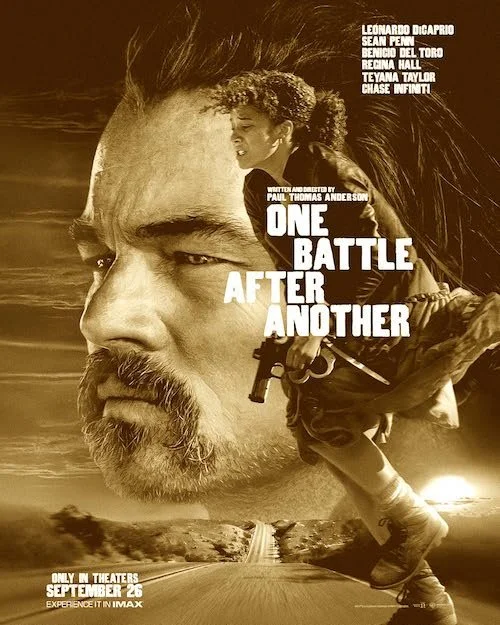



Paul Thomas Anderson has been scrutinizing the American sociopolitical landscape for the majority of his career. He captured the chasing of dreams to the point of self-implosion in Boogie Nights. He circumnavigated the search for companionship while combating self-hatred in Punch Drunk Love. He depicted the extent of human greed within the realms of capitalistic corrosion in There Will Be Blood. He studied the exploitation of vulnerable citizens via abusive forms of religion in The Master. Throughout his tenure as a prominent American auteur, Anderson has tried to figure out why people behave in the ways that they do. Then, there is a film like One Battle After Another which is less interested in the why but, rather, the what people do in fight-or-flight situations. As a father of biracial children with partner Maya Rudolph, it is clear that Anderson looked at the landscape of the United States for the past decade and saw a future that concerned him: a place that would not be accepting of the children he and Rudolph are raising — a nation that was previously reaching a point where it was deemed okay for people of different races to marry and bear offspring (as someone in an interracial relationship myself, this should have always been considered okay). Anderson created One Battle After Another not as an inquisitive mind but as a frustrated parent who is tired of the regression of a nation that proclaims to be “free.”
The second time Anderson was inspired by the works of Thomas Pynchon (he previously adapted Inherent Vice), Anderson looked to Vineland as a launch point this time around. Unlike his hazy neo-noir Inherent Vice, Anderson wound up making a large number of adjustments to Vineland before arriving at One Battle After Another; the preliminary, expository act feels the most Pynchon-esque with its satirical, nearly absurdist look at American sociopolitics via a psycho-sexual lens — to the point that much of the malaise that many feel stem from the fetishization, perversions, and self-indulgence from those in power. Anderson aims to modernize this concept not solely in actuality but in theme; One Battle After Another takes place sixteen years before the present, but its notions on a divided America ripple throughout all of contemporaneous history. This opening chapter introduces us to the far-left revolutionary troupe, the French 75. They fixate on rescuing detained immigrants, destroying numerous facilities, and other radical acts in the name of trying to better life for their fellow citizens.
A frequent complaint I have seen from naysayers of this film is that One Battle After Another promotes acts of terror; I do not think we have watched the same film. To me, Anderson’s focus is on the hideousness of the situation for all, and that everyone is experiencing the parade stated in the title of the film: one battle after another. Everyone fights back in their own ways, as is present in the film via the various methods implemented by different characters (Sensei Sergio does not fight back in the same way that Perfidia Beverly Hills does). The film is not for or against what people are doing; it merely understands why they feel the need to fulfill these actions. If anything, the film does take a stronger stance on the beliefs of its characters, not their actions; sure, it might not agree with Colonel Steven Lockjaw’s stances (then again, who fucking would), but it acknowledges that some of the actions of the French 75 are as grotesque as what he and the extreme-right are doing. The whole situation is awful and everyone is capable of devastation, but it is the hatred within that makes us the most hideous. In One Battle After Another, some shocking actions are made out of the need to protect loved ones; others are done so someone can join the Christmas Adventurers cult. I hope you see the point between those who are driven to these points of darkness out of desperation and survival, and those who remain in darkness for selfish power and corruption.
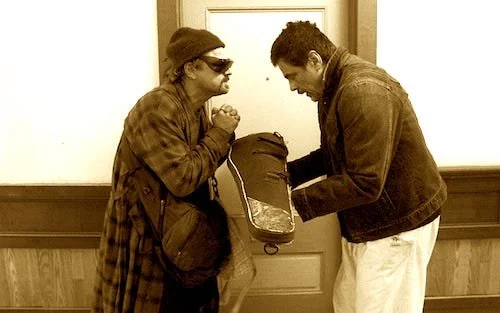
One Battle After Another is one of the numerous films that comment on the current divide in America; its methods are incredibly effective and thought provoking.
When the film cuts sixteen years ahead, we are now looking at the landscape for the future generation. Things are exactly the same, but the battle has migrated in a number of different ways. For example, mobile phones can be penetrated so their user’s location can be traced. Yet, the same ideologies remain: there are those fighting for the freedoms of all, and then there is Lockjaw wanting to execute a young girl who may be his daughter just because she is of mixed race — all so he can be approved of by his white-supremacist cohorts, mind you. That daughter is Willa, born Charlene: she is the daughter of French 75 members Pat — renamed Bob — and Perfidia. Perfidia has gone rogue for all of Willa’s life, after she was caught by Colonel Steve Lockjaw and, thus, ratted out the rest of the French 75 to protect herself and her family. Bob fled with Willa and has been hiding ever since, trying to give their child a hopeful and protected life. For most of the film, Willa’s biological father is up in the air, but her roots are otherwise indisputable: she is her mother’s child. She is as intense and fierce as Perfidia is, and her instinctual need to fight back makes it feel like Perfidia never left the film. Willa also symbolizes the concept of unlearning hate: should she actually be Lockjaw’s child, she does not embody his bigotry or self righteousness whatsoever. Hatred is taught. The drive to protect one’s self and others is inherent. Who we protect and why is instilled in us by those we look up to; guardianship can be weaponized, as is clear throughout all of history.
As Lockjaw abuses his military powers to hunt down Willa to — again — literally kill her (if it is proven that she is his child), thus begins a dog-cat-and-mouse chase that becomes many levels of screwy. Bob is trying to find Willa, who has been whisked away by surviving members of the French 75 for her protection. Lockjaw is trying to find Willa, while his men are trying to find Bob as well. Meanwhile, the Christmas Adventurers Club is now hunting Lockjaw who they have deemed impure for engaging in sexual acts with a Black woman sixteen years prior (hence the possibility that Willa is his child); need I remind you that this is the cult that Lockjaw wants to be accepted by. There are many other swirling factors that complicate this kinetic force of seeking and fleeing, rendering a vast majority of One Battle After Another an endless spiral of calamity. Once the film concludes and you feel that sweet release and relief, it might dawn on you the way that it dawned on me: this is one such circumstance. These kinds of incidents happen all the time (perhaps without the Pynchonian absurdity, but certainly with the same levels of ridiculousness and callousness, unfortunately). When a film like One Battle After Another comes out and people are still misconstruing the handling of illegal immigrants, do they not see that it is about the senseless killing and abuse of human beings — not the passports and citizenship? Do they not see how the start of these slaughters then turns into the abuse of many walks of life regardless of their papers? How many persons of colour have already been accosted because they were incorrectly assumed not to be citizens? How many persons of colour have been abused because they were deemed unfit to be citizens? This is the point of a film like One Battle After Another. If you still do not see it, you frankly never will.
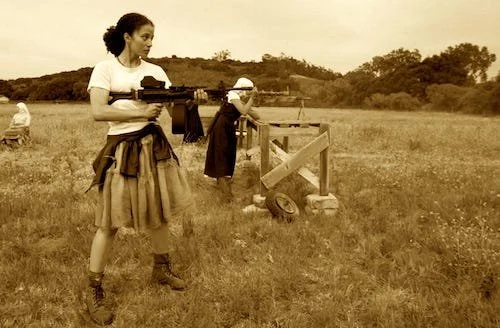
One Battle After Another takes an impossible conversation on sociopolitics and creates a riveting, thrilling experience as a means of catharsis.
One Battle After Another is far from the first film to try and encapsulate the modern mindset; Ari Aster’s excellent Eddington had the same intentions earlier last year. It won’t be the last, either, clearly because this conversation will not end as long as older generations are teaching hate to the youths of tomorrow. As long as there are Colonel Lockjaws trying to join hypocritical clubs like the Christmas Adventurers, there will be evil. As long as other people who are not you are deemed impure, lesser-than, or even simply “different,” there will be a divide. There is an ongoing epidemic of people misunderstanding pride. Divide does not come from those who are celebrating their own identity and culture. It comes from those who try to erase the identities and cultures of others. Anderson’s inspiration from Gillo Pontecorvo’s The Battle of Algiers — as evident from Bob watching the film midway through One Battle After Another — led to his attempt to make fully complicated characters on both sides of the political spectrum; despite the hostility and atrocity of some, Anderson crafts the desires and aspirations of even the most hateful, here. We do not agree with them, but we sadly understand them.
When you are forever chasing impossible dreams, there is no time to try and fix the present. One Battle After Another is a call-to-action to stop listening to the empty promises of lying politicians and those elite clubs you will never be a part of; it encourages you to see the bigger picture of reality — ironically with this satirical method — and try to help nurture an ailing nation as best as you can. You do not need to be a Perfidia; you can simply be a Sergei who will sacrifice himself to protect others in their times of need. Just be there to help those you love. When Paul Thomas Anderson made his Best-Picture-winning One Battle After Another, he was trying to depict how he saw his homeland — the very one he would be referencing in a majority of his motion pictures. Here, he sees red: knowing that his children may face a grim future if things do not change. We cannot let hate win. We must keep fighting. In a time where the film industry is also greatly threatened, Anderson reverts back to the ways of New Hollywood to help give us that much needed oomph that the wave of yesteryear provided: there is life that still remains in the arts; there is promise in the future generations; we can become a more loving and unifying world; we must just keep battling; one battle after another.
Finally, for those of you who want to whine and proclaim that cinema should stay away from politics, the entirety of film history has been political or has been affected by politics — never mind the complete histories of most other artforms. Keep telling yourself that film shouldn’t be political and being dead wrong, all in the name of trying to justify the wrongness you endorse. Keep trying to join the Christmas Adventurers Club.


Andreas Babiolakis has a Masters degree in Film and Photography Preservation and Collections Management from Toronto Metropolitan University, as well as a Bachelors degree in Cinema Studies from York University. His favourite times of year are the Criterion Collection flash sales and the annual Toronto International Film Festival.