Wild Horse Nine
Written by Dilan Fernando
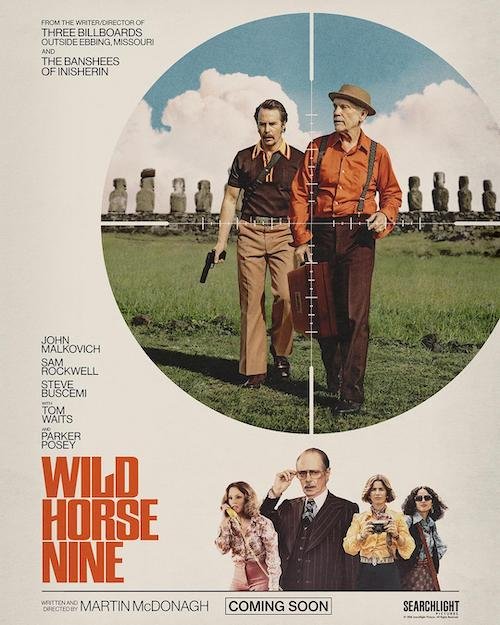



Martin McDonagh’s latest film, Wild Horse Nine, shows two CIA operatives (best friends) — Chris Carlisle (John Malkovich) and Lee Chesterfield (Sam Rockwell) in Santiago, Chile in 1973. After putting in place the finishing moves to set up the coup over the (name of Chilean Marxist president’s) government. Given Chris’ age and the more he’s been contemplating his life with the growing fatality count — 68, he’s mentioned to Lee, Chris can’t help but realize that his age is closer to his kill count; a constant reminder of a life lived or not lived. While doing reconnaissance at a church as Lee takes discreet photos of Marxist university students (revolutionaries), Chris drones on about moths. Notice Chris’ tie which has a moth like pattern to it. This subtle detail shows McDonagh blurring the line between whether or not Chris is always lying or being truthful. It’s here where McDonagh leaves it to the audience to distinguish what they perceive and believe to be true as corruption, conspiracy and methods of coercion for larger political gain loom over and drive the characters to do what it takes to survive in a merciless world. Within this framework McDonagh dissects his signature themes of friendship, loyalty and guilt.
To keep a low-profile and not arouse suspicion, Chris and Lee are told by their boss MJ (Steve Buscemi) to take a vacation. While Chris continues to grow more agitated and annoyed at MJ’s management he reluctantly goes along with Lee to Easter Island to see the Moai (big head statues). Unbeknownst to Chris, MJ has been directing Lee to find out what he knows about Chris’ babbling about previous confidential missions their organization has had a hand in like the Guatemalan coup, the Bay of Pigs invasion and the Kennedy Assassination which will serve as the weight of his memoirs; waiting for an opportune time for Lee to eliminate Chris and recover a relic of grave importance. Waiting for their flight at the Santiago airport Chris can’t help but prophesize and flaunt his knowledge over those he finds annoying and naive like two young Chilean college students – Monica (Mariana di Girolamo) and Alicia (Ailín Salas). McDonagh’s dark wit greatly informs Chris and Lee’s friendship both professionally and personally as they seem like a great comedic duo like Abbott and Costello but paints them more like Felix Unger and Oscar Madison in The Odd Couple (1968). The use of humour is more layered than levity; rather its purpose is to help Chris and Lee confront their own emotions as they try to find a way to express them to the other. This film like many of McDonagh’s previous works is a buddy movie with understanding what it takes to maintain a friendship at its center.
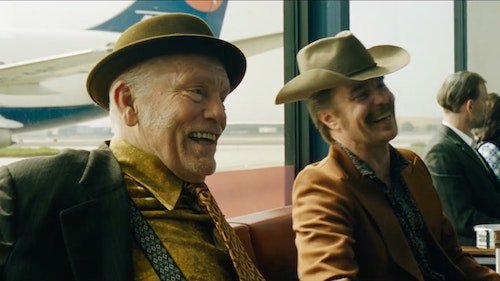
Wild Horse Nine showcases Martin McDonagh’s gritty, witty writing once more.
Upon landing the pair rent a bright yellow car for their trip, drive through Easter Island seeing the plains and check into the hotel, all the while Chris expresses his opinions on Lee being the leader of their duo. What begins as a simple observation ultimately becomes a scathing critique. Funny how someone like Chris who’s been the leading man for many projects regarding political interference makes so many comments about anything and everything. Typically, with films about espionage and intrigue there’s an unspoken ‘mum’s the word’ type code which adds to the spy character but detracts from what makes them more human and therefore relatable. McDonagh’s skill at writing shows that regardless of profession, people are human and they are remembered by their contributions to the world instead of themselves. Could it be because of the guilt and grief that Chris suffers from that he feels compelled to aggrandize his status in the world so as not to be forgotten when he dies?
Perhaps it’s this way of thinking which may have caused Chris’ dementia and brain cancer, creating lapses in his memory and unbearable pain which he tries to alleviate with doses of morphine. Lee appointing himself as Chris’ guardian and caretaker is reminiscent of Gary Sinise’s George Milton taking care of John Malkovich’s Lennie Small in Of Mice and Men (1992). It shows the great lengths that Lee will go to show his allegiance and friendship to Chris even when his own commitments and priorities are in jeopardy. The film does have a plot however, McDonagh’s fascination with the friendship and relationship dynamics during a time in history where corruption and conspiracy run rampant are much more compelling, giving it a hangout movie feel which feels more entertaining as the audience follows the personalities of those in the plot instead of the plot threads hoping to create the film’s personality.
One may think that given Chris’ age and movements that he’s way beyond his years of the serviceman he once was let alone whether or not he’s able to lift a gun, Malkovich’s portrayal of Chris shows how his acting ability has become more conditioned with age becoming more instinctual than theatrical. It’s this instinct which is integral to the pair’s survival throughout the film when it seems like even a place like Easter Island (like Bruges) is more hostile than it appears. Despite what Chris can or can’t remember, he’s able to distinguish what he sees in a given moment showing that his perception hasn’t been affected (yet) by the cancer. When Chris borrows the car to go for a ride he sits in front of the Moai drinking with a gun by his side as he rants to horses sauntering about in the surrounding field. Sensing it’s time to go, Chris stands up and begins firing into the darkness before hitting the rear windshield of a red car hastily driving away.
Wild Horse Nine is equal parts compelling and entertaining, in typical Martin McDonagh fashion.
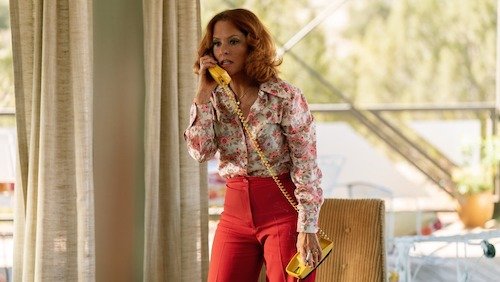
Lee also deals with his own afflictions as he carries various crosses throughout the film while trying to maintain the appearance of a cool, calm and collected professional. Lee tries to appease MJ by fulfilling his duty and tries to maintain a caring relationship with his promiscuous wife Marge (Parker Posey). McDonagh intricately prepares the final plot elements by having these two parts of Lee’s life overlap in an interesting way. Notice a scene where Lee talks to MJ, MJ suggests (threatens) that Lee carry out his mission before anything should happen to his wife. In a panic, Marge phones Lee to tell him that she’s got a feeling that somebody was in their house the night before despite nothing being taken and the house being left intact. Lee tries to talk her back into rationality before the phone line goes dead and Lee is left standing in his room. McDonagh’s compositions throughout the film are exemplified perfectly here showing that he’s a writer first type of filmmaker as the dialogue sets the shots up. A good director knows where to place the camera while a great filmmaker knows when the writing and direction work in tandem with each other it adds other imperceptible elements to a scene. The low-angle shot of Lee holding the phone as the ceiling fan rapidly whirs and spins above his head indicates as much internally as it does externally.
I’d be remiss if I didn’t mention the great performances that McDonagh gets out of his small but stellar cast. Chris and Lee play off each other well and show they’ve got a real chemistry that transcends their age gap. MJ’s disgruntled and oily character shows that being dedicated for the overall goal of creating a better world is by destroying enough to rebuild it hence his dependence on dope to cope. Jim (Tom Waits), Chris’ brother who lives in seclusion somewhere in a scenic valley, has one final phone conversation together. Both brothers know that this is the last conversation they’ll have and none of the dialogue or emotion is played with a phony sense of sentimentality but a cold poetic realism. Finally, one of the most heartfelt and captivating screen presences in the film is that of Monica as her character has so many layers while only being in the film for a fraction of its runtime. Each of them represents a different perspective as they react to the various events. While some of them like Monica show more humanity others like Chris, Lee and MJ know that things like democracy are the result of blood, sweat and political factions which must be sacrificed for the benefit of those with the most to gain.
This film overall may seem like a downer but if you look at the moments in between there’s a poetry and emphasis on friendship and unity that brings people together when it seems the darkest before the dawn. There’s a reason why some of the film’s most tender moments occur during sunny set daytime scenes. When Chris talks to Lee about his thoughts on mortality knowing that he doesn’t have long to live before the cancer completely kills him, notice the cloud that passes over the pair on the hillside, similar to a shot in Bonnie and Clyde (1967) as the titular duo run hand-in-hand through a field, foreshadowing Chris’ death. Chris asks Lee to kill him in Venice; Lee who tells Chris the arrangements for Chris to die in a boat (gondola) on a canal in Venice can be made, but if Chris were to change his mind again Lee will tell him what the last place he chose to die in was before relenting and going along with his most recent choice. If this doesn’t say friendship and loyalty then the world is in a darker place than it appears.

Dilan Fernando graduated with a degree in Communications from Brock University. ”Written sentiments are more poetic than spoken word. Film will always preserve more than digital could ever. Only after a great film experience can one begin to see all that life has to offer.“