
Taika Waititi vs. Film Critics: The Art of Expression
Written by Andreas Babiolakis

Today's think piece was incurred by an argument that I have heard for the vast majority of my life — and this particular straw that has now broken the camel's back. In case you have not been aware, Academy-Award-winning Mauri director, Taika Waititi (responsible for some excellent films of the 2010s like Boy, Hunt for the Wilderpeople, and What We Do in the Shadows), has taken to social media to comment on the less-than-stellar response to his latest picture: an adaptation of Kazuo Ishiguro's Klara and the Sun. The film was ripped to shreds by critics (which should not be a surprise after the releases of works like Thor: Love and Thunder, and Next Goal Wins) — so much so that Sony Pictures Releasing pulled its global distribution early. At the time of this article, it has only accumulated 1.8 million dollars back when its budget is anywhere between twenty to forty-five million. I do not usually care about the box office earnings of a film when it comes to its artistic merit, but I do bring it up because Waititi himself has made it a point of contention. Rather than trying to promote Klara and the Sun in a different way or try to make light of a dismal situation, Waititi went on a bit of a rant that was clearly meant to seem fun and tongue-in-cheek but comes off as salty, bitter, and borderline narcissistic: worst of all, it flops as drop-dead wrong for the most part (when I can tell that this is meant to come from a good place and with something important to say).
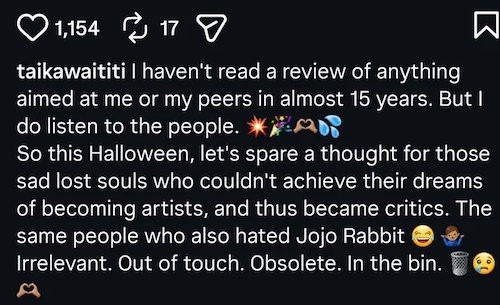
Yes, I am a critic, but there is a crumb of truth to this sentiment. Not everyone should care about what critics say — if I have to admit that my opinion should not be that of the masses, then I also have to accept that the entirety of civilization will not be of the same opinion (and, especially in the day and age of social media, the urgency of artistic criticism as a resource is not what it once was). Having said that, to outright discredit and dismiss criticism is asinine, and if anyone should know better, it is a filmmaker like Waititi. Knowing that he will (allegedly) never read this, let me dig deeper into what he had to say in the above quote (then again, according to him, words don't mean anything, and reading deeply into an opinion or criticism that someone has shared with the world is futile and arbitrary). Before I proceed, I quickly want to point out that comments were turned off the second that the post was made (in a post that says that he does "listen to the people," no less — are you sure, Waititi?).
So, since I am irrelevant and have nothing better to do, let us break down this post line by line.
"I haven't read a review of anything aimed at me or my peers in almost 15 years."
First off, this is clearly fundamentally impossible when there are marketing posts for Klara and the Sun with pull quotes from actual critics, like Erin Banks from Ladbible who declared Jenna Ortega as "Exceptional." Sure, Waititi doesn't have to be a part of the marketing department, but if he has posted this image on his own social media, surely he has seen it himself. Argue some more and insist that he has an intern or handler who takes care of his social media, which is more than likely true: he hasn't come across his own feed whatsoever, even though it is clear that he — unlike some celebrities — at least uses his social media to some capacity? I find this highly unlikely. The insinuation that he hasn't read a review of any of his works in around fifteen years is false when you can see simply from a quick glance of his Instagram (the very Instagram which houses the above "think piece") that he has at least noticed a critical opinion of his work from not even fifteen days ago. You can accuse me of splitting hairs, and there is a great chance that he hasn't read a full review of any of his works, and this may very well be true. However, he clearly holds the opinion a critic in high-enough regard that his earlier statement is hogwash. Take George C. Scott's absolute refusal to partake in the Academy Awards — even when he wins Best Actor for Patton. This holds much more weight compared to those who "hate" awards ceremonies and show up anyway.
Additionally, let's continue the "what if" that Waititi has not read a full review of one of his own works for nearly two decades. You don't have to read reviews if you don't want to, and many artists do not want to know what critics say about their work. I cannot fault someone for not finding value in the essence of artistic criticism. However, someone like Waititi should know better. He was once a darling of independent cinema. Starting out within the short film circuit with films like John and Pogo and the Oscar-nominated Two Cars, One Night, no one can dispute the importance of the spread of awareness when it comes to the longevity of an indie filmmaker's career. In the early aughts, there weren't influencers on social media like there are nowadays, and I highly doubt that films like these were being marketed like the biggest films of these years. Of course, a lot of early buzz for a budding director's preliminary works stem from — you guessed it — critics who cherish and champion the films that they want other cinephiles to know about. Granted, Waititi did say that he hasn't cared about what critics have had to say for fifteen years, and Two Cars, One Night is twenty-three years old at this point.
Does he still discredit the importance of the critics who were at least partially — if not majorly — responsible for the success of his works like Boy (what is considered a breakthrough film for Waititi) that placed him on the map, or Hunt for the Wilderpeople which was celebrated to the point of even topping some year-of lists (like Empire magazine's best films of 2016)? What about the slow word-of-mouth spread from 2014's Sundance Film Festival (which is, famously, a film festival that sparks the expectations that people will have for a film for up to an entire year based on — yep — critical reception) that turned into the uproarious response to What We Do in the Shadows (which is, clearly, now a contemporary phenomenon)? At this point, we are well within that fifteen-year window that Waititi boasts about, and you cannot tell me that he neither paid attention to or even cared about the benefit or damnation of critical opinion in these early, formative, crucial years.
Let's pretend that this is still somehow true — just to play devil's advocate (because why not). You mean to tell me that Waititi didn't sculpt the television adaptation of What We Do in the Shadows based on the reception of the film or the early seasons of the series at all? Not as an executive producer whose job it is to basically care about what the masses are saying? Yes, the masses include both audience members and critics, especially in the day and age of social media where the two can be one and the same now (hello). You mean that Waititi didn't take notes on why Alan Taylor's Thor: The Dark World struggled critically (and was then considered the worst Marvel film — we are far below this bar now, I'd argue) when making amendments for Thor: Ragnarok? One of the prevailing criticisms of The Dark World is that it wasn't fun at all, and yet then came a Thor film that was oodles of fun (I wonder why that is). Furthermore, you don't think that Waititi leaned into what made Ragnarok more successful when making Love and Thunder (albeit way too god damn much, I'd argue)? You don't pull these decisions from out of thin air. You work with what you have, and the loudest voices are two things: box office results, and critical reception. Sure. Waititi could have only focused on what drew audiences and made money, but even Waititi himself would know that a film with heaps of screaming goats and shots of Thor's golden-God ass would sell money if it has Marvel's name attached to it (he should know: he literally made this film in the form of Love and Thunder).

"But I do listen to the people"
I cannot dispute this. Waititi's films do generally draw crowds, and the only time (since he took off) that I could argue a film of his hasn't done extremely well (well, until Klara and the Sun, that is) is Next Goal Win's eighteen-million box office returns against the fourteen-million dollar budget (even then, I'd call that enough of a success). There are directors who appeal to film goers more than critics. It's true. I clearly have much less to say about this point. You have shut this critic up, Waititi.
"So this Halloween, let's spare a thought for those sad lost souls who couldn't achieve their dreams of becoming artists, and thus settled, and became critics."
Alright. I'm talking again. This is a tired and untrue notion: that all critics wanted to be artists and couldn't hack it. Someone whose early works feel indicative of the slice-of-life conceptions of neorealism and the French New Wave masters like François Truffaut and Eric Rohmer knows that, often enough, critics can turn to becoming artists (like, well, the aforementioned). Sure, this isn't a frequent occurrence, nor are names like Truffaut and Rohmer contemporary, but my point isn't so much that critics can become directors: it's that many people choose to start off as critics first and foremost. When I was in my undergrad years, I chose to specifically study Film Theory. At York University back in the early aughts, you originally had to study filmmaking before you could choose to major in theory and academia. I fought tooth and nail to skip straight to theory. I wasn't a coward who was scared of what would happen. I always knew that I wanted to study film, teach theory, and spread the joys of dissecting cinema. Sure, I have an inkling to make a film deep within me, but until I actually want to chase that dream, I have always been more content with analyzing films than wanting to make them. I guarantee that I am not the only critic who feels this way. I also know that Waititi is partially correct: some critics are people who couldn't hack it in the industry as creators. However, to suggest that all critics are failed artists is disrespectful and dishonest. The worst part is that I know that Waititi knows this deep down, but not all of his followers do — he knows this as well.
Besides, is anyone who has an opinion on film supposed to be a filmmaker — or else their opinion doesn't hold weight? So, when you said that you listen to the people, are all of the people you listen to filmmakers? I didn't think so. You can admit that you are choosing who to listen to, but you also have to be consistent with your claim.
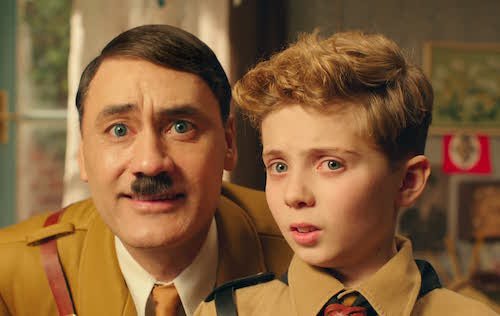
"The same people who also hated Jojo Rabbit"
This is — as anyone could ascertain — only partially true. Yes, critical opinion of Jojo Rabbit was rather split, but some critics adored this film — so much so that the film was nominated for a number of critics-related awards. Waititi's film even won some critics-based awards, including Best Adapted Screenplay at the Hollywood Critics Association Awards and the San Francisco Bay Area Film Critics Circle Awards. As any faithful reader of Films Fatale can tell you, the Oscars award season depends entirely on small movements, and it is through wins like this that Waititi wound up finally winning an Academy Award for screenwriting for Jojo Rabbit. Mind you, Waititi's film was a crowd pleaser, even if not every critic loved the film, and it was the push of the Toronto International Film Festival crowd — the very one that awarded it the People's Choice Winner that hear (a major precursor to most modern Best Picture nominees and winners) — that really got the film going. However, to insinuate that it was despised by critics overall is an outright lie, and there is clearly no way that Waititi wouldn't have known this if he was accepting awards from these organizations.
Also, I like Jojo Rabbit. Not as much as some of its biggest fans do, but I think that there is quite a bit to admire with this film. If anything, I can attest to a patron at my TIFF screening who did not like it while this critic (and other fellow critics there) did. That’s kind of the point: nothing is set in stone, cut-and-dry, or black-and-white. Art is highly subjective. I don’t think that critics try to make it objective; rather, they capture that subjective response in pieces, and it is best to analyze a spectrum of thought, discourse, and scrutiny.
And, finally...
"Irrelevant. Out of touch. Obsolete. In the bin."
Then why did you have to comment on the critics at all?
If critics are so obsolete, why are you doing this damage control on your film?
Look. I may not be the biggest fan of this guy. However, I am not one to wish ill on others. Waititi has brought me joy in the past, particularly with Hunt for the Wilderpeople and for bringing one of the greatest television series — Reservation Dogs — to live. I would have found such statements problematic from even my favourite directors. In this day and age — one when many creatives are threatened by AI and auto-generated junk — to try and shut down any form of expression is in poor taste. In the same way that Waititi can make Klara and the Sun, people (including critics) should be able to discuss the film. Is art not at its best when it pushes us, inspires us to converse and to think, or motivates us to step outside of our comfort zones? We learn more about ourselves, and that is one of the primary responsibilities of a critic: to help cinephiles discover more about themselves. To outright ignore all forms of opinion is ludicrous if you take opinions seriously. If I like a film a critic dislikes, I can disagree. I can even learn more about myself through the very act of not seeing eye-to-eye with a critic, and my bond for a film can strengthen. If you listen to the people, then why are you speaking for them? Why are you encouraging shielding them from learning more about themselves and their connection with cinema? If the people have already made up their mind about your film, why are you robbing them of liking your film even more fondly (to the point of fighting for it) once they come across critics they will disagree with?
A critic's job isn't to defecate all over a film just because (even though bad critics will choose to do this). It's to help cinephiles discover more angles about films they have seen, judge if they may want to see films they haven't, or encourage an open discussion of interpretation. These acts are not the same, but if someone can adapt a novel into something drastically different (like Waititi has with Ishiguro's source material), then someone can interpret in the form of a written or recorded opinion. Sure, to adapt is to create, but art is something that can be shared, and artistic criticism is one of the major factors of that discourse staying alive. Whether critics get it right or get it wrong, this initial response is often the point of discussion in regards to a film's legacy. Take John Carpenter's The Thing, which was eviscerated by critics but is now rightfully considered a masterpiece. While you can argue that this emboldens Waititi's point (that criticism is irrelevant), I believe the contrary. The critics act as a time capsule, and our contemporaneous understanding that they were wrong — to me — strengthens the legacy of this film: one that we can now prove was ahead of its time, and one that defied the then-modern understanding of how films should be made. What about the few critics who stood up to the film then? Did their opinions not matter? Or the critics who worship the film now?
Also, why did Waititi not bring up the critics who loved his earlier works? Why only Jojo Rabbit? Is it because this is the film he won an Academy Award for, or is it so it can fit in line with his narrative?
At the end of the day, all of this is a caption typed underneath an image that seventy-five percent of audience members like Klara and the Sun. I know that's a positive majority, but I also wouldn't call this a glowing endorsement (it's not like ninety percent — or more — like the film). If a filmmaker known for uplifting, feel-good pictures (and ones that specifically deal with overcoming both the odds and hardship) wanted to circumnavigate a potential box-office bomb here, I think that a snarky, vicious, ill-formed rant was not the way to go; if anything, it has only done more damage (given the rough response his caption has already garnered).
(Almost) finally, I want to state the obvious: I did not attack Klara and the Sun because I have not seen it. The concept of blindly attacking something is ridiculous and always has been. If anything, despite not liking his last two films, I actually liked what I saw in the promotional materials for Klara and the Sun and was hoping that I would view it as a return to form for Waititi. Maybe I will still feel that way when I get around to the film. I know that he won’t care about what I think either way (or apparently that’s the case, anyway), but I want it to be known that none of this came from a disgruntled viewer of a new release; rather, this is all in relation to how Waititi is handling the response to his latest film. Not everyone will like what you do. Lord knows I have received many emails from people who disagree with me, and that’s fine. I think art must be an open dialogue. Otherwise, we lose the circulation of the soul of art; where does the essence of art go if there is no one to share it with — to pass it along to others?
Even though he will never read this, I leave Taika Waititi with a final quote: something that I learned from a film. I hope it can be of help to him.
"Let everything happen to you. Beauty and terror. Just keep going. No feeling is final."


Andreas Babiolakis has a Masters degree in Film and Photography Preservation and Collections Management from Toronto Metropolitan University, as well as a Bachelors degree in Cinema Studies from York University. His favourite times of year are the Criterion Collection flash sales and the annual Toronto International Film Festival.