
Godzilla Minus Zero
Written by Cameron Geiser
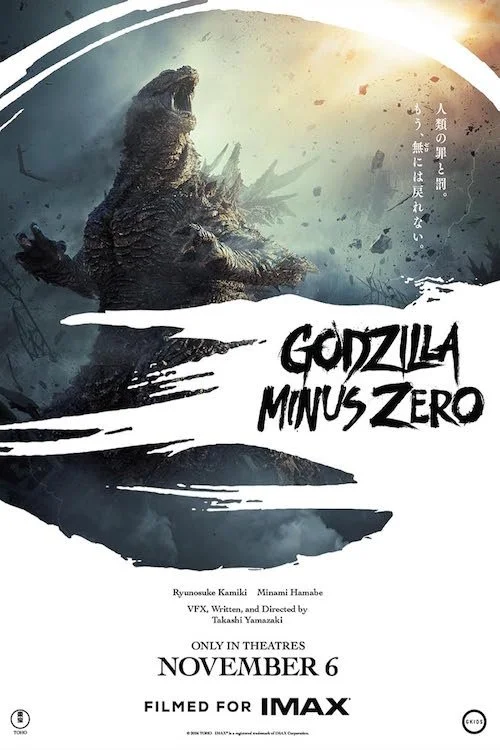


Warning: The following review contains minor spoilers for Godzilla Minus Zero. Reader discretion is advised.
Godzilla Minus One wasn’t just a surprise hit Monster Movie from the best studio to do it (Toho), it was something special. Set during the aftermath of World War Two it follows a cast of characters trying to pick up the pieces of Japan’s post war despair when Godzilla first emerges and trashes the remains of Tokyo before being thoroughly destroyed. At least, that’s what the characters all believed to be true, but as with every Godzilla film that came before it, the lesson to be learned is that even when you think Godzilla has lost, he will always return to reclaim victory against mankind and kaiju alike. Which brings me to this sequel set two years later. Our inciting incident? After a new monster arrives on the scene the Large-Scale Disaster Response Bureau leaps into action to minimize damage and gather information about the kaiju in question.
At the forefront of the Bureau is Kenji Noda (Hidetaka Yoshioka) the lead scientist from the last film who takes on more of a leadership role this time around. Several side characters from the first film pop in but don’t linger for long before we’re introduced to one of the latest major characters to arrive on the scene with Makoto Aoyama (Masami Nagasawa), a meteorological scientist who believes predictive weather patterns can also help in calculating where this new Kaiju threat will emerge next. Speaking of that, I have to admit I was incredibly surprised when one of the early trailers gave an audio clue to indicate that the next threat would come from Godzilla’s Arch Nemesis, King Ghidorah. The film opens with an unevolved version of Ghidorah rampaging through Matsumoto City in terrifying fashion. Which is all good and visually striking but once the film gets running the recurrent issue across the runtime becomes clear.
There is a fairly glaring pacing problem for a majority of Godzilla Minus Zero. For example, there are several scenes of the science teams forging new plans to stop these threats that are skimmed over or straight up skipped in favor of wallowing through scenes with Noriko (Minami Hamabe), Kôichi Shikishima (Ryûnosuke Kamiki), and Akiko (Sae Nagatani) the found family forged in the fires of both Godzilla and World War Two’s wake. In Minus One Shikishima, Noriko, and Akiko’s story was the most compelling human drama in any Godzilla film thus far and here they are important but they feel mishandled in the context of the character drama overall. I can understand wallowing in the grief and tragedy of everything that has happened during the war and since then, but the stifling nature of overwhelming sadness can feel overbearing at times. There are also many notions throughout the film wherein characters are asked not to express their feelings but to bottle them up for the sake of community and respect. Like when Shikishima asks Akiko not to be too happy and excited in front of the orphaned kids at her daycare, or later in an overcrowded hospital when some parents begin to cry over their child’s death the officials ask them to grieve more quietly — if they could. None of this is in itself a negative for the film but it all does merge to suggest a thesis that wants you to feel bad when you may just have bought your ticket to see wanton Kaiju destruction. Granted I suppose that’s what the Monsterverse Godzilla films are for but this atmosphere does build throughout the movie that just never quite meshes as well as in Minus One.
The human drama that works best this time around are the story beats related to Kenji Noda and newcomer Professor Kanji Murakami (Min Tanaka). Professor Murakami, you see, happened to be visiting extended family in Hiroshima when the bomb fell, he was saved only by the fact that he had been wandering down by the coastline when it happened. However despite his perfect emotional setup to want revenge on America for having killed his entire family — there were several key scenes with him that didn’t quite meld with the tone they wanted to emit. Once his plan for vengeance is revealed to the audience he turns comically evil and over the top in his performance paired with a rapid fire edit that honestly made the moment feel more comedic than intense. The other major sequence is later in the film when he is seemingly convinced by Noda not to hold hate in his heart, but the flip to humble wisdom from evil mad scientist was done so quickly that it eroded the immersion and believability of the ideas in play.
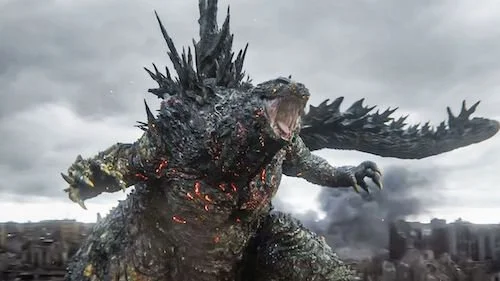
Godzilla Minus Zero isn’t quite as strong as its predecessor, and that’s perfectly fine if you just wanted more of the same from before.
However, this isn’t to say this is a bad movie by any means. There is a respectable level of brutality and emotional weight displayed when referencing the nuclear bomb attacks during World War Two. This is something I found lacking in Christopher Nolan’s Oppenheimer, which is ironic as Director Takashi Yamazaki has stated that this film is his response to Oppenheimer and in this regard he has greatly succeeded. And while Godzilla may not get as much to do in his own sequel when he finally does arrive onscreen the Kaiju action is pure spectacle and visually quite well designed– but it’s all over before you know it. This however is very much in line with Toho’s longstanding inability to efficiently merge compelling human drama with glorious monster destruction, especially in any of the more direct sequels.
Noriko may have a more important role in the film than in Minus One, but the story’s momentum screeches to a dreadful halt nearly every time the found family is onscreen, especially with the repeated instances of poor Akiko’s heart being broken by abandonment anxiety. There are several sequences where Akiko’s cries go on for long uninterrupted periods, but the worst one is saved for the final scene of the film. Choosing to end the film with what feels like ten straight minutes of a small child scream-crying her eyes out feels painful and not exactly the vibe you’d think the filmmakers would want people to walk out of the theatre with. While the film overall is an interesting sequel with enthralling ideas in play, it ultimately isn’t as good as Godzilla Minus One. However, there have definitely been worse Godzilla sequels and I do recommend giving this one a shot!


Cameron Geiser is an avid consumer of films and books about filmmakers. He'll watch any film at least once, and can usually be spotted at the annual Traverse City Film Festival in Northern Michigan. He also writes about film over at www.spacecortezwrites.com.